

Legal experts warn Ruto-Natembeya political showdown threatens devolution and good governance

Legal experts warn that the escalating dispute over markets and hospital projects in Trans Nzoia risks undermining constitutional boundaries, county autonomy and cooperation between the national and county governments.
The escalating political confrontation between President William Ruto and Trans Nzoia Governor George Natembeya is raising concerns over good governance, constitutional boundaries and relations between the national and county governments, with legal experts warning that political rivalry should not undermine devolution.
The two leaders have been trading accusations over development projects in Trans Nzoia, a county that has become a political battleground as both seek to consolidate their influence ahead of the 2027 General Election.
Despite their growing differences, Ruto has insisted that he will proceed with the construction of a major hospital in the county, maintaining that the project is intended to benefit residents and should not be derailed by political disagreements.
Speaking on Sunday, October 18, 2026, during a church service in Kapsabet, Nandi County, the President said the proposed hospital would go ahead despite his differences with Natembeya, whom he has repeatedly criticised over his opposition politics.
Without mentioning Natembeya by name, Ruto directly referred to the Trans Nzoia governor, insisting that their political differences would not stop him from delivering the facility.
“Yule wa Trans Nzoia ako na kisirani, lakini hospitali nitajenga,” Ruto declared.
Latest Stories
- Congolese in Kenya condemn Kabila’s alliance with M23 rebels, warn of fresh threat to DRC peace efforts
- Kalonzo blames Migwena violence for Uhuru’s absence from Raila memorial
- How Kenya's recognition of Kosovo sparked diplomatic rift with Serbia
- Police to conduct rigorous checks on school buses as holidays begin
He argued that the proposed hospital was meant to serve ordinary residents rather than political leaders.
The Masinde Muliro Business Park in Kitale, Trans Nzoia County, is at the centre of a dispute between President William Ruto and Governor George Natembeya. (Photo: PCS)Lawyer Evans Ogada, a specialist in constitutional and administrative law litigation, told The Eastleigh Voice that relations between governors and the national government are governed by the Constitution of Kenya, 2010.
He pointed to Article 6(2), which provides that the national and county governments are distinct and interdependent and requires them to conduct their mutual relations through consultation and cooperation.
“A governor is not a subordinate of the President, just as the President is not a subordinate of a governor. Each must respect the constitutional mandate of the other,” said Ogada.
The dispute has also drawn in other opposition leaders, with Wiper party leader Kalonzo Musyoka warning the Ruto administration against alleged plans to arrest Natembeya following his public confrontation with the President over the Masinde Muliro Business Park in Kitale and clashes involving the Linda Mwananchi movement and Ruto’s motorcade at Kitale Roundabout.
Kalonzo said he had received information suggesting that the National Police Service was threatening to arrest Natembeya and possibly other leaders associated with the United Alternative Government.
The Wiper leader, who said he had previously represented Natembeya in a court case following his arrest by Ethics and Anti-Corruption Commission (EACC) officers, vowed to ensure the governor received legal protection if authorities moved against him.
“I want to make it very clear to this regime that we will resist any attempt to harass any national leader, and so Governor Natembeya is included,” Kalonzo said.
He suggested that the alleged threat could be linked to Natembeya’s growing political profile and his association with opposition leaders.
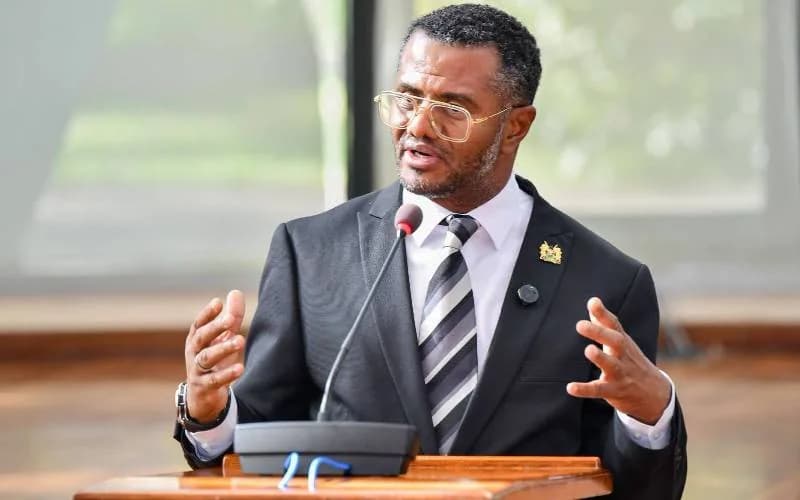
Trans Nzoia Governor George Natembeya, who has challenged President William Ruto over the management of development projects in the county. (Photo: X/George Natembeya)Meanwhile, the National Police Service (NPS) has condemned clashes involving rival political supporters in Kitale, Trans Nzoia County, on Friday, October 16, 2026, saying two law enforcement officers were injured and two government vehicles damaged.
“The National Police Service (NPS) strongly condemns the conduct of certain politicians who contravened the Public Order Act, Cap 56, in an incident that occurred today, 16th October 2026, in Kitale, Trans Nzoia County,” the police said in a statement.
Natembeya, for his part, has vowed to challenge Ruto over the allocation of stalls at a market in the county, accusing the President of removing traders he had selected and replacing them with people whose origins he said he did not know.
Speaking during a public gathering on Saturday, October 17, 2026, the governor said he had completed the market and organised traders to move into the facility before the President intervened.
He explained that the market was built to provide traders who had been operating along roads with a designated place to conduct their businesses.
“Mimi nimejenga soko, nimealiza, nimesanya wafanyabiashara wote nawajingiza kwa soko. Yeye amekuja amewatoa wote, ameingiza watu ambao mimi sijui amewatoa wapi,” Natembeya said.
The confrontation follows an earlier clash on October 10, when Ruto criticised Natembeya’s Tawe slogan, accusing opposition politics of frustrating development in Trans Nzoia.
During the same visit, the President also promised additional funding for hospital improvements in the county.
Natembeya has, however, challenged the President over the handling of national government projects, including the disputed market, as the two leaders continue to exchange accusations over development and political interference.
On the specific dispute over the market, Ogada said the Constitution clearly assigns responsibility for markets to county governments.
“Part 2, paragraph 7(a) of the Fourth Schedule assigns trade development and regulation, including markets, to county governments. Article 186(1) reinforces this allocation by providing that the functions of the two levels of government are those set out in the Fourth Schedule. Further, section 5 of the County Governments Act, 2012, recognises the responsibility of county governments for functions assigned to them by the Constitution and legislation,” he explained.
Ogada said that if, as Natembeya maintains, Masinde Muliro Market in Kitale was constructed using county government funds and World Bank support, the national government must recognise the county’s role and respect its constitutional mandate.
“The President is entitled to visit the market, engage with residents and support development. However, he cannot use the authority of his office to displace the county government’s lawful responsibility for the management of a devolved market. The legal question is not who gets the political credit for the project, but who has the constitutional authority and responsibility to manage it.”
Ogada further argued that the President would be acting wrongly if he treated a county market as a national government project under his unilateral control.
“The President’s constitutional responsibility is not to dominate governors, but to respect devolution and cooperate with county governments in delivering services to Kenyans. The Constitution does not contemplate a contest between the President and governors for political supremacy. It contemplates two levels of government working together, each within its lawful mandate, for the benefit of the people,” Ogada concluded.
Senior constitutional and human rights lawyer Bobby Mkangi also argued that the Constitution requires the national and county governments to cooperate, particularly in areas where their responsibilities overlap, such as healthcare.
“What is happening between Natembeya and Ruto is not necessarily new considering the politics between the two in recent times, but also joins a retinue of controversial launches of projects by the national government, mostly for the alleged absence of proper planning and consultation. The question is why this trend if these are well-intended,” said Mkangi.

Comments
No comments yet. Be the first to share your thoughts.