
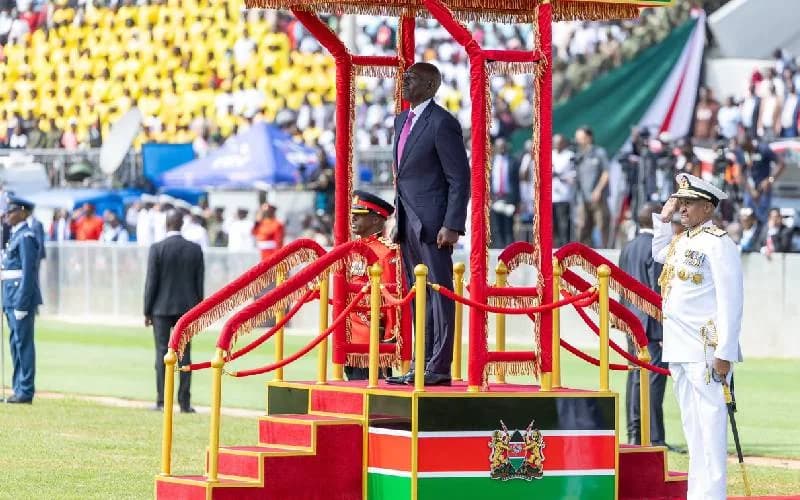
President William Ruto has outlined four proposed measures to ease household expenses and expand opportunities for young Kenyans in a bid to reduce financial pressure on low-income households.
Speaking on Tuesday during the 63rd Mashujaa Day celebrations at Kipchoge Keino Stadium in Eldoret, Uasin Gishu County, Ruto said the proposals would be presented to Parliament next week to put more money in workers’ pockets, make land ownership more affordable, expand access to digital opportunities and help young people gain work experience.
The first proposal seeks to exempt workers earning Sh32,333 or less per month from Pay As You Earn (PAYE) income tax, allowing low-income households to retain more of their earnings to meet daily expenses.
"First, we have prepared a proposal to exempt Kenyans earning 32,333 shillings per month or less to be exempted from paying pay-as-you-earn Income tax for workers on modest incomes. Every shilling saved means more money for food, transport, school expenses, and the needs of their families," he said.
The proposal comes days after Treasury Cabinet Secretary John Mbadi announced that the government would present a proposed amendment to Parliament in November to provide tax relief to Kenyans.
“In November, we are bringing that amendment to Parliament to tell those Kenyans that we appreciate the sacrifices, however little or however big you have made,” Mbadi said.
The second proposal, developed by the National Treasury, seeks to remove stamp duty on land transactions worth Sh1 million or less while introducing progressive rates for higher-value transactions.
President Ruto said this will help reduce the cost of acquiring and transferring land, especially for citizens at the bottom of the pyramid, and strengthen every Kenyan's ability to own property.
The government also plans to pursue legal and regional customs processes to remove the 25 per cent import duty on mobile phones, which Ruto described as an important tool for education, business, banking and employment.
"As we all know, a mobile phone is no longer a luxury. It is a classroom, a marketplace, a bank, and an office for many young Kenyans. A gateway to employment. Making phones more affordable will bring the opportunity of the digital economy within reach of more citizens," Ruto said.
The fourth measure aims to expand the national internship programme from January 2027 to accommodate another 50,000 young people from colleges, technical and vocational education and training institutions (TVETs) and universities.
The government's core public sector internship program has historically recruited around 5,000 interns annually, meaning the expansion to 50,000 slots represents a tenfold increase.
Ruto said beneficiaries will receive monthly stipends, while placements will be made through a transparent, digital and merit-based system.
"Too many young people cannot secure employment without experience, yet cannot gain experience without employment. This program is intended to break that cycle and provide a pathway from education to productive workplace," he said.
Ruto said the four proposals would address challenges linked to taxation, property ownership, digital access and entry into the job market. He added that the government would follow the required legislative, financial and administrative processes to ensure sustainable funding, transparency and proper implementation.
"The necessary legislative, fiscal, and administrative processes will follow with attention to sustainable financing, transparency, and effective implementation. I have directed the National Treasury to place before Parliament these proposals next week. Our purpose is clear: to put more money in the pockets of workers, make ownership easier for families, bring digital opportunities within reach and open the doors of employment for our young people. That is what it means to translate Usawa from principle into practical action," he said.
Ruto also used the Mashujaa Day celebrations to recognise freedom fighters, security officers and athletes who have contributed to the country's history and development.
He paid tribute to officers serving in the Kenya Defence Forces, National Police Service, National Intelligence Service and Kenya Prisons Service for protecting the country, often away from their families and without public recognition.
"They stand watch over our children as they learn, over our people as they work, and over communities who live in peace. We salute their service, commend those who have made the ultimate sacrifice, and stand with the families that they have left behind. They too are the heroes of our nation," he said.
Using the relay race as an example of shared responsibility, Ruto urged Kenyans to build on the sacrifices made by earlier generations by protecting freedom, respecting the Constitution and creating opportunities for all citizens.
"The story of our champions offers a lesson for our nation. In a relay race, no athlete wins alone. Each runner must receive the baton, run their path with courage and determination, and pass it on without losing sight of the team's purpose. Our freedom fighters carried the baton through sacrifice. Those who built the republic carried it through nation-building. Those who defended our constitutional freedoms carried it through courage and conviction. Today, the baton is in our hands. We will be judged not merely by the positions we held or the promises we made, but by the country we left behind. Whether more children can learn, more families can access healthcare, more young people can find work, more enterprises can prosper, and more Kenyans can live with dignity," he said.
He called on farmers, teachers, health workers, entrepreneurs, athletes and young people to contribute to national development.
Comments
No comments yet. Be the first to share your thoughts.