
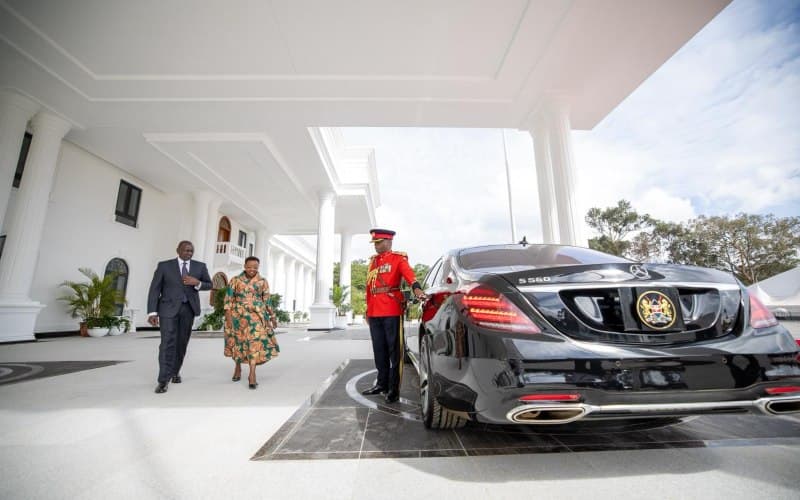
President William Ruto has adopted a new political message of equality, inclusion and equitable development as he positions himself for the 2027 elections, moving away from the “Hustler” narrative that propelled him to power in 2022.
Ruto has embraced the slogan “Usawa ni Sawa, Mbele Pamoja” (Equality is Fair, Forward Together), which political observers view as his emerging campaign mantra. He first used the phrase in Bondo town, Siaya County, during a public rally on October 7, shortly after presiding over the handover of the late Raila Odinga’s mausoleum.
“Kenyans have decided that it is in 2027 that they shall vote resoundingly for the equity and equality of all Kenyans,” Ruto said. “We shall vote for equity of all Kenyans. We shall get rid of discrimination, hatred, jealousy and tribalism so that Kenya can unite and forge together.”
Explaining the slogan during the Mashujaa Day celebrations at Kipchoge Keino Stadium in Eldoret on Tuesday, the President challenged his opponents to offer Kenyans alternative policies instead of criticising his government without proposing solutions.
He said leaders must debate ideas and development plans, rather than resort to ethnic politics and personal attacks, while insisting that his government remains open to scrutiny. The President added that his administration is spreading development across the country without discrimination, unlike previous governments.
“Our democracy must be a contest of ideas, policy and programmes, not a competition in ethnic division and personal attacks. Every leader must present a clear vision of where they want to take Kenya and a practical plan on how they will take it there,” Ruto said.
However, political analysts link the shift to the broad-based government formed following Ruto’s political rapprochement with the late Raila, with national unity and inclusive development now at the centre of the President’s messaging.
According to Javas Bigambo, President William Ruto's “Usawa ni Sawa” slogan means that every Kenyan citizen, regardless of where they live across all 47 counties, should benefit from government projects and development.
“Certain regions have been left behind for decades, facing shortages of critical things such as roads, employment opportunities, and even access to water, where mothers are forced to walk long distances just to find it. President’s push for “Usawa ni Sawa” shows that his focus is on the welfare of all citizens regardless of political affiliation,” argues Bigambo.
Significant questions have, however, arisen over whether the new slogan will resonate with voters as strongly as previous campaign narratives, particularly as the Opposition develops its own messaging ahead of the elections after gaining traction with slogans such as “Wantam” and “Cousins”.
Ndung'u Wainaina argues that Ruto never changed the structure of the economic system: "There was never a 'hustler bottom-up economy'. He merely sold a political narrative packaged as a hustler economy (bottom-up). It was a big lie. It was never the case."
“Within months of being sworn in, President William Ruto returned to the status quo. What he knew and was comfortable with. He quickly abandoned his political hustler economy narrative. He returned to establishment politics and the economy, leaving us waiting for bottom-up,” noted Ndung’u.
Ndung’u said Ruto has exacerbated the structural problems undermining the economy, including spiralling public debt, institutional weaknesses, financial system challenges and human capital deficits. While he stabilised the macroeconomy, he fundamentally failed to address the daily economic realities facing ordinary Kenyans.
“A new economic and fiscal compact model is non-negotiable, driven by the strengths of a debt-free economy, human capital, investment, innovation, and entrepreneurial energy,” argued Ndung’u.
Kenya’s political history is replete with slogans and narratives that have helped leaders mobilise voters around economic empowerment, national unity, development and political change.
In the 2022 presidential election, Ruto’s “Hustler Nation” versus “Dynasties” narrative framed the contest as a struggle between ordinary citizens and established political families, particularly the Kenyattas, the family of former President Uhuru Kenyatta, and the Odingas, the family of the late Raila.
The wheelbarrow became the defining symbol of the campaign, representing Ruto’s bottom-up economic model. The message helped him mobilise support, particularly in the Mt Kenya region. However, his economic promises have since faced scrutiny amid concerns over taxation and the rising cost of living.
In 2002, the Opposition rallied behind the slogan “Yote Yawezekana bila Moi” (Everything is Possible Without Moi) to end KANU’s 24-year rule under Daniel arap Moi. Led by Mwai Kibaki, the National Rainbow Coalition (NARC) promised democratic renewal, economic recovery and political freedom.
Its rainbow symbolised unity among previously divided Opposition parties. Kibaki’s victory ended KANU’s uninterrupted hold on power and ushered in widespread optimism.
Earlier, founding President Jomo Kenyatta popularised “Harambee”, meaning “pulling together”, as a nation-building philosophy after independence in 1963. It encouraged communities to pool resources to build schools, health facilities and other public amenities.
His successor, Moi, introduced “Nyayo”, meaning “footsteps”, in 1978, pledging to follow Kenyatta’s principles of peace, love and unity. The philosophy later became associated with political conformity as Moi consolidated power and Kenya moved towards a de jure one-party state.
Comments
No comments yet. Be the first to share your thoughts.