
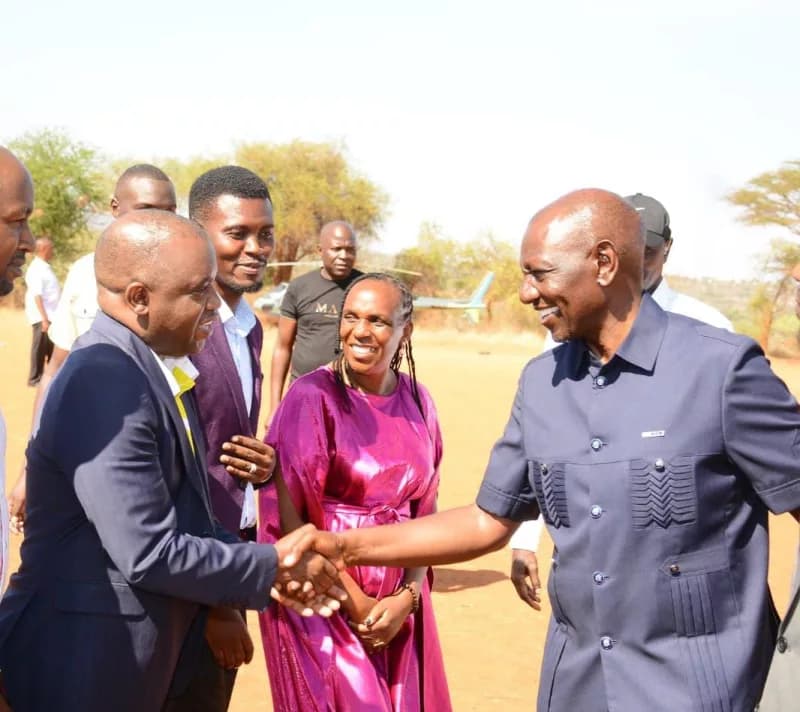
Kenya Water Institute Chairman Patrick Musili Mbangula and dignitaries receive President William Ruto during his Ukambani tour/HANDOUT

President William Ruto toured Mwingi in Kitui County accompanied by key leaders, as the government highlighted infrastructure, industrial investment, affordable housing and economic empowerment projects across the region.
Kenya Water Institute Chairman Patrick Mbangula was among leaders who joined Ruto during the second day of the four-day presidential tour of the Ukambani region.
Water scarcity remains one of the major challenges facing residents of Ukambani, where communities in Kitui, Makueni and Machakos counties grapple with unreliable water supplies, prolonged dry spells and dependence on seasonal rivers, boreholes and water vendors.
The President’s engagements also featured the Economic Stimulus Programme (ESP) market in Mwingi town, an initiative intended to improve trading facilities and support small-scale traders, farmers and entrepreneurs.
In Mwingi North, the Tseikuru Affordable Housing Project was among the initiatives included in the programme, with the government seeking to expand access to affordable homes while stimulating local economic activity.
Road infrastructure was another priority, with the Twimiwa-Tseikuru-Usweni Road project expected to improve connectivity, ease transportation and facilitate the movement of agricultural produce to markets.
Mbangula called for government development programmes to deliver tangible benefits to ordinary Kenyans, citing job creation, improved service delivery and infrastructure investment as key priorities.
The chairman highlighted the need to translate development initiatives into economic opportunities and improved livelihoods for local communities.
“Development must translate into tangible benefits for ordinary Kenyans through job creation, effective service delivery and investments that respond to the needs of the people,” Mbangula said.
Ruto also commissioned the Enziu River Bridge in Nguni, Mwingi Central, marking an important infrastructure milestone for residents.
The bridge carries particular significance following the December 2021 tragedy in which 31 people died when a bus was swept away by floodwaters while attempting to cross the river.
The new bridge is expected to improve safety, provide more reliable passage and strengthen economic connections within the region.
Mbangula also highlighted challenges facing Nairobi, including flooding, poor physical planning, building collapses, inefficient garbage collection, youth unemployment and insecurity. He underscored the need for better urban planning, effective public services and sustainable employment opportunities.
Comments
No comments yet. Be the first to share your thoughts.