
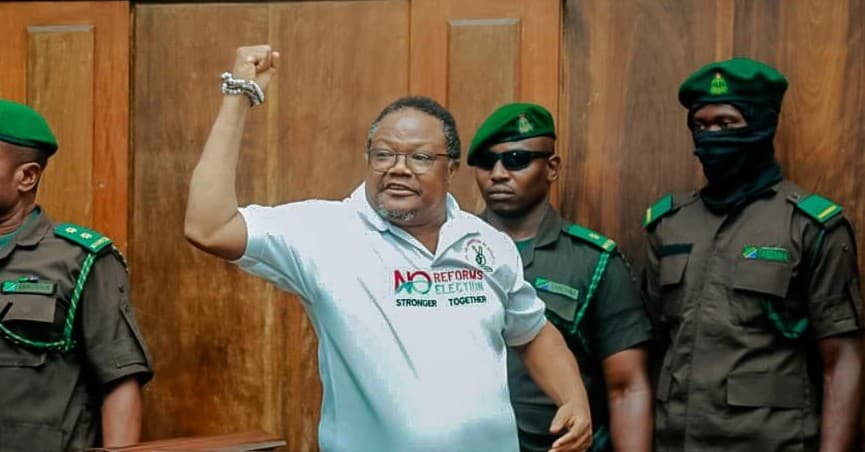
Tanzania’s jailed opposition Tundu Lissu begins hunger strike ahead of November 6 treason ruling

The hunger strike comes ahead of a November 6 judgment in Lissu’s treason trial, in which he could face the death penalty if convicted.
Tanzania’s jailed opposition leader Tundu Lissu has officially begun a hunger strike amid growing concerns over restrictions on his access to legal services.
In a statement on Monday, Chama cha Demokrasia na Maendeleo (CHADEMA) said its chairperson began the protest on October 26, 2026, after prison authorities denied his three lawyers access to him, raising concerns about his right to legal support and the protection of his rights while in custody.
The party said lawyers Dickson Matata, Doris Kafuku and Neema Massame went to the prison on Monday to meet and speak with Lissu but were denied entry.
CHADEMA expressed deep concern over the decision to block the lawyers from seeing its chairperson, especially as he had already begun the hunger strike.
“CHADEMA expresses deep concern over the denial of access to the party’s Chairperson, especially at a time when he has already begun a hunger strike. This situation raises serious questions about access to legal services and how Honourable Tundu Lissu’s rights are being protected while he is in prison,” it said.
It called on the relevant authorities to allow his lawyers to meet him without restrictions lacking a legal basis and to take urgent steps to protect his safety and well-being.
Latest Stories
CHADEMA said it was closely monitoring Lissu’s condition and would continue to inform the public on any developments.
The hunger strike comes ahead of a November 6 judgment in Lissu’s treason trial, in which he could face the death penalty if convicted.
Lissu’s lawyer, Rugemeleza Nshala, announced the planned hunger strike after meeting him in prison on Saturday. Nshala said he had warned Lissu about the health risks of refusing food because he was taking medication.
“I am ready to face the consequences, but I will fight for the rule of law,” Nshala quoted Lissu as saying.
The dispute over access to Lissu’s lawyers follows an October 16 High Court ruling that found prison officers had been able to overhear conversations between the opposition leader and his legal team at Ukonga Prison.
The court ruled that this violated the rules protecting confidential discussions between lawyers and their clients.
The court ordered prison authorities to allow lawyers to meet Lissu without their conversations being overheard, while allowing officers to maintain visual supervision for security reasons.
It also directed the Commissioner General of Prisons to issue instructions to prison heads across the country within 60 days to protect prisoners’ right to confidential legal consultations.
However, Nshala has accused prison authorities of continuing to restrict Lissu’s access to his lawyers despite the court ruling, sometimes denying him meetings altogether.
Lissu’s treason trial ended on September 29 after the prosecution and defence presented their final submissions. He is now awaiting the court’s decision on November 6.
The case arose from Lissu’s calls for electoral reforms ahead of Tanzania’s October 2025 general election. He was arrested on April 9, 2025, after addressing a rally on the issue and was charged with treason the following day.
Prosecutors accuse him of making statements and publishing online material intended to prevent the election from taking place. Lissu has, however, contested the allegations.
His prosecution has also drawn attention amid wider human rights concerns under President Samia Suluhu Hassan’s government, including a crackdown on opposition figures and deadly violence during the October 2025 election.
Human Rights Watch (HRW) documented the killing of 31 people who were not taking part in protests and said it had received credible information about another 19 such deaths.
The organisation said its initial research suggested that hundreds of people may have been killed across the country as security forces used live ammunition against protesters and bystanders.
A government-appointed inquiry later confirmed at least 518 deaths across 11 regions, while warning that the actual number could be higher.

Comments
No comments yet. Be the first to share your thoughts.