
Lawrence Lorot celebrates after winning the men's elite race during the second leg of the 2026 L00P Gravel Series in Naivasha

For a long time, Kenya’s international sporting footprint rested almost exclusively on the track and the marathon course.
Yet across the dust-choked dirt trails of the Great Rift Valley, along the coastal ridges of Kilifi and through the high-altitude escarpments of Limuru, a different kind of endurance culture is taking root.
Launched in 2024, the LOOP Safari Gravel Series is helping to build a structured competition circuit for Kenyan cycling, combining elite racing with recreational participation. Organised by The Amani Project in partnership with the Kenya Cycling Federation (KCF) and sponsored by LOOP Digital Financial Services (LOOP DFS), the series aims to develop talent, widen participation and create opportunities beyond the racecourse.
The 2026 season opener in Limuru attracted a reported 822 registered cyclists across elite and recreational categories, the highest turnout since the series began. The finale in Nanyuki drew 711 cyclists.
For the organisers, however, growth will ultimately be measured by whether those numbers translate into stronger teams, more opportunities for women and juniors, and a pathway from local racing to international competition.
“A rider should not only come to race and go home; they should be able to find a team, improve their skills and understand what the next step in their cycling journey can be,” says Troy Barrie, Team Amani coordinator.
The series began with a launch at Karura Forest in January 2024, followed by its first competitive race at Tatu City the following month. The inaugural season continued through Iten, Hell’s Gate in Naivasha and Vipingo Ridge in Kilifi.
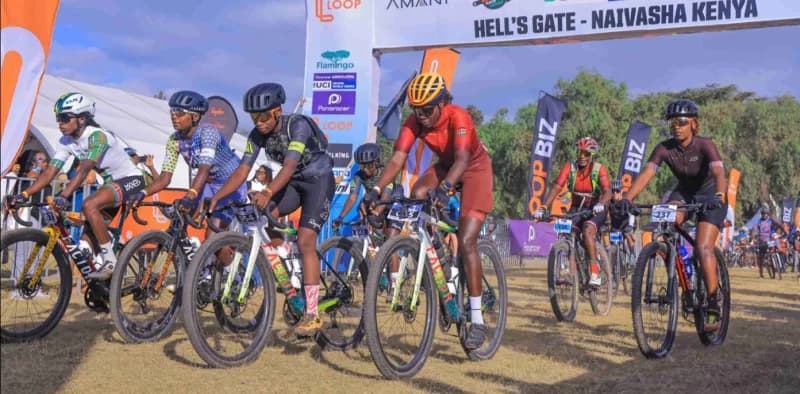
Its format accommodates different experience levels, with 20km routes for recreational and junior riders, 60km routes for enthusiasts and 120km routes for elite competitors.
The Naivasha round attracted more than 467 cyclists from Africa, Europe and the United States. Dutch rider Hans Becking won the 120km elite race, while Kenya’s Duncan Ruto claimed the 60km category.
Cyclists in action during the second leg of the 2026 L00P Gravel Series in Naivasha

At the Vipingo finale, Uganda’s Jordan Schleck won the men’s 120km race, having also triumphed at Tatu City, while compatriot Mary Aleper claimed the women’s title. Black Mamba took the overall team championship.
The second season included a stop in Machakos, while the 2026 calendar opened in Limuru and introduced a rider vote to determine the final destination.
Barrie says the field has grown in both size and diversity. The latest finale featured 25 teams, 12 highly competitive and 13 recreational, with some bringing more than 20 amateur and beginner cyclists.
“The biggest change is the depth of the field and the confidence of the riders. Teams are returning, international riders are paying attention, and recreational cyclists understand that there is a place for them alongside the elite competition,” he says.
The next challenge is sustaining that interest between events. Kenya already has a Cycling Race Series featuring about 30 road and off-road races annually, but Barrie says these typically attract between 30 and 60 elite riders each.
“We would like to see our 25 teams attend these races regularly and increase the average to more than 100 riders per race,” he says.
The ambition is to make participation more consistent, giving cyclists regular opportunities to compete and improve rather than relying on a handful of major events.
The series’ Naivasha leg, held at Hell’s Gate, is also a UCI Gravel World Series qualifier, connecting Kenyan racing to an international competition pathway.
In 2026, it was one of four qualifiers in Africa, alongside two in South Africa and one in Namibia. The event gives riders an opportunity to pursue qualification for the UCI Gravel World Championships without first having to travel abroad to compete.
“UCI accreditation elevates the race from a regional event to an internationally recognised competition,” says Barrie. “It validates the work that goes into the course, safety systems and athlete support, while giving African riders a direct opportunity to earn qualification and visibility.”
KCF chief executive officer Kevin Mwangi says the series has helped expand the pool of cyclists available for talent identification.
“The value of a series such as this is that it gives riders repeated opportunities to compete and gives the federation a wider pool from which to identify talent,” he says.
Rather than judging riders on a single result, Mwangi says the federation looks at consistency, discipline and performance against strong opposition across different terrain. But identifying talent is only the beginning.
“Riders need regular competition, coaching, equipment, medical support, nutrition and a pathway that allows them to plan a career. They also need teams and sponsors that can support them between races,” he says.
The series can provide competition and exposure, but developing international-level cyclists will require sustained investment beyond race day.
Nina Ndabaneze, LOoP DFs Chief Marketing 0fficer flags off cyclists during the launch of the L0oP Safari Gravel Series in Jaruary 2024

Increasing participation among women and young riders is another priority. According to Nina Ndabaneze, LOOP DFS chief marketing officer, female participation has reached approximately 30 per cent, while more children are also taking part.
“We have witnessed the cycling community grow, with more clubs emerging and more people embracing the sport. Female participation has also increased significantly, reaching approximately 30 per cent,” she says.
Maintaining that progress will depend on access to equipment, training and teams that support riders throughout the year.
Barrie says The Amani Project wants to connect cyclists with development squads and help them gain experience against stronger competition.
“Riders need training, mentorship, equipment, recovery and opportunities to learn how to conduct themselves as athletes. We want the series to connect riders to teams and make it possible for development squads such as Black Mamba to gain experience against strong competition,” he says.
“The long-term goal is to help riders move from potential to performance.”
Mwangi says the federation must work with schools, counties, clubs and private partners to make cycling more accessible beyond established centres.
“Women and young riders must see a clear place for themselves in the sport, from the first community ride to national competition,” he says.
The series also seeks to connect cycling with local businesses and tourism. Its race village brings together riders, families, equipment suppliers and brands, while activities and free spectator access give newcomers an opportunity to experience the sport.
“The race village is where the sport meets the community,” says Ndabaneze. “Riders, clubs, equipment suppliers, brands and families come together in one space, and for many first-timers, it is their entry point into cycling.”
Equipment costs remain a barrier for some prospective participants. Ndabaneze says LOOP has worked with partners to offer deals through LOOP Discover and instalment payments through LOOP FLEX for eligible customers.
The company also sees opportunities to support businesses connected to the sport through LOOP BIZ+, including equipment suppliers, event vendors and hospitality operators.
Ndabaneze says LOOP’s involvement grew out of increased interest in cycling during the COVID-19 pandemic, when people turned to the sport to stay active.
“Our vision was to become a lifestyle partner that supports people in living fuller, healthier and more active lives. We believe that physical wellness and financial wellness go hand in hand,” she says.
Events in destinations such as Naivasha and Vipingo can also bring visitors to local businesses. However, lasting economic benefits will depend on whether organisers and host communities can turn event-day spending into repeat business.
Ndabaneze says the next phase should combine wider participation with greater support for emerging athletes and businesses.
“We want to see stronger development teams, more women and juniors participating, and more opportunities for emerging cyclists to nurture their talent and compete at higher levels,” she says.
Barrie adds that success over the next five years would mean a stable calendar, stronger Kenyan teams, increased participation by women and juniors, and a clearer pathway to international competition.
He expects cycling to create more professional opportunities at home, including in coaching, event management, bicycle mechanics, media and sports science.
“We would like to see more riders earning opportunities abroad, but also more professional opportunities at home,” he says.
Mwangi agrees that progress will depend on connecting competition with the support athletes need to develop. He believes this will only happen if the federation, organisers, clubs and sponsors work together to provide regular racing, training, equipment and medical care.
Ndabaneze says LOOP wants the partnership to evolve beyond sponsorship.
“Our ambition is to build a sustainable ecosystem where cycling thrives, businesses grow, communities prosper and more people have access to opportunities that improve their financial well-being,” she says.
The next measure of progress will be whether more riders remain in the sport, local teams become stronger, and promising cyclists receive the support they need to advance beyond domestic competition.

Comments
No comments yet. Be the first to share your thoughts.