
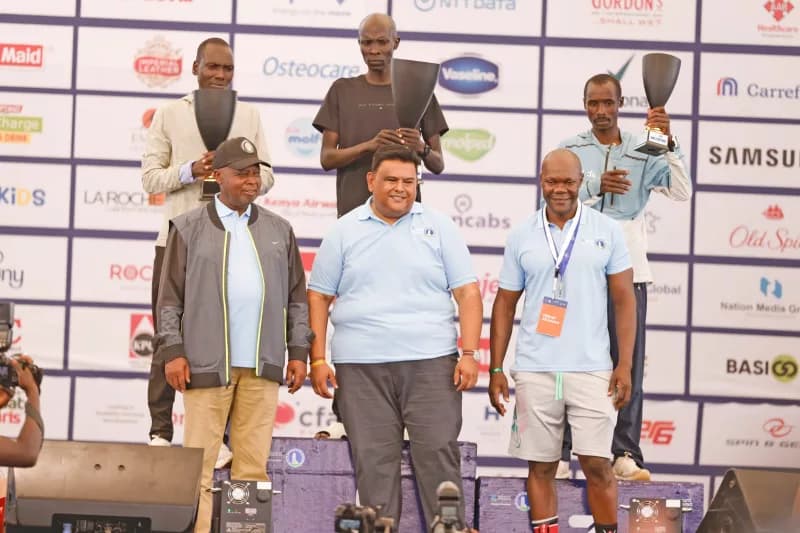
Podium finishers in the men’s 42km race at the Standard Chartered Nairobi Marathon 2026 display their trophies and dummy prize cheques presented by (front row from left) World Athletics Vice President and Athletics Kenya President Jackson Tuwei (Rtd), Standard Chartered CEO and Head of Coverage Birju Sangrajka, and Standard Chartered Nairobi Marathon Chairman David Mwindi/ HANDOUT

Abraham Kiptum and Mercy Rotich claimed the men’s and women’s 42km titles, respectively, at the 23rd Standard Chartered Nairobi Marathon, headlining a day of thrilling distance racing that brought together over 30,00 participants from more than 100 nationalities.
In the men's race, Kiptum crossed the finish line in 2:10:35 ahead of Amos Cheruiyot (2:10:37) and Mark Kibiwott (2:11:05).
Rotich secured the women's crown in 2:31:25 with Peris Jerono (2:31:27) and Ruth Wakabu (2:31:36) rounding off the podium.
Nahason Kipsang secured the men's half marathon in 1:03:07, leading Wiycliffe Kipsang (1:03:13) and Kevin Kemoi (1:03:17).
Orba Chemurgor triumphed in the women’s race clocking 1:11:55 ahead of Esther Borua (1:12:54) and Mercy Kimaiyo (1:14:34).
Alfred Kimani won the 10km race, clocking 29:21 as Ezra Lekuya (29:27) and William Rombas (29:35) sealed the podium.
Uganda's Joy Cheptoyek (32:20), Faith Jeptum (34:14) and Betty Chepng'eno secured the women's 10km podium.
In the half marathon wheelchair race, Samwel Kuria (1:28:54), Denis Ndungu (1:30:35) and John Wambua (1:32:32) took the top three slots.
The women's podium belonged to Mercyline Ajenjo (1:39:04), Christine Mutheu (2:02:13) and Mbinya Nzive (2:06:54).
The marathon offered a total prize purse of Sh11.24 million, with the men’s and women’s 42km champions each earning Sh2 million.
Winners in the 21km Half Marathon and wheelchair races took home Sh300,000, while the 10km champions pocketed Sh200,000.
The winning Corporate Relay and PWD teams each received Sh100,000.
More than 400 elite athletes were among the participants who tackled the course along Nairobi’s Southern Bypass, with the scenic backdrop of Nairobi National Park adding to the spectacle. The event was supported by a record Sh273 million in sponsorship.
Beyond the competition, the marathon raised Sh76 million through registration fees, with all proceeds earmarked for community programmes supported by the Standard Chartered Foundation.
The latest contribution brings the total amount raised since the event’s inception to Sh596 million.
The funds will support initiatives aimed at helping young people learn, earn and grow through education, employability and entrepreneurship, while expanding economic opportunities for young people, women and persons with disabilities.
The organisers also placed emphasis on runners’ welfare, introducing a range of support measures to enhance the race-day experience.
These included 19 hydration stations, roaming bicycle medics, dedicated muscle-relief stations, improved post-race recovery services and downloadable digital finisher certificates.
“The strength of an international marathon is not just the size of its field, but the quality of the experience and the integrity of the competition. From elite athletes chasing a podium place to recreational runners pursuing a personal goal, every participant deserves dependable support. Our focus was on getting the essentials right: accurate timing, medical care, hydration and recovery,” said David Mwindi, chairman of the Standard Chartered Nairobi Marathon Local Organising Committee.
Environmental sustainability also featured prominently, with every finisher receiving a tree seedling to plant as part of the organisers’ target of planting 40,000 trees in partnership with Nairobi County.
The 2026 registration figures also highlighted the growing appeal of the marathon among women, who accounted for 15,796 entries, representing 51.5 per cent of the total, compared with 14,904 men (48.5 per cent).
Millennials made up the largest age group, with 15,544 registrations (50.6 per cent), followed by Generation Z with 10,175 (33.1 per cent), Generation X with 3,782 (12.3 per cent) and Generation Alpha with 920 (3 per cent).
Overall, 86 per cent of registered participants were aged 45 and below.
Comments
No comments yet. Be the first to share your thoughts.