
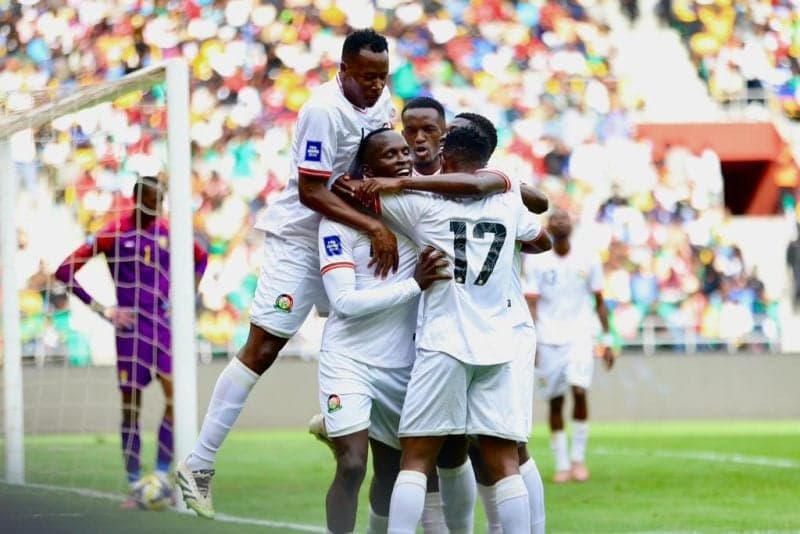
NAIROBI, Kenya, September 23, 2026 – In a world where modern football journalism is dominated by stats, heat maps, and goal tallies, Harambee Stars head coach Benni McCarthy operates on a radically different currency: unyielding personal loyalty.
Addressing the persistent clamor from fans and pundits demanding the inclusion of in-form strikers, most notably Moses Shumah, following his impressive goal-scoring campaign with Zambia’s Power Dynamos, McCarthy laid bare his selection philosophy in an emotional, raw, and uncompromising defense of his squad choices.
“When I go to war, I know I’m going to get to the front line with the soldiers that I have. I want to know who’s going to jump in front of me to save contractually or otherwise or jump in front of me to save me, rather than someone who chooses self-worth over the country or what the team needs of you. In this point in time, it’s loyalty over everything,” the South African said.
To McCarthy, managing a national team isn’t a game of fantasy football or Russian roulette. It’s a battle, and he only goes to war with soldiers he trusts to take a bullet for the cause.
The “War” Analogy: Why Form Takes a Backseat to Unity
For fans tracking weekly domestic and international stats, Shumah’s omission seems almost illogical.
Yet, McCarthy insists that picking a squad purely on individual form ignores the invisible, high-stakes psychology of international tournament football.
McCarthy traced this uncompromising stance back to Kenya’s crucial fixtures in Chad, where a squad operating under intense pressure, administrative uncertainty, and adverse conditions forged an unbreakable bond.
“These players that I picked, they were loyal to me. I’ve never seen a country so much in love with football as I did during CHAN… If I need to go to jail because I’m illegal, I’ll go to jail because of the unity that we had and what we were able to achieve. Those players were the ones that gave up everything to be there,” he said.
Acknowledging the frustration of supporters who judge squad selections based strictly on weekly scorelines, McCarthy admitted that his approach might occasionally seem cold or unfair to outsiders.
However, he remains steadfast in his refusal to gamble with national team dynamics.
“When you ask me about winning Golden Boots, me, I know I’m going to win matches. Other players need to prove me otherwise,” the coach asserted. “When I make an executive decision, it will always be for soldiers I can count on, not people who put self-interest over the bigger picture,” McCarthy argued.
Addressing the tactical keyboard managers and social media commentators head-on, the former UEFA Champions League winner made it clear that accountability ultimately rests on his shoulders alone.
“Maybe sometimes it is a little bit unfair, yes. I agree with you fully. I agree with the fans on that. But the day each one of you, the people with their fingers on their phone criticizing, sit in my shoes, you can gamble with things you don’t know and play Russian roulette. But while I’m sitting in this seat, I go for what I know: the tried and tested,” the gaffer said.
McCarthy’s philosophy ignites a timeless debate in international management: Does loyalty win matches, or do in-form players turn the tide when games are on the line?
Across world football, selection criteria remain entirely subjective, dictated by each manager’s personal ethos.
Managers like Gareth Southgate with England or Lionel Scaloni with Argentina famously prioritized dressing-room harmony, tactical familiarity, and trusted lieutenants over calling up whichever player was trending on social media in a given month.
For them, a cohesive, self-sacrificing unit beats eleven talented strangers every single time.
On the flip side, coaches who strictly follow merit-based selection argue that national team caps should never be lifetime achievement awards or rewards for past service.
When facing elite opposition, momentum, sharp instincts, and physical sharpness, qualities brought by in-form goalscorers like Shumah, are often the exact margins that separate victory from defeat.
This raises the broader question: Should federations mandate a fixed, standardized criteria for national team call-ups?
Enforcing rigid rules, such as requiring a minimum number of league minutes or goal contributions, would eliminate favoritism, ensure transparency, and reward domestic excellence. However, it would also strip head coaches of their tactical autonomy.
A national team manager isn’t a club scout assembling an all-star roster; they are building a collective identity under extreme time constraints.
The Bottom Line
McCarthy’s fiery manifesto sends a crystal-clear message to every Kenyan footballer eyeing a national team call-up: scoring goals at club level is merely the baseline.
Until fringe players and prospective debutants demonstrate that same blind, self-sacrificing commitment to the collective ethos McCarthy forged in the trenches of Chad, the Harambee Stars dugout will remain reserved for the coach’s proven brotherhood.
Whether “loyalty over everything” will deliver results when the stakes are highest remains to be seen, but Benni McCarthy is more than willing to live and die by his army.

Comments
No comments yet. Be the first to share your thoughts.