
PawaPay now holds a payment service provider (PSP) licence from the Bank of Mozambique, the country’s central bank. The licence went to its local subsidiary, Quidexplus Mozambique. It lets PawaPay sign up Mozambican businesses directly and process their payments under the central bank’s supervision, and the company says merchant onboarding should start in the coming days.
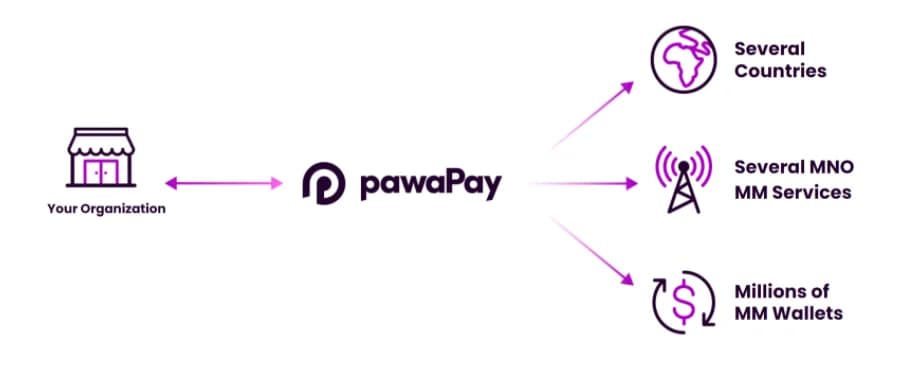
PawaPay is a payments company founded in 2020. It sells businesses a single API, the connection one piece of software uses to talk to another, that reaches mobile money wallets in 23 African countries. Without something like it, a company that wants to collect from M-Pesa users in one country and Airtel Money users in another has to sign a deal with each operator, build to each operator’s system and handle settlement and currency in every market. PawaPay does that work for its customers. So a ride-hailing app, a remittance company or an aid group can plug in once and take or send payments wherever PawaPay is connected.
Mobile money is far bigger than banking in Mozambique. The country has three services, each run by a mobile network:
- M-Pesa from Vodacom,
- e-Mola from Movitel and
- mKesh from Tmcel.
M-Pesa there is the same brand Kenyans know, but Vodacom’s Mozambican business runs it, not Safaricom. The Bank of Mozambique counted 24.6 million mobile money accounts at the end of November 2025, almost four times the country’s 6.7 million bank accounts. Not every account is in use, and PawaPay counts more than 12 million active ones.
PawaPay already works in the country. Its developer documentation already lists Mozambique, with Vodacom’s M-Pesa and Movitel’s e-Mola connected. e-Mola is marked as payouts only, which means a business can send money to e-Mola wallets but can’t yet collect from them. Tmcel’s mKesh isn’t on the list. The licence changes who the merchant signs with. A Mozambican business can now sign up with a locally licensed company that answers to the Bank of Mozambique.
Ilídio Matchebe, PawaPay’s Mozambique country director, said “merchants have had no reliable way to operate here at scale.” The announcement doesn’t explain what those merchants used before, how PawaPay served Mozambique until now, which licence category it received or when the licence was issued.
Mozambique has had a licence for payment companies since a December 2019 decree. It splits them into three kinds: e-money institutions, which is what the mobile money operators are, money transfer companies, and payment aggregators, the businesses that collect payments on behalf of merchants. PawaPay’s business fits the third kind.
PawaPay calls itself “one of the first” PSPs licensed in the country. The Bank of Mozambique doesn’t publish a register of licensed payment companies on its website, so we couldn’t check that against a list.
Mozambique’s payment rules changed this year too. The country replaced its 2008 payments law with Law 15/2026 of 2nd July 2026, which took effect in August, made the Bank of Mozambique formally responsible for licensing and supervising every payment operator, and gave existing operators 180 days to adapt. PawaPay doesn’t say whether its licence was issued under the new law.
PawaPay says it is in advanced talks with M-Pesa, e-Mola and international remittance companies about inbound payments, the money people abroad send home to wallets in Mozambique. It has built this before: last year we covered Airtel Money opening inbound remittances through PawaPay in seven countries, including Uganda, Rwanda and Tanzania.
In 2021, when we first wrote about its USD 9 million seed round, PawaPay ran in 10 countries and handled millions of transactions a week. By August 2025 it was handling more than four million a day. In June this year it said it was handling five million a day across 20 countries. Today it says around 7 million a day across 23 countries, and 3.5 billion transactions since it started.
This is the second licence of this kind PawaPay has announced in a month. In September it said Quidexplus Kenya Limited had been authorised by the Central Bank of Kenya to process and settle payments for merchants. The CBK’s directory of payment service providers, dated 10th August 2026, lists it among 44 licensed PSPs, first licensed on 17th June 2026, with David Kanyora as chief executive.
In Kenya, PawaPay’s developer documentation lists only M-Pesa, and marks it payouts only. So for now a business using PawaPay can send money to M-Pesa wallets in Kenya but can’t collect from them through PawaPay.
Mozambican merchants start with more: they can collect from M-Pesa users and pay out to e-Mola users. Whether they can reach every wallet in the country depends on e-Mola collections and mKesh being added, and PawaPay hasn’t said when either will happen.



Comments
No comments yet. Be the first to share your thoughts.