
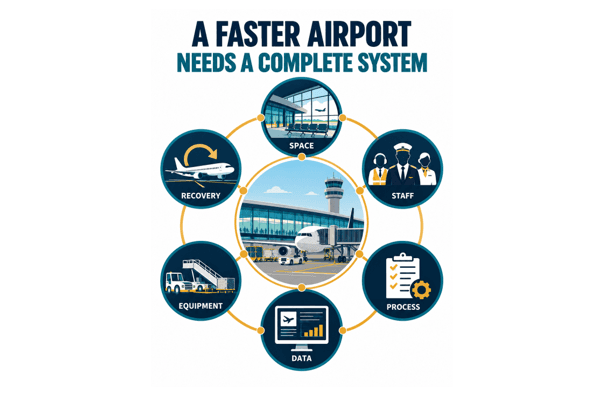
When an airport queue grows, the most visible answer is usually more equipment: more desks, more scanners or more automated gates. Extra capacity can help, but it will not fix a journey whose slowest part sits somewhere else.
For passengers, a fast airport is not the one with the most machines. It is the one in which the airline, terminal, border authority, security teams, technology and staff work as one service from arrival to onward movement.
Measure the queue passengers actually experience
An immigration desk may complete its check in a short time while a traveller still spends much longer waiting to reach it. Measuring only the transaction at the desk can therefore make a slow experience appear efficient.
A useful service measure begins when the passenger joins the relevant queue and ends when the border check is complete. It should show both a typical time and the experience during the busiest periods. Citizens, residents, visitors, crew and travellers sent for additional checks should be reported separately because their journeys are not identical.
The same principle applies elsewhere in the terminal. Walking distance, unclear signs, a late transfer from the aircraft or a congested document-check area can become the real bottleneck even when the gate itself works well.
Arrival patterns can overwhelm good equipment
Airports do not receive passengers in a smooth line. Several large flights can land close together, producing a sudden surge. A row of gates sized for an average hour may struggle during that peak.
Operations teams need to plan for the busiest realistic arrival pattern, not only the daily total. That means coordinating flight information, lane opening, officer deployment and passenger direction before the queue forms.
Technology can provide a clearer view of demand, but people still have to act on it. A dashboard that predicts a surge has little value if lanes remain closed or trained staff cannot be moved.
Automation still depends on officers
Automated border control can authenticate electronic passports, compare a live face with the passport portrait and consult the checks authorised by the state. ICAO says these systems can improve identity assurance and traveller processing when they are integrated with the national border-control system.
They do not remove the need for officers. Someone must supervise the lanes, resolve unreadable documents, review uncertain biometric results and assist travellers who cannot use the automated route.
A gate that processes routine cases quickly can free officers to concentrate on judgement. But if the referral desk is understaffed, the queue simply moves from the gate to the officer.
Better data can move work before arrival
Advance Passenger Information allows a border authority to receive core identity and flight details before an aircraft lands. Travel-authorisation or visa processes can also resolve some questions earlier in the journey.
This can reduce repeated data entry on arrival and give authorities time to prepare. It only works when records are accurate, systems can exchange them and discrepancies can be corrected without sending the passenger from one institution to another.
The processing must also respect Kenyan data-protection law. The Office of the Data Protection Commissioner says transport organisations should handle passenger information lawfully, fairly, transparently and securely, with safeguards against unauthorised access, disclosure or loss.
Layout can defeat a fast gate
An automated lane needs enough space for the traveller to approach, present a document, follow camera instructions, exit and seek help if required. Poor placement can create crossing lines, block travellers with luggage or make the accessible route difficult to find.
Signs should explain eligibility before the passenger reaches the gate. Instructions should be readable and available in forms that serve the actual users of the airport. Assistance should be visible rather than hidden behind the technology.
These details are inexpensive compared with major construction, but they have a direct effect on whether existing capacity is used well.
Every critical system needs a manual plan
Power, connectivity, document readers or databases can become unavailable. The right question is not whether an outage will ever happen, but how the airport will continue operating when it does.
Authorities should define when manual processing begins, which functions remain available, how officers record decisions and how data is reconciled after recovery. They should also test the plan during realistic passenger volumes.
The technology market includes specialist gate manufacturers, biometric companies, airline-network providers and border-system integrators. Companies such as IDEMIA, SITA, Thales, NEC and Securiport provide different combinations of these components. The public authority still owns the task of fitting them into local law, infrastructure and operating practice.
Publish a small passenger-service dashboard
Kenya does not need to disclose sensitive rules to explain whether an airport improvement is working. A monthly dashboard could report passenger volume, typical queue time, the time experienced by most passengers during peak periods, automated completion rate, referral-resolution time, lane availability and major service interruptions.
The definitions should remain consistent so that a change in staffing, layout or technology can be evaluated fairly. Aggregated figures can protect personal information while helping passengers and decision-makers see whether the complete journey improved.
Modernisation is a system, not a shopping list
More gates may be part of the answer at a busy Kenyan airport. So may better signs, coordinated flight scheduling, improved data quality, trained officers, reliable maintenance and a tested continuity process.
The strongest investment case begins with the passenger journey and works backwards to the equipment required. It asks how many people the whole process can move safely and comfortably during the busiest hour, how uncertainty is resolved and how quickly service recovers after disruption.
That approach turns airport modernisation from a collection of machines into a measurable public service.



Comments
No comments yet. Be the first to share your thoughts.