
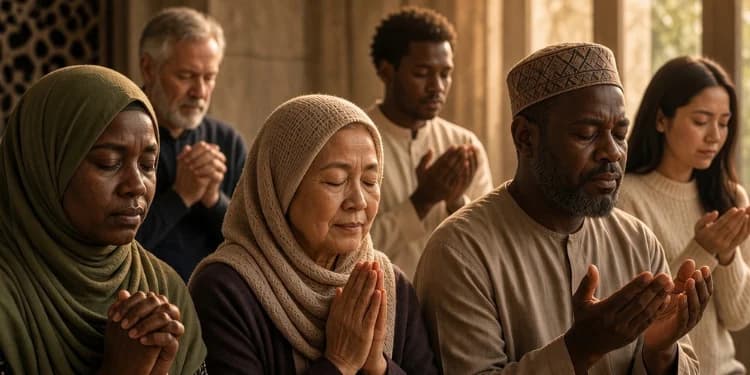
In some societies, large shares of the population identify with a religion and consider it an important part of their lives, while others have large populations who describe themselves as atheist, agnostic, or having no religion.
Recent research by the Pew Research Center, a nonprofit research organization known for its global surveys on religion and public opinion, shows that religiously unaffiliated people have become the largest share of the population in several countries and territories.
Pew defines the religiously unaffiliated, sometimes called “nones,” as people who identify as atheist, agnostic, or as having no religion.
China Has the Largest Unaffiliated Population
China stands out because of the sheer size of its religiously unaffiliated population.
Pew estimates that almost 1.3 billion people in China were religiously unaffiliated in 2020, accounting for about two-thirds of the world’s entire unaffiliated population.
About 90% of China’s population was classified as religiously unaffiliated.
China stands apart from smaller countries with high levels of religious non-affiliation because of its massive population. As a result, it has the world’s largest number of people who do not identify with any religion.
Countries in the World With a Religious Majority of No Religion
According to Pew’s latest global religious landscape estimates, based on 2020 data, 10 countries and territories had a religiously unaffiliated majority.
They were:
- China – 90%
- North Korea – 73%
- Czech Republic – 73%
- Hong Kong – 71%
- Vietnam – 68%
- Macao – 68%
- Japan – 57%
- Netherlands – 54%
- Uruguay – 52%
- New Zealand – 51%
Pew’s estimates cover 201 countries and territories and use religious affiliation rather than simply asking whether people believe in God.
The Czech Republic Has One of the World’s Largest Unaffiliated Shares
The Czech Republic recorded one of the highest proportions of religiously unaffiliated people in the world, with 73% of its population falling into the category in 2020.
The country had already been among the places with unaffiliated majorities in 2010. Its position reflects a long-term decline in formal religious affiliation.
Similarly, Japan had 57% of its population classified as religiously unaffiliated in 2020. Pew’s research notes that Japan is also among the countries where relatively few adults describe religion as highly important to their lives.
The Netherlands and New Zealand Join the List
The Netherlands and New Zealand became majority-unaffiliated countries in the world between 2010 and 2020.
Pew estimates that 54% of the Dutch population and 51% of New Zealand’s population were religiously unaffiliated in 2020.
The increase was part of a pattern of people moving away from formal religious identification, particularly in countries historically associated with Christianity.
The same trend was evident in Australia, Chile and Uruguay, where the share of religiously unaffiliated people increased substantially between 2010 and 2020.
Uruguay Has the Highest Unaffiliated Share in the Americas
Uruguay is notable because it became the only country in the Americas with a religiously unaffiliated majority in Pew’s 2020 estimates.
The unaffiliated accounted for 52% of the population, while Christians represented 44%.
Pew also found that the unaffiliated share had increased by 16 percentage points between 2010 and 2020.
France, Australia and the UK Have Large Unaffiliated Populations
A country does not need to have an unaffiliated majority to have a large population without a religious affiliation.
Pew estimates that Christians fell below half of the population in France, Australia and the United Kingdom by 2020. Christians accounted for 46% in France, 47% in Australia and 49% in the UK.
In all three countries, religiously unaffiliated people represented at least 40% of the population.
This suggests that these countries have experienced major shifts in their religious makeup, even though none had most people identifying as religiously unaffiliated in the 2020 estimates.
Being Unaffiliated Does Not Always Mean Being Atheist
Pew’s definition of religiously unaffiliated includes atheists, agnostics, and people who simply describe themselves as having “nothing in particular” as their religion.
A 2025 Pew study found that many religiously unaffiliated adults still hold spiritual or religious beliefs.
For example, among the 22 countries examined in detail, sizeable shares of unaffiliated adults said they believed in an afterlife or some form of spirituality. In some countries, unaffiliated people also reported beliefs involving ancestral spirits, nature, or supernatural forces.
In Sweden, for example, 52% of adults were religiously unaffiliated in the Pew study, but only about half of that group expressed nonbelief in God, an afterlife, and the existence of something spiritual beyond the natural world.
Japan Records Low Religious Importance
Another way to measure religiosity is by asking people how important religion is in their daily lives.
Pew’s 2025 research found particularly low levels of reported religious importance in several European and East Asian societies. In Japan, only 7% of adults said religion was very important to them, while 44% identified with a religion.
The finding illustrates why religious affiliation and personal religious commitment should be treated as separate measures.
A person may identify with a cultural or traditional religion without considering religion central to everyday life.
Europe and East Asia Feature Prominently
The countries in the world with large unaffiliated populations are concentrated mainly in Europe, East Asia, and parts of the Americas.
Pew’s global analysis found that the unaffiliated population grew between 2010 and 2020, making it the world’s third-largest religious category after Christians and Muslims.
Pew found that in 14 countries, at least 95% of adults identified with a religion, with countries in South and Southeast Asia, Africa, and the Middle East particularly represented among those with high affiliation rates.
The latest Pew research shows that religious identity is changing in several parts of the world, particularly through people leaving the religion in which they were raised and becoming religiously unaffiliated.
Between 2010 and 2020, the unaffiliated population increased substantially in several countries, while the number of countries and territories with an unaffiliated majority rose from 7 to 10.
Follow our and X Account for real-time news updates



Comments
No comments yet. Be the first to share your thoughts.