
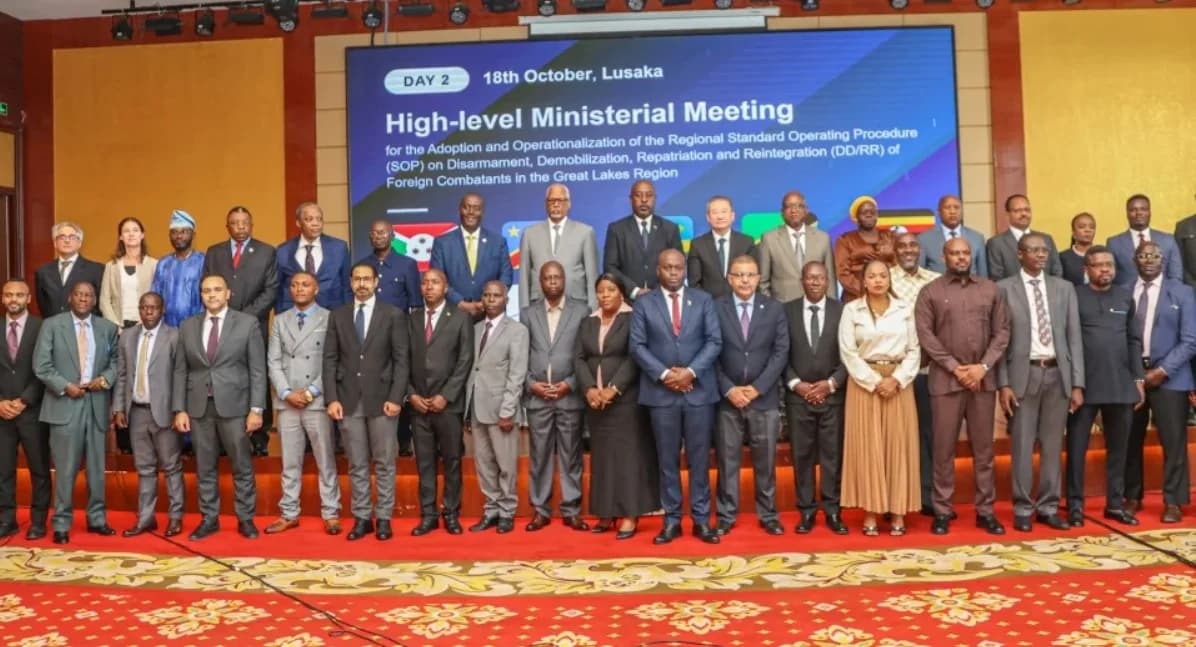
Foreign ministers from the Great Lakes region convened in Lusaka on Monday to take stock of peace and security, but Kenya was notably absent at the ministerial level.
The high-level gathering comes as escalating conflicts and fierce diplomatic tensions—particularly between the DRC, Rwanda, and Burundi—test the region's fragile stability.
Zambian President Hakainde Hichilema opened the meeting, which the Rwandan Ministry of Foreign Affairs said brought representatives together to "review regional developments and discuss joint efforts to advance peace, security and stability."
The ministerial meeting followed a preparatory defence officials' summit held from October 14 to 18. Kenya was represented at that defence meeting by Major General Fredrick Leuria, Assistant Chief of Defence Forces in charge of Operations, Plans, Doctrine, and Training.
The Kenya Defence Forces (KDF) stated that Kenya’s participation "reinforced its strategic role in regional defence diplomacy and multilateral security cooperation."
However, by failing to send a minister to the top-level diplomatic table, Nairobi missed a crucial opportunity to shape the political dialogue, especially given its past attempts to mediate the DRC conflict.
Despite Kenya's absence, the ministers achieved a tangible outcome. On Sunday, five countries—Burundi, DRC, Rwanda, Uganda, and Tanzania—endorsed draft procedures for disarming, demobilising, repatriating, and reintegrating foreign combatants operating in the region.
It is a critical step, given that the presence of cross-border armed groups (like the FDLR and M23) remains the primary driver of the region's instability.
The International Conference on the Great Lakes Region (ICGLR) comprises 12 member states. However, the bloc's cohesion is deeply strained by the ongoing feuds among its most powerful members: the DRC, Rwanda, and Burundi.
For the draft procedures to succeed, the political will demonstrated in Lusaka must survive the deep mistrust back home.



Comments
No comments yet. Be the first to share your thoughts.