
The suspension of the elected government in Khyber Pakhtunkhwa and the renewed emphasis on exploiting the province’s mineral wealth have raised questions that extend beyond constitutional procedure. At the heart of the debate is a more fundamental issue: whether political authority, security policy and economic opportunity are being managed in a way that serves the people of the province and respects their stake in its natural resources.
The federal government has presented Governor’s Rule as a response to a deteriorating security environment and alleged failures in counterterrorism cooperation. But the prominence of mineral extraction in the public discourse that followed has prompted political observers and citizens to question whether the current political circumstances could affect how the province’s resources are governed.
Khyber Pakhtunkhwa is one of Pakistan’s resource-rich provinces. Its mountains, river valleys and mineral-bearing belts contain gold, gemstones, marble, coal, chromite, gypsum and other valuable resources. For decades, however, much of this potential has remained underdeveloped, poorly regulated or vulnerable to informal extraction.
There is therefore a compelling economic case for developing the province’s minerals sector. Responsible mining can create employment, support local businesses, generate public revenue and reduce dependence on external assistance. The question is not whether these resources should be developed. It is how they should be developed, who should have a say in their exploitation and how the benefits should be distributed.
On October 11, the federal government imposed emergency rule in Khyber Pakhtunkhwa, suspending the elected provincial government led by Pakistan Tehreek-e-Insaf. The official justification centred on the security situation, including a reported rise in terrorist violence and allegations that the provincial administration had failed to cooperate adequately with counterterrorism efforts.
Whatever the merits of that security assessment, the suspension of an elected government is an extraordinary constitutional measure. It removes representatives with a democratic mandate and transfers significant administrative authority to the Governor. Such a measure therefore requires clear legal justification, transparency and safeguards against the expansion of temporary powers beyond their intended purpose.
The mineral question has acquired greater prominence following remarks by Governor Faisal Karim Kundi that the province’s minerals should be extracted and sold to promote prosperity. He has invited domestic and foreign companies to invest through joint ventures, arguing that mineral wealth should not remain unused.
The economic proposition is not difficult to understand. A province sitting on valuable mineral deposits should be able to convert those resources into jobs, investment and public revenue. Yet the timing of the initiative inevitably gives the debate a political dimension. A province whose elected government has just been suspended is simultaneously being presented as an investment destination for mineral extraction. That coincidence makes transparency and institutional safeguards particularly important.
The federal government has rejected any connection between Governor’s Rule and mineral policy. Parliamentary Affairs Minister Tariq Fazal Chaudhry has said the two issues are separate and has argued that the resources of Khyber Pakhtunkhwa and Balochistan should benefit their own people.
That assurance is important. But in a federation, resource governance cannot depend solely on political assurances. Its legitimacy must rest on clear constitutional arrangements, transparent licensing, public disclosure, proper auditing and meaningful participation by communities whose land and livelihoods are affected.
The problem is compounded by the scale of illegal extraction.
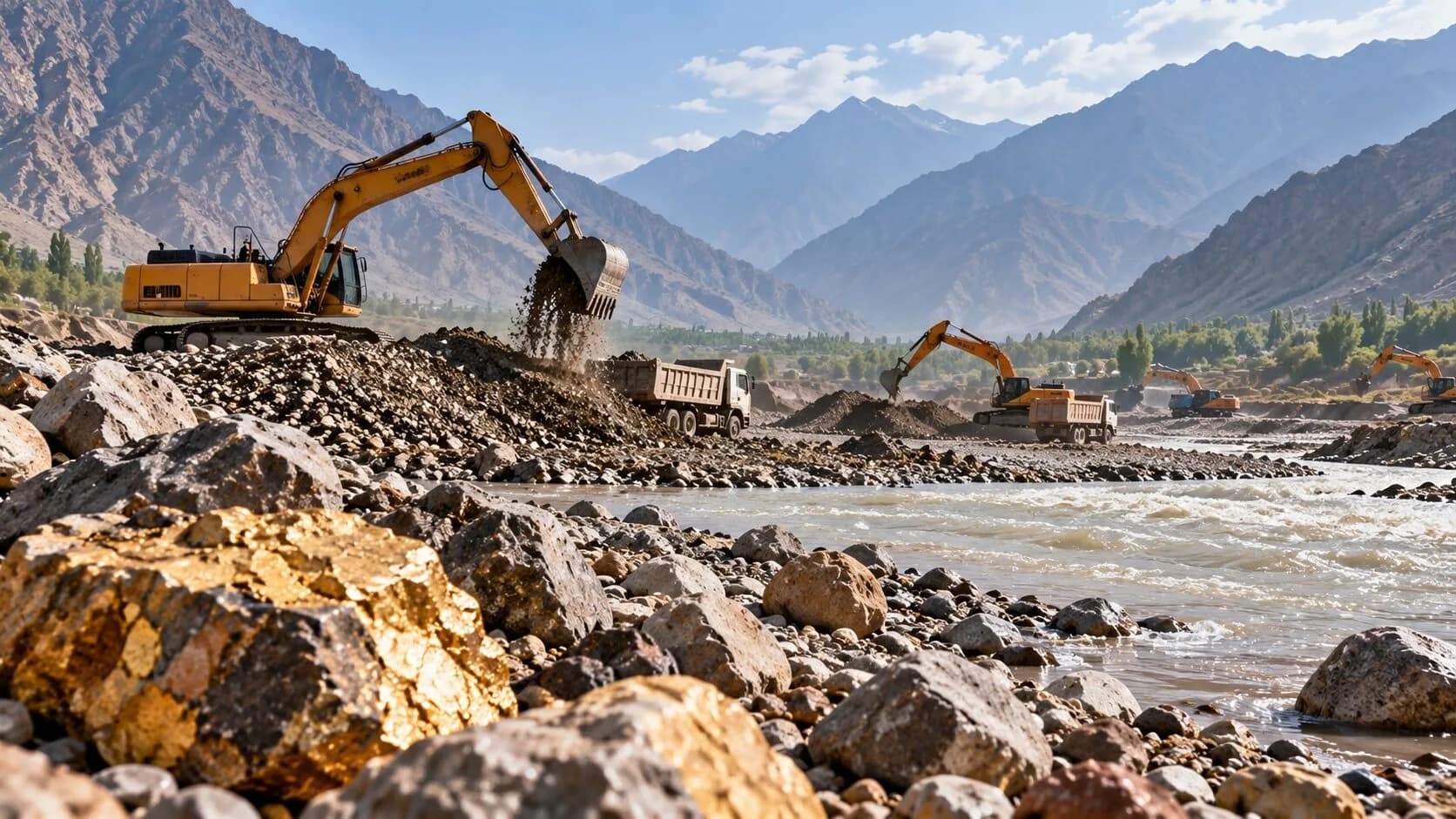
Recent reports have described unauthorised placer gold mining along parts of the Indus and Kabul rivers, particularly in Nowshera, Swabi and Kohat. An FIR cited the use of hundreds of heavy excavators in alleged unlawful extraction, while the suspension of five legally auctioned gold blocks was reported to have contributed to a regulatory vacuum.
If legitimate mining operations are delayed or suspended while informal extraction continues, the consequences are serious. The state loses revenue, lawful operators lose certainty, communities lose potential economic opportunities and criminal networks gain room to operate.
An Auditor General report has further highlighted weaknesses within the sector, reportedly identifying irregularities amounting to Rs16.94 billion in the Khyber Pakhtunkhwa Minerals Department, including losses of about Rs8 billion attributed to illegal mining.
These figures point to a governance problem that cannot be solved simply by accelerating extraction. Khyber Pakhtunkhwa needs stronger regulatory institutions, reliable geological and licensing records, digital monitoring, independent audits and consistent enforcement.
Investment without institutional reform could simply reproduce the weaknesses that have allowed illegal extraction and revenue losses to persist.
The people of Khyber Pakhtunkhwa also have a direct stake in how mining develops. Mineral extraction affects land, water, forests, livelihoods and public health. Communities need access to information, meaningful consultation and appropriate safeguards. Local workers, mine owners, transporters, processors and small businesses also need a predictable legal environment in which to operate.
The concerns of the mining industry itself deserve attention. The Frontier Mine Owners Association has said restrictions on explosives have left hundreds of thousands of mine workers without employment and forced thousands of mining projects to close. If accurate, such disruptions illustrate how regulatory decisions, even when taken in the name of security or reform, can have immediate consequences for legitimate economic activity.
Pakistan’s economic circumstances make the effective management of its mineral wealth particularly important. The country faces fiscal constraints, external debt obligations and the need to expand productive capacity. Minerals could contribute significantly to that effort.
But extracting more resources is not, by itself, a development strategy.
The real challenge is to build a system in which mineral wealth generates lasting economic value. That requires transparent concessions, competitive investment processes, environmental safeguards, fair taxation, local employment and mechanisms that ensure communities benefit from the resources extracted from their areas.
It also requires clarity over the relationship between federal authority and provincial interests. Natural resources are not simply commodities waiting to be taken to market. They are public assets whose exploitation carries economic, environmental and political consequences.
Khyber Pakhtunkhwa therefore stands at an important crossroads. It can use its mineral wealth to build industries, create jobs and strengthen public finances. Or it can allow weak regulation, political uncertainty and opaque decision-making to perpetuate a system in which the value of its resources is captured by a limited number of interests.
The suspension of the provincial government makes this question even more important, not less.
If the objective is genuinely to unlock Khyber Pakhtunkhwa’s mineral potential, the process should be transparent enough to withstand political scrutiny, strong enough to prevent illegal extraction and inclusive enough to give the people of the province confidence that their resources are being developed in their interests.
The measure of success should not be how quickly minerals are extracted or how much investment is announced. It should be whether mineral wealth produces durable jobs, stronger local economies, greater public revenue, environmental responsibility and institutions capable of protecting the province’s interests long after the current political crisis has passed.

Comments
No comments yet. Be the first to share your thoughts.