
Nigeria investigates two suspected Ebola cases in country's North East

Nigeria's latest suspected cases come 11 days after the country confirmed its first Ebola infection in more than a decade.
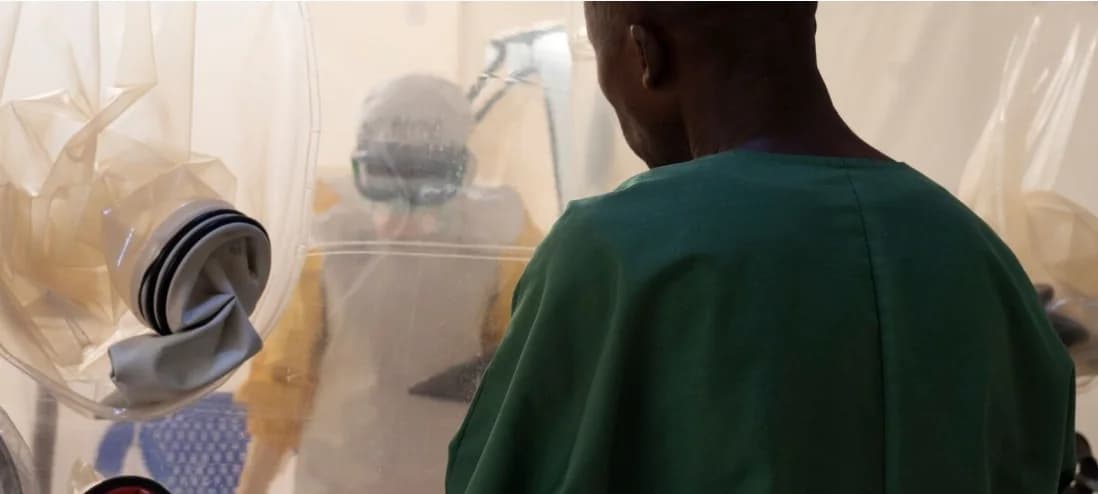
Health authorities in Nigeria are investigating two suspected Ebola cases in the country's North-East region, with both individuals isolated as officials work to establish whether they are infected.
In a statement on Saturday, the Nigeria Centre for Disease Control (NCDC) said laboratory tests were underway, while health workers were identifying and documenting people who may have come into contact with the suspected cases.
The investigation is yet to establish whether either individual has Ebola, with the agency cautioning against treating suspected infections as confirmed cases.
"Being classified as suspected cases does not mean they are confirmed Ebola cases; confirmation is subject to laboratory results," the NCDC said.
The agency subsequently urged Nigerian citizens to maintain proper hand hygiene, improve sanitation and follow guidance issued by public health authorities as investigations continue.
Nigeria's latest suspected cases come 11 days after the country confirmed its first Ebola infection in more than a decade.
Latest Stories
- Drought forces livestock farmers to make tough decisions: Our model shows the impact on inequality
- Dutch professor with terminal cancer builds AI twin to teach after his death
- 𝐄𝐚𝐬𝐭𝐥𝐞𝐢𝐠𝐡 𝐕𝐨𝐢𝐜𝐞 𝐚𝐭 𝐍𝐢𝐧𝐞 - Families cling to hope as rescue mission at Eastleigh collapsed bulding continues
- FIFA warns FKF over court battles, raises prospect of disciplinary action
On October 20, the Federal Ministry of Health announced on that a 42-year-old woman had tested positive for the Bundibugyo strain in Abuja.
The woman had reportedly arrived in Nigeria on October 3 after travelling from Uganda through Ethiopia's capital, Addis Ababa. She developed symptoms on October 7 and sought treatment at a private health facility in Abuja on October 11.
According to NCDC, 44 people who had come into contact with the patient had initially been identified for monitoring, with the number rising to 62 by October 27.
The Nigerian infection is linked to a wider outbreak of the Bundibugyo strain that was declared in the Democratic Republic of Congo (DRC) in May. The outbreak spread across neighbouring countries, prompting regional health authorities to strengthen surveillance and cross-border monitoring.
Uganda reported 20 confirmed infections and two deaths during its outbreak, which included cases imported from the DRC and locally acquired infections. The World Health Organisation (WHO) and Africa Centres for Disease Control and Prevention (Africa CDC) declared the outbreak over on August 27, after the country completed 42 consecutive days without a new confirmed infection.
Kenya also reported an imported infection on October 6 involving a man who had travelled from the DRC through Uganda before arriving in Nairobi. Eight additional infections were subsequently identified among his contacts, bringing the country's total to nine confirmed cases and two deaths.
The DRC remains the epicentre of the outbreak, with the country recording 10,193 confirmed infections and 4,960 deaths as of October 28.



Comments
No comments yet. Be the first to share your thoughts.