
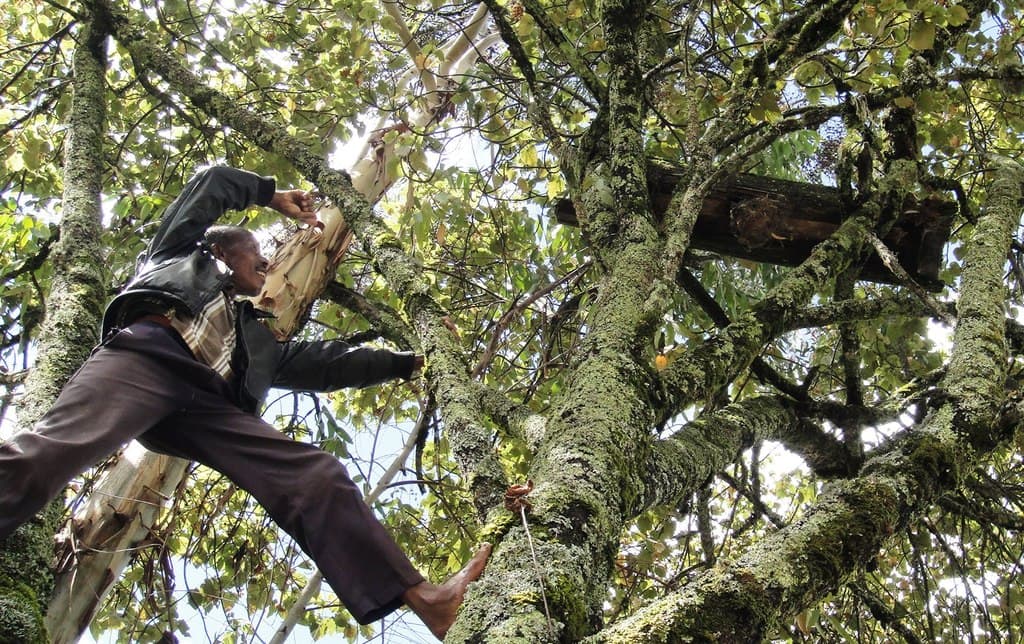
One Kitui County farmer has kept honey badgers away from his hives using ordinary iron sheet guards nailed around the trees hosting the bees.
Mutemi Nguli flattens the ordinary roofing irons sheets and nails them on the stems of the trees having the log. The sheets have to be fixed about three to four metres above the ground and away from branches.
According to his son Festus, the badgers are a menace that even dogs cannot chase away because of their strength and strong repelling odour. But the iron sheets have worked well in preventing the pests from reaching the hives.
The smooth sheet is about three feet long , but is must go round the stem so as to leave no space for the badger to hold, Festus said.
“Killing the pests was not solving the problem because they are many in this vast semi arid forest. It is easy to keep them off with the iron sheets because it is smooth and if the stem is covered all round, the badger cannot have somewhere to hold and move upwards given that the bark is hidden,” Festus said.
The badger gives up after several failed attempts to go past the iron sheets.
Festus, a bachelor of science in agricultural economics student at Laikipia University, says the badger is one of the most destructive bee pest feeding on honey and the larvae.
READ ALSO:Greasing beehives helps keep them safe from crawling predators
This rodent is listed as the least fearful animal in the Guinness book of records. It can attack even a lion by scratching the eyes with its sharp claws. Its skin is thick and tough to an extent that a machete, arrow or spear not easily pierce it.
Stings from bees cannot chase it away. At the same time, it releases a “very strong” odour that scares its enemies. When it releases the odour, the bees move away from the honey combs, Festus said.
READ ALSO: Domesticating stingless bees
The predator can grow up to two and a half feet in length and attain 11 kg.
Mutemi has 80 bee hives logs. He is adding more into the acacia and baobab trees around his homestead.
“Maintenance is minimal because the hives are left in the forest until harvesting. Inspection is done once in a while. I have more time to do other farming errands as the bees work to fill the honey combs on their own. I only ensure they are free from predators,” the farmer said.
READ ALSO: Wood smoke smell helps farmers stock bees
Mutemi harvests about eight kilos twice a year from the one and half metre long logs.
Locally, he sells one litre of honey at Sh350, which earns Sh2,800 per season. Large scale market remains the main challenge to him.
Festus said they borrowed the idea from the metal guards placed around maize granaries to keep off rats and other rodents.
Are you a farmer looking to grow the most profitable crop on your farm, with or without irrigation. Use FarmBizAfrica’s HarvestMAX on https://harvestmax.farmbizapps.com and it will tell you in less than a minute what the highest income-earning crops are for your weather, soil type and this season, based on your seasonal weather forecast. Don’t make weather losses ever again, and more than triple your income.

Comments
No comments yet. Be the first to share your thoughts.