
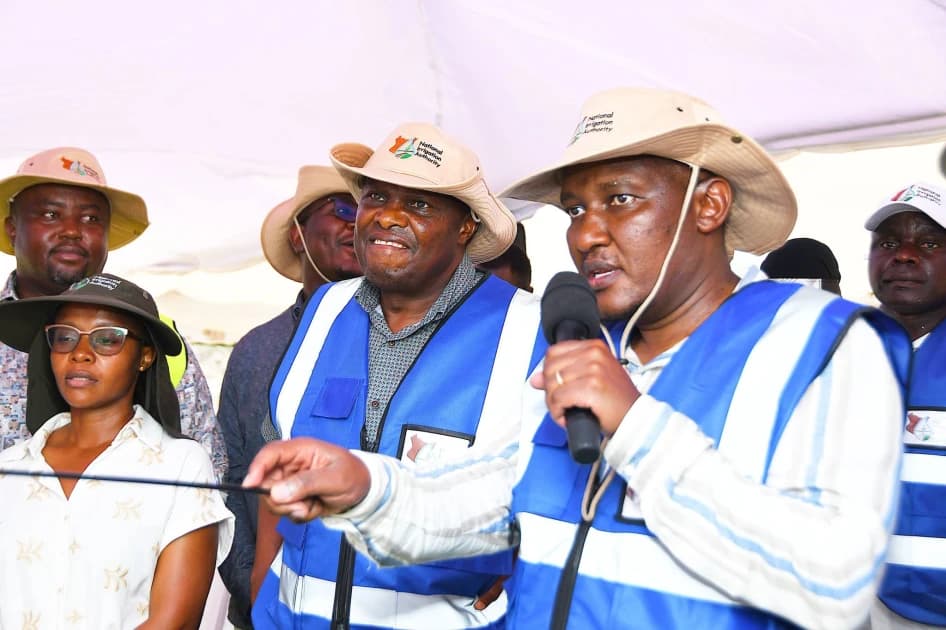
Irrigation PS Ephantus Kimotho with Head of Public Service Felix Koskei at the Galana-Kulalu Food Security Project on November 3, 2026. PHOTO | COURTESY
The plan will be implemented in phases, with an initial target of 500,000 acres, as the government expands water infrastructure and seeks partnerships with private investors to support large-scale farming.
Irrigation Principal Secretary Ephantus Kimotho says the Galana-Kulalu Food Security Project is among the initiatives expected to contribute to the national target, with the government having invested approximately Ksh.520 million in water infrastructure at the scheme.
The investment initially enabled irrigation of 10,000 acres, of which about 6,000 acres are currently under cultivation by private investors growing commercial maize, seed maize and soya beans. The remaining 4,000 acres are expected to be brought under production in the next planting season.
Kimotho, who hosted Chief of Staff and Head of Public Service Felix Koskei and a delegation of 32 Principal Secretaries and senior government officials at the project, said the planned Galana-Athi Dam would further expand the scheme's production capacity.
The proposed 350 million cubic metre dam is expected to unlock an additional 200,000 acres for irrigation, significantly expanding the project's potential.
The government has also identified the Bura Irrigation Scheme, with a potential area of 165,000 acres, as part of the wider irrigation expansion programme.
The Galana-Kulalu project is being developed through a public-private partnership framework initiated by President William Ruto in January 2023, with five private investors participating in the initiative.
Among them, Selu Ltd is cultivating 2,000 acres of seed maize and plans to expand its operations to 20,000 acres within the next three years.
Pwani Farms is also cultivating 2,000 acres of soya beans and a similar area under maize. The company has established a maize mill and uses solar-powered irrigation to support production.
During the visit, Koskei said the government was committed to developing irrigation, water storage and supporting infrastructure to turn arid and semi-arid areas into food production hubs.
He noted that unpredictable weather patterns and recurring droughts had exposed the risks of depending heavily on rain-fed agriculture, making investment in irrigation necessary to secure the country's food supply.
The delegation also discussed the need for complementary infrastructure, including roads and electricity, to support commercial farming, processing and access to markets.
Energy Principal Secretary Alex Wachira highlighted the importance of reliable power and road networks in making irrigation projects commercially viable.
Livestock Principal Secretary Jonathan Mueke said expanding soya production could help reduce dependence on imported edible oils and animal feed ingredients, while lowering production costs for livestock farmers.
Special Programmes Principal Secretary Ismail Malim Abdi said irrigation could help arid and semi-arid counties move from relying on food relief to producing food for supply to other parts of the country.
Water Principal Secretary Julius Korir pointed to the need for additional dams and water infrastructure, including the proposed Thwake Dam and a government programme targeting close to 200 dams.
The government is also seeking to address food security through increased domestic production of maize, rice, wheat, sugar and edible oils, with annual food imports estimated at Ksh.560 billion.
The delegation further linked increased food production to improved nutrition and reduced childhood malnutrition, while noting the potential for expanded agricultural activity to create employment opportunities for young people.



Comments
No comments yet. Be the first to share your thoughts.