
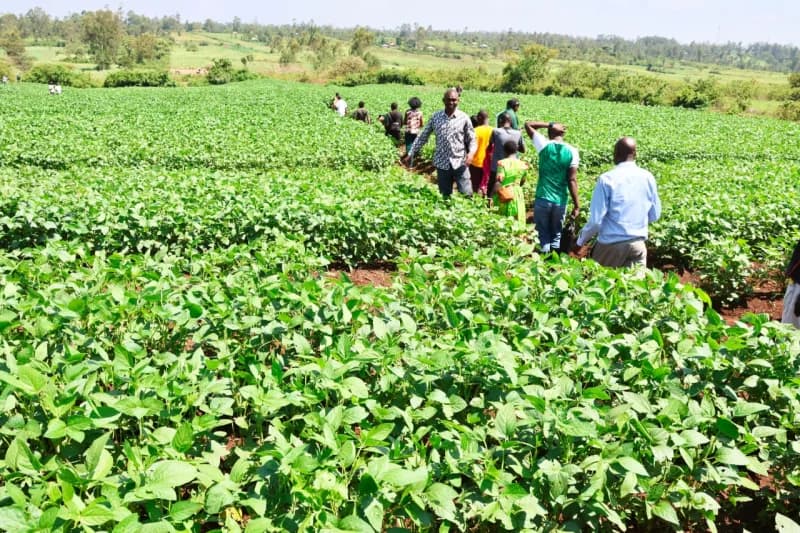
Under this technology, soybean plants host nitrogen-fixing bacteria that use nitrogen from the air to provide the plants with nitrogen.
Dominick Okungu with some trained soya bean farmers at Jabagre village farm in Ndhiwa constituency/Robert Omollo

The Farm Africa organisation has introduced technologies under its Youth in Sustainable Agriculture (YISA) programme to reduce the cost of soybean production.
The Agronomy Technical Lead for the YISA programme, Bundi Muguna, said more than 6,000 young women and men farmers in Homa Bay had been introduced to minimum tillage and nitrogen-fixing bacteria technologies to boost farmers’ incomes.
Minimum tillage is a sustainable farming method that limits soil disturbance to the lowest level needed to grow a crop, avoiding deep ploughing or turning over the soil.
Under this technology, cultivation is restricted to shallow depths of about two to four inches or narrow strips where seeds are planted.
Muguna said minimum tillage was one of the cultivation methods that promoted climate-smart agriculture practices.
“The cost of ploughing a one-acre farm is at least Sh3,500, yet minimum tillage, which involves spraying herbicides, costs about Sh1,200. This maximises income and encourages financially challenged farmers to venture into soybean production,” Muguna said.
Soya bean farmer Dominick Kungu speaks to journalists in his farm at Jabagre village in Ndhiwa constituency,Homa Bay County/Robert Omollo

Speaking during a visit to Domnick Kungu’s farm in Jabagre village, Ndhiwa Constituency, Homa Bay County, the expert said they were also promoting the use of nitrogen-fixing bacteria in soybean production.
He argued that the use of nitrogen-fixing bacteria reduced dependence on fertilisers in soybean production.
Another advantage of nitrogen-fixing bacteria is that they are not easily washed away during heavy rains, unlike artificial fertilisers, which can be carried away by runoff.
“This is a natural way of applying fertiliser to soybean plants so that farmers do not spend money buying fertilisers. This cuts production costs as well,” he said.
During the visit, Jacinta Kariuki, a gender specialist at Echo Network Africa Foundation, said the YISA programme aimed to empower women aged 18 to 35 years.
Kariuki said the empowerment was being undertaken through three domains, including enabling women to own and control resources.
Another domain involved addressing harmful cultural practices that impeded women’s prosperity, as well as ensuring women participated in decision-making at the family level.
She said women should be engaged in large-scale soybean production as a source of job creation.
“Women need to be decision-makers and own resources. It is in production where there is money, and that is where we want them to be,” she said.
Kungu, whose farm was visited, said they were already applying the technologies as they enhanced economies of scale in soybean production.
He is growing soybeans on a three-acre piece of land and expects to harvest 2.4 tonnes by the end of this year.
The farmer hopes to construct a permanent house using the proceeds from soybean production.
“Minimum tillage has helped me reduce the cost of production significantly. This will enable me to make a desired profit,” Kungu said.
Another farmer, Linet Opiyo, said the technologies allowed soybean plants to germinate and grow without the adverse effects of weeds.
She argued that minimum tillage saved resources and the time spent preparing land for planting.
“The conventional means of land preparation I have been applying used to take about two months before planting. It was very expensive since it involved spending money as the farm had to be tilled twice or thrice before planting,” Opiyo said.
According to Opiyo, they expected to harvest more than 1.5 tonnes of soybeans. The crop sells for between Sh60 and Sh70 per kilogram, depending on supply.
“Apart from continuing with this project, I expect to use the proceeds from my soybeans to start poultry farming. This will help me achieve my financial dreams,” she said.



Comments
No comments yet. Be the first to share your thoughts.