
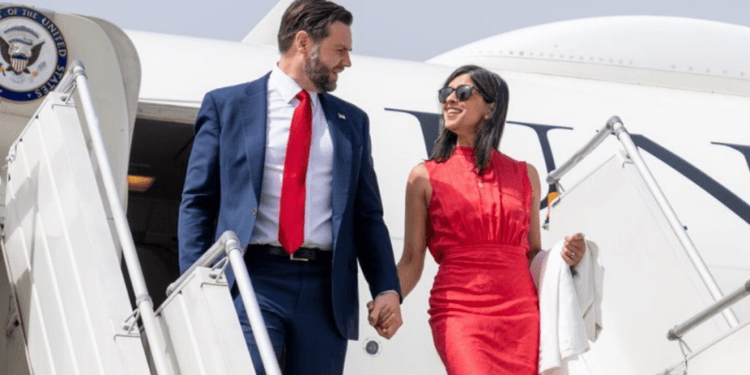
Vice President J.D. Vance triggered a storm of criticism on social media on Wednesday, April 8, after invoking a personal analogy involving his wife, Usha Vance, to explain why the United States rejects Iran’s claim to a “right to enrichment” in nuclear negotiations.
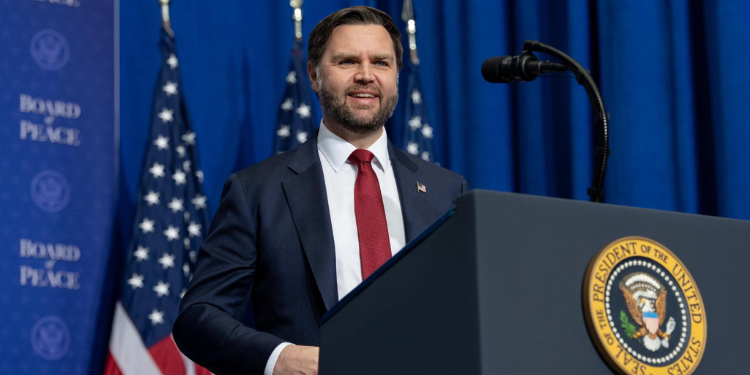
Speaking to reporters in Budapest, Hungary, where he was campaigning for Prime Minister Viktor Orbán, Vance dismissed Iranian demands by comparing them to an agreement in his own marriage that prevents his wife from skydiving.
The remarks came in response to comments from Iran’s Parliament Speaker, Mohammad Bagher Ghalibaf, who insisted that any peace deal following a recent two-week ceasefire must include recognition of Iran’s right to enrich uranium.
Vance rejected that outright, stressing that the Trump administration focuses on concrete actions rather than abstract rights claims.
“I thought to myself, you know what? My wife has the right to skydive, but she doesn’t jump out of an airplane because she and I have an agreement that she’s not going to do that because I don’t want my wife jumping out of an airplane,” Vance said.
The analogy attracted a series of negative responses on social media right away. Critics called it strange, tone-deaf, and awkward, especially because it brought the second lady into a conversation about stopping Iran from getting nuclear weapons.
Vance trolled on X.
In no time, social media sites were flooded with pictures, ridicule, and criticism, calling the whole comparison “stupid” and irrelevant to international diplomatic relations.
Netizens on X noted that describing a sovereign nation’s nuclear policy as spousal control struck many as odd and condescending.
“What? Is Vance saying that men should control their wives like property?” one user remarked.
The main point of the disagreement is that the U.S. says Iran must stop all uranium enrichment activities that could make material for nuclear weapons and give up its current stockpiles of enriched nuclear fuel.
President Donald Trump has been insisting, “There will be no enrichment of uranium.”
A White House official confirmed that Iran’s initial 10-point proposal, which included the claimed right to enrich, did not align with Trump’s framework and was deemed unserious.
Iran later submitted a modified proposal described by the administration as a potential starting point for talks, though it still falls short of fully meeting U.S. demands.
Vance sets the record straight.
Vance stressed that the United States holds strong leverage in the negotiations, with Trump “having all the cards.”
He is scheduled to lead the U.S. negotiating team in direct peace talks with Iran, set to begin Saturday in Islamabad, Pakistan. The delegation will include special envoy Steve Witkoff and Jared Kushner.
The ceasefire between the U.S. and Iran followed intense military action, including U.S. and Israeli strikes on Iranian nuclear sites.
The White House maintains that those operations successfully degraded Iran’s atomic capabilities.
However, Iran has already accused the U.S. and Israel of violating the truce through actions in Lebanon and alleged incursions into Iranian airspace.
Al-Jereeza reported on Wednesday that Iran is already planning to strike Israel in response to the IDF’s action in Lebanon. Intelligence groups in Israel are already indicating possible ceasefire cancellation and a fresh exchange of strikes between Israel and Iran.
Back in Iran, Ghalibaf cited the denial of enrichment rights as one of three key breaches that make further talks unreasonable from Tehran’s perspective.
Despite the rhetoric, the Trump administration maintains that Iran will not be permitted to reach the threshold of a nuclear weapon.
Civilian nuclear power without enrichment is possible, officials note, but Iran has so far rejected limits that would prevent weapons-grade material production.
The skydiving analogy was meant to illustrate Vance’s point that “rights” don’t mean much without enforceable agreements, and that the stronger party can set reasonable limits for safety reasons.
Vance’s trip to Budapest also raised eyebrows. Some reporters and commentators questioned the decision to mix Orbán’s election campaigning with sensitive nuclear diplomacy. Orbán is a leader who is regularly criticized for being authoritarian.

Comments
No comments yet. Be the first to share your thoughts.