
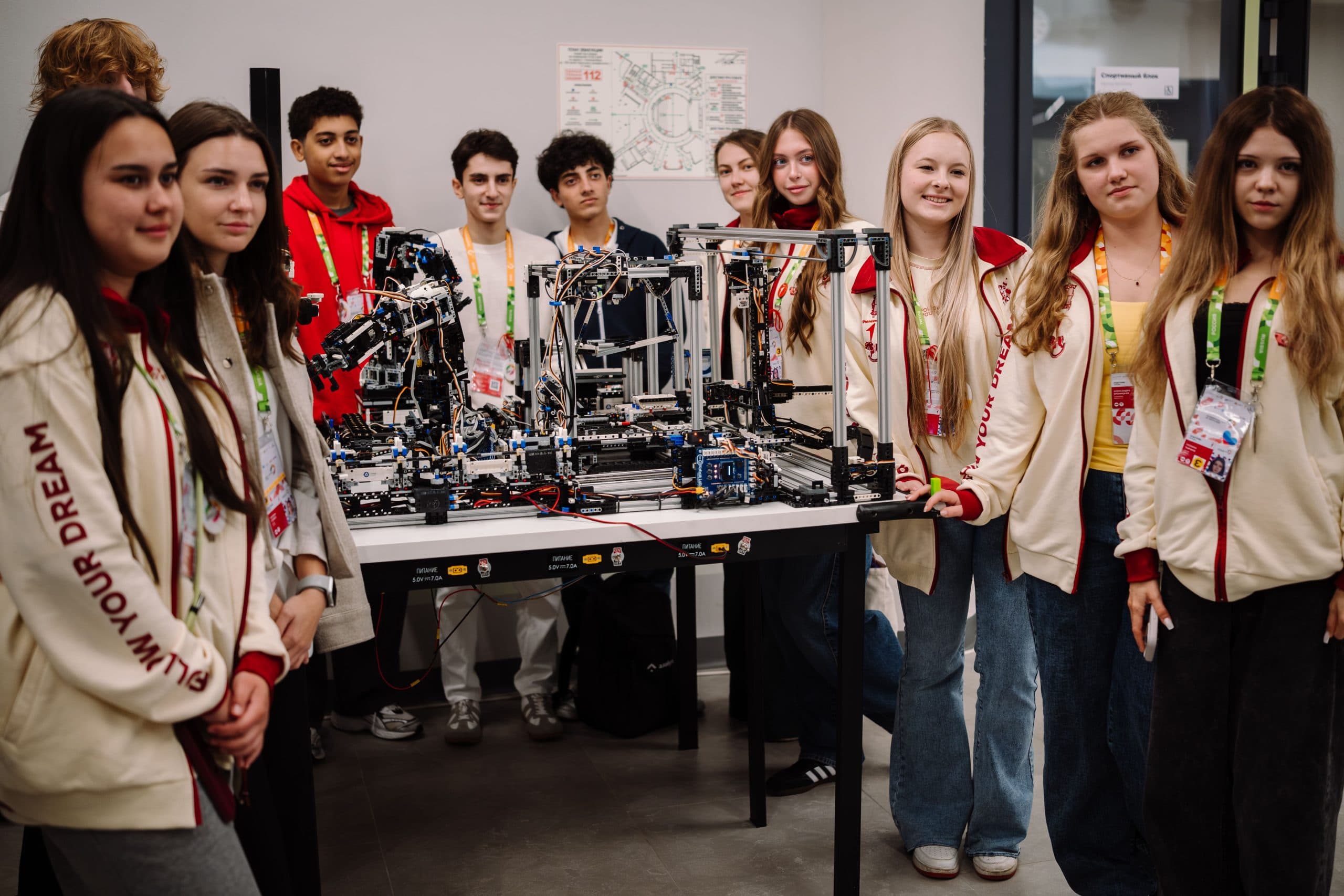
Young participants at the International Festival of Youth 2026 showcased 60 projects spanning science and technology, digitalisation, creative industries, sports, media and civic engagement.
The school children presented 60 initiatives across a wide range of fields, in the event that brought together participants from both the Children’s and Adult Programs of the Festival.
As part of the Children’s Program, a Festival of Projects was held where all 60 initiatives were divided into seven tracks.
Science and technology accounted for the largest share (21 projects). Participants also presented 11 projects in creative industries, 8 in digitalization and IT, and 6 in public administration. The sports, media, and civic engagement tracks featured four projects each.
The results of the participants’ work were displayed across all four floors of the Pioneer House at the Specialized Education and Research Center (SERC). At the booths, visitors could talk with the creators and learn what the children had come up with and how they brought it to life.
Artur Orlov, Hero of Russia, graduate of the presidential personnel program “Time of Heroes” and Chairman of the Board of the Movement of the First, toured the exhibition and reviewed the participants’ work.
“Our Children’s Program at the festival was very productive. In just a few days, the children were able to create original developments in priority areas for the country and present them to leaders of the technology market. Over this week alone, 60 new ideas were proposed in science and education, digital solutions, creative industries, media, IT, and other relevant fields. Together with our partners, we will support the most striking ideas within the project activities of the Movement of the First, so they will certainly be developed further. The results of the program showed that the younger generation strives to find its own path and improve life in their home countries, acting as a driver of technological leadership,” said Artur Orlov.
Project laboratories and workshops operated at the Festival. Their key feature was close interaction between the children and experts from leading corporations. Thirty-nine partners shared their experience and knowledge, including Russian Railways, RUSNANO Management Company, Geoscan Group, and other major scientific, educational, sports, and creative organizations from across the country.
“The Children’s Program, which Sirius organizes together with the Movement of the First, brought together about a thousand young participants from Russia and abroad. Sixty leading industrial companies and universities from across the country posed real technological and scientific tasks before the teams. As part of the ‘Global Big Challenges’ program, schoolchildren proved they are ready to tackle problems of global scale — from medicine to engineering. Most importantly, international teams formed over these five days. I am confident that the friendships and scientific connections created here will shape the future of world science in 10–20 years, and many projects will continue at the All-Russian ‘Big Challenges’ competition,” said Anton Gusev, Deputy Head of the Talent and Success Educational Foundation and Director of the Sirius University of Science and Technology.
While working on their projects, the young participants thought not only about the technical side of their products and solving specific tasks, but also about their meaning. Teams sought answers to important questions: which ideas and beliefs help meet the challenges of our time, and what emotions the solutions they create should evoke.
One of such projects “Invisible Digit: An Objective Vision Speed Test” was created with support from the Sirius University of Science and Technology. Participants in the Science and Education track developed a hardware & software system for accurately assessing visual perception thresholds. In the course of their work, the authors studied the critical flicker fusion frequency and the limitations of conventional subjective vision testing methods. The team has already tested the system, using an image of a digit as the stimulus. Participants measured indicators using several methods and found out how virtual reality affects perception thresholds.
“This is my first time coming to Russia for a festival, and I liked everything very much the food, the people, the atmosphere. Joint work with the others made a particular impression, because they welcomed me very warmly and took me into their team. In my view, our project is very important, because it helps people of various professions react quickly in extreme conditions. It could be useful for pilots, drivers, and firefighters, so we need to continue the research we started,” shared Penuel Zevdu Basazineu from Ethiopia.
In addition, with support from the State University of Education, the children worked on the project “Ethnodesign: A Contemporary Interpretation of Traditional Ornaments.” Its main goal was to create an art object combining the ornaments of the peoples of Russia and the world with contemporary aesthetics. Participants studied the symbols, artistic traditions, and features of ethnic art.
Over five days, they developed a concept and sketches, created decorative elements and a virtual visualization. It resulted in the Tree of Life art object more than two meters tall. In their design, participants used silhouettes of flowers, fruits, birds, and other motifs referencing the traditions of different cultures. The authors also prepared a video about the idea and the stages of creating the project.
“Russia has always attracted talented young people from around the world, and joint creativity brings people together better than anything. All week, Festival guests and students of the Faculty of Fine Arts and Folk Crafts under the guidance of teacher Mikhail Lebedev, People’s Artist of Russia and Chief Artist of the Zhostovo Decorative Painting Factory, and Evgeny Kryuchkov, Candidate of Pedagogical Sciences and Associate Professor of the Department of Design and Folk Arts and Crafts created a single art object, the Tree of Friendship, where everyone painted their own element with a national ornament,” noted Natalia Naumova, Rector of the State University of Education.
Adding that: “Our career guidance track, led by Ekaterina Bulgakova and Evgenia Kalinina, teachers from the Faculty of Psychology, helped the young choose their future professional path, because teenagers in all countries are concerned with the same questions regarding their development. Seeing young, smart, and enthusiastic people is deeply inspiring. The organizers put in a lot of effort, but tomorrow, when the guests leave with love for Russia in their hearts, something will stay with us a warm sadness, a beautiful aftertaste, and dreams of the next festival.”
Two more groups of participants, with support from Russian Railways, worked on the Digital Railway project. They learned how modern technology is changing the railway industry. They studied sensors and safety systems, the basics of electronics and automation, and explored the possibilities of 3D printing and artificial intelligence. For practice, they assembled and programmed their own model of a digital railway.
“The participants worked on the Digital Railway project: they designed a smart washing station with sensors and automatic drying, and also planned the improvement of the entire area. The schoolchildren threw themselves into programming, 3D design, and prototyping with great enthusiasm when they saw their drawings and code turn into three-dimensional, working elements of a single system. The project presentations were evaluated by heads and chief engineers of research institutes and design bureaus of Russian Railways. This experience gave the children not just new engineering knowledge, but a real social lift for further development in the field of digitalization,” said Olesya Stepanova, Expert at the Employer Brand and Human Capital Development Center of Russian Railways.
Another important task of the Festival was creating an updated concept for the International Festival of Childhood and Youth Movement of the First Festival. Two groups of participants worked on it.
“We developed a new concept for the Movement of the First Festival and learned from past mistakes. Our idea is based on a metaphorical bridge uniting culture and values. The space will span 12 pavilions at VDNH across 12 tracks of the Movement, where master classes and lectures will be held. Six bridges will connect adjacent tracks in pairs around a shared idea. Our motto will be: ‘From every corner of the world to the city of bridges and opportunities.’ The finale on the main stage will symbolize a unified platform of childhood and youth. We also came up with branded merchandise. We worked on the project for four days and are very grateful to our mentors for their support and the result. Our shared dream is to return to the festival as part of the Children’s Directorate,” said Yaroslav Aseev, an IFY 2026 participant from the Tula Region.
The participants studied what children and teenagers expect from modern festivals and came up with ways to make the event more interesting and memorable. They proposed new activity formats, ideas for merchandise and art objects, and thought through the atmosphere and visual style. Participants paid special attention to developing a shared narrative and unifying idea for the celebration. Based on their work, they prepared detailed recommendations for the design of the space and the program of the future festival.
The team of Alexey Khodyrev from Udmurtia assembled a training model of a satellite constellation to demonstrate how signal relay from one station to another works.
“Our team consisted of four groups. The first one made 3D models and printed them, the second soldered circuit boards, the third wrote code, and the last assembled everything into a single whole. In total, 14 people from Russia, the UK, Vietnam, Belarus, Slovakia, and Armenia,” said Alexey Khodyrev.
According to him, interacting with teammates was easy because everyone shared a common goal. In addition, several of the children knew both Russian and English, which simplified communication.
The project was prepared jointly with the Russian Space Systems company. It demonstrates how satellites operate in orbit, explained Maxim Tsukanov, a supplementary education teacher and space exploration popularizer who served as the team’s mentor.
“What the guys received was both theory and, most importantly, real experience working with 3D programs and systems for programming electronic devices, which may be useful to them in the future. Perhaps not all of them will go into the industry, not all will be engaged with space, but the engineering approach we tried to instill will be useful to them in everyday life for solving simple household tasks,” he said.
Another team prepared a project dedicated to the international cultural code. The participants collected words and concepts that have no equivalents in different languages and dialects, and created collections of such expressions from various regions of the world. They formatted their work as books, stands, brochures, and souvenirs, and covered the process of creation and the stories behind the items in a specially created VK community.
“We came to this idea when we had communication problems within our team, and it turned out these dialects were the reason. So we decided to turn it into a project. We presented the results through our creativity, through our art objects, because creativity is a language that everyone understands without words,” shared Tamara Korovkina, a participant in the project.
Thanks to the diverse national backgrounds of the participants, the range turned out to be quite vivid: festival guests had the chance to encounter dialects from Russian regions Udmurtia, the Bryansk Region, and Chechnya as well as from Kazakh, Mongolian, English, and French.
Comments
No comments yet. Be the first to share your thoughts.