
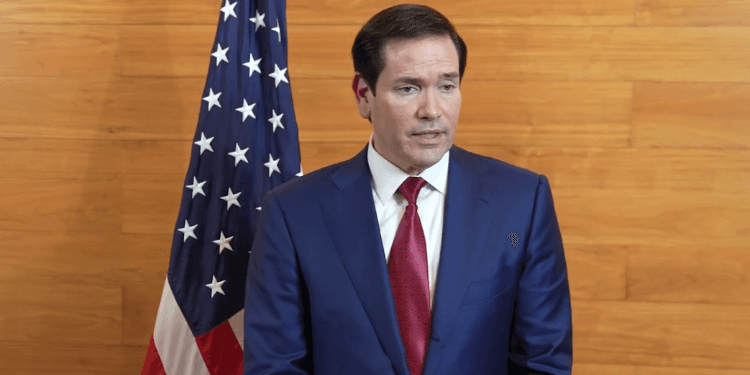
Secretary of State Marco Rubio has revoked the green cards of the son, daughter-in-law, and grandson of Masoumeh Ebtekar, the Iranian official who served as spokeswoman for the militants who seized the U.S. Embassy in Tehran in 1979.
Ebtekar, nicknamed “Screaming Mary” by Americans for her shrill propaganda during the crisis, helped justify the 444-day ordeal in which 52 U.S. diplomats and citizens endured beatings, starvation, and mock executions.
On Saturday, April 11, Rubio announced that her son Seyed Eissa Hashemi, his wife Maryam Tahmasebi, and their young son are now in Immigration and Customs Enforcement custody and face removal from the United States.
According to Rubio’s post on X, the family entered the country legally under the Obama administration. In 2014, they received visas, and in June 2016, they obtained lawful permanent resident status through the Diversity Immigrant Visa Program.
Marco Rubio stamps authority.
Rubio has now declared that those benefits ended this week, adding that this family should not have been allowed to enter the United States.
“Her family should never have been allowed to benefit from the extraordinary privilege of living in our country,” Rubio wrote. “America can never become home for anti-American terrorists or their families, and under the Trump Administration, it never will.”
The 1979 hostage crisis remains one of the most humiliating chapters in modern U.S. history. Iranian students, backed by the new Islamic regime, stormed the embassy on November 4, 1979.
They held Americans captive until January 20, 1981. Ebtekar appeared regularly before cameras to defend the captors and denounce the United States.
Former hostages have described psychological torture that included staged firing squads where blindfolded prisoners heard rifles cocked and then lowered at the last moment.
Hashemi, now 43, had been living openly in the Los Angeles area. He worked as an adjunct psychology lecturer at a private college.
Reports described him enjoying an affluent lifestyle while his mother continued to hold high positions in the Iranian government, including vice president for women and family affairs.
Critics had already called for his removal. At the start of this year, in January, protesters gathered outside the college where he taught and demanded that management fire him. Protesters also demanded action from the government.
Many Iranian-Americans argued it was unacceptable for the son of a regime figure tied to the hostage-taking to teach and live comfortably in the same country whose citizens his mother once helped torment.
Rubio’s action fits a broader Trump administration push to bar supporters of designated terrorist regimes from U.S. soil.
In recent days, the State Department has also stripped status from relatives of other senior Iranian figures, including a niece of the late Qasem Soleimani.
They were taken into ICE custody after their green cards were terminated.
The decision on Ebtekar’s family closes a loop that began more than four decades ago. The Obama-era visas and green cards had allowed the family to settle in California despite Ebtekar’s direct role in one of the worst assaults on American diplomats since the Iran hostage crisis defined U.S.-Iran relations.
What does this mean?
The Trump administration’s action makes it clear that the US will not reward people who are linked to those who humiliated American soldiers and civilians for more than a year.
Rubio said that families connected to such acts do not have the right to live in America permanently.
The family is likely to go to court to challenge the revocation, but the links to the 1979 crisis and Ebtekar’s documented role will give the Trump administration strong grounds to defend its decision.

Comments
No comments yet. Be the first to share your thoughts.