
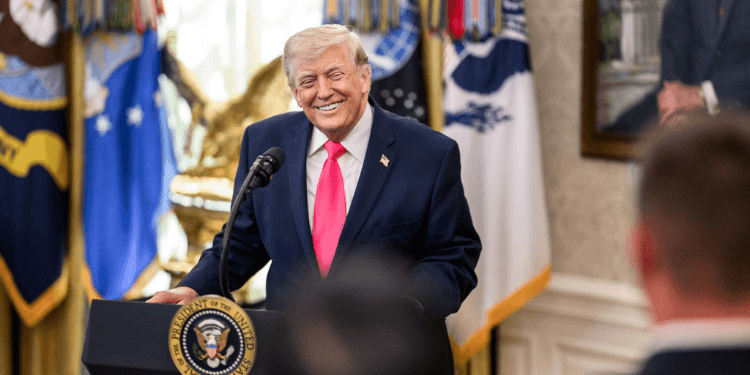
President Donald Trump said Saturday that Iran sent his administration a revised and improved proposal for ending the war just minutes after he canceled a planned trip by U.S. envoys to Pakistan.
The president spoke to reporters before boarding Air Force One in Florida on April 25. He described the first Iranian document as one that “should have been better.”
He added that right after he called off the trip, “within 10 minutes, we got a new paper that was much better.”
Trump did not release details of either proposal, but he said Iran “offered a lot but not enough.” He made clear the United States holds strong leverage in the talks. “We have all the cards,” he said. “We’ll deal by telephone, and they can call us any time they want.”
The canceled trip involved special envoy Steve Witkoff and senior adviser Jared Kushner, who is Trump’s son-in-law.
They were set to fly to Islamabad on Saturday for what was supposed to be the second round of negotiations aimed at securing a lasting ceasefire. Vice President JD Vance had led the first round of talks earlier.
Plans for the meeting unraveled quickly on Friday and Saturday. White House press secretary Karoline Leavitt had told Fox News that the U.S. delegation would hold “direct” talks with Iranian representatives in Pakistan. Iranian officials pushed back hard against that claim.
Esmaeil Baqaei, a spokesperson for Iran’s foreign ministry, posted on X that “no meeting is planned to take place between Iran and the U.S.” He said Iran’s positions would be conveyed only through Pakistani mediators.
Abbas Araghchi meets Pakistani officials
Iranian Foreign Minister Abbas Araghchi arrived in Islamabad on Saturday morning and met with Pakistani officials.
He described those talks as “very fruitful” in a post on X. Araghchi said the Iranian side had communicated its views on a “workable framework to permanently end the war on Iran.” He added that it remained to be seen whether the United States was “truly serious about diplomacy.”
The back-and-forth came against the backdrop of a fragile ceasefire that has held for several weeks after intense fighting between U.S., Israeli, and Iranian forces.
The conflict disrupted oil shipments through the Strait of Hormuz and raised fears of wider regional unrest.
Trump cancels the trip
Trump said the long travel time to Pakistan, 15 or 16 hours, made the trip unnecessary once the initial proposal fell short.
He called it too much work and too expensive. Instead of sending senior officials around the world, he said future contact could take place by phone.
Pakistani officials have played a central role as mediators throughout the process. Iran and the United States have not held direct high-level talks in recent rounds, relying instead on indirect channels through Islamabad.
While Trump sounded upbeat about the revised Iranian paper, he gave no timeline for the next steps. He said he had not yet decided whether to extend the current ceasefire further.
The president repeated his long-standing position that Iran cannot be allowed to develop nuclear weapons.
On the Iranian side, tensions remained high. The Iranian embassy in South Africa posted on X on Saturday that Tehran has prepared for what it called the “largest missile strike in history” against Israel and U.S. bases in West Asia.
Trump has used the same tricks in trade deals and talks about foreign policy in the past. He showed that the United States would not spend time and money on meetings that did not promise real progress by canceling the trip.


Comments
No comments yet. Be the first to share your thoughts.