
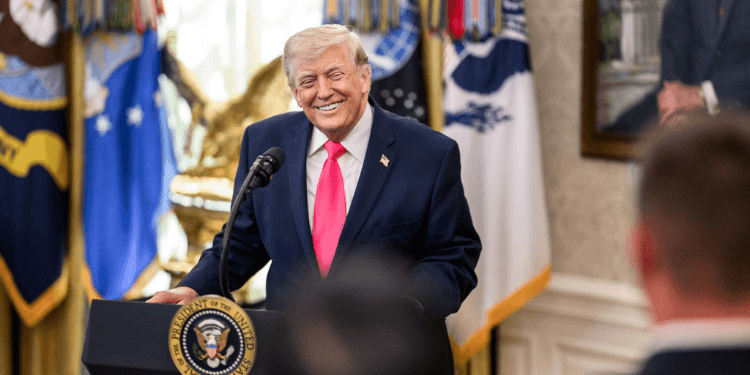
The House of Representatives on Thursday turned back a Democratic effort to force President Donald Trump to end U.S. military operations against Iran, defeating the measure by the slimmest possible margin of 213-214.
The April 16 vote marked the second time this year the House has rejected a War Powers Resolution aimed at withdrawing American forces from the conflict without fresh congressional approval.
Republicans held firm behind Trump, with only Rep. Thomas Massie of Kentucky crossing over to support the resolution. Rep. Warren Davidson of Ohio, who backed a similar measure in March, voted present this time.
Democrats picked up ground compared to the earlier attempt, with three of the four members who previously broke ranks to let the military campaign continue switching sides and voting to constrain the administration. Only Rep. Jared Golden of Maine stuck with the Republicans in opposing the resolution.
What the outcome means for Trump
The outcome keeps Trump’s hand free for now as the U.S. presses its campaign alongside Israel. However, the razor-thin tally revealed increasing unease within the narrow GOP majority, especially as real-world costs mounted at home.
Iran’s closure of the Strait of Hormuz triggered sharp spikes in oil and gas prices, hitting American consumers and businesses hard.
This week, the U.S. Navy imposed its own blockade on Iranian ports, further tightening the squeeze on Tehran but adding to the economic fallout. Reopening that critical shipping lane has become a top priority for the administration.
The fighting has dragged on for weeks with no clear end in sight. A fragile ceasefire is due to expire on April 22, and recent peace talks led by Vice President JD Vance concluded without a deal. Trump and his team continue to project strength, saying the U.S. holds the upper hand.
At the Pentagon on Thursday, Defense Secretary Pete Hegseth said American forces stand “locked and loaded” and ready to resume strikes if Trump gives the order.
Joint Chiefs Chairman Gen. Dan Caine highlighted U.S. military superiority in the region as the blockade takes effect.
House Foreign Affairs Committee Chairman Brian Mast, R-Fla., accused Democrats of playing politics with national security.
“I think they want America to lose,” Mast said on the floor as first reported by Politico. “That is why in the midst of this ceasefire … they are literally putting forward a resolution to say remove any and all U.S. forces from hostilities in or within Iran.”
The sponsor of the resolution, Rep. Gregory Meeks of New York, the top Democrat on the committee, fired back that the conflict risks becoming an endless war with no exit strategy.
“We’re positioned at the edge of a cliff, and Congress must act before the president pushes us off,” Meeks warned. “Every day we delay, we move nearer to a conflict with no exit ramp.”
The Senate already killed a nearly identical measure on Wednesday, its fourth rejection since the conflict started.
The 1973 War Powers Resolution is the biggest Test.
However, a more serious test looms at the end of the month. It should be noted that under the 1973 War Powers Resolution, U.S. forces must withdraw from hostilities after 60 days unless Congress explicitly authorizes them to stay.
While the White House can claim a 30-day national security extension, April 28 is a hard deadline that could force Republicans to vote on continued involvement or risk a public break with Trump.
Moreover, the administration is preparing to ask Congress for tens of billions of dollars, possibly more than $200 billion, to fund the fast pace of operations and restock expensive munitions.
White House budget director Russ Vought said Wednesday that officials have not yet finalized the exact amount of the supplemental request.


Comments
No comments yet. Be the first to share your thoughts.