
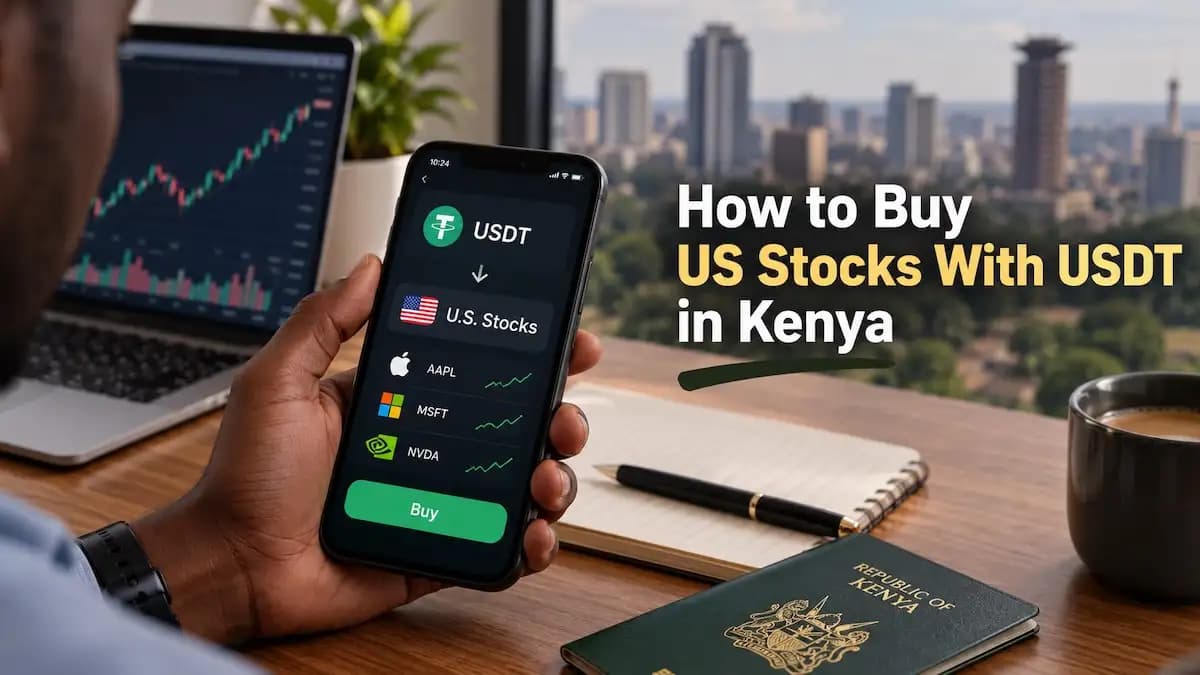
Yes. Kenyan investors who already hold USDT generally have two routes. The first is to use an eligible platform that accepts USDT as funding for real U.S.-listed shares. The second is to convert USDT to fiat and fund a conventional international broker.
- Depending on the platform, USDT can remove the need to send Kenyan shillings through an international bank transfer.
- Confirm what you own before you trade. Real shares, tokenized exposure and stock futures carry different rights and risks.
- Kenya’s Virtual Asset Service Providers Act, 2025 took effect on November 4, 2025, and the VASP Regulations, 2026 have since been gazetted to put its licensing regime into operation.
- Crypto regulation in Kenya does not mean every foreign securities product is licensed or available locally.
- Compare the total cost of buying, transferring, trading and withdrawing, not only the headline commission.
The phrase covers two funding paths. Both can end in real U.S. equity exposure, but they differ in cost, speed and the providers involved.
The investor transfers USDT into a stock-account balance, where it becomes buying power. A securities broker executes the purchase, and the position represents a whole or fractional share held under the provider’s custody structure. MEXC’s RealStocks FAQ describes this model: the shares are acquired through licensed brokerages, and holders may receive dividends when a listed company distributes profits.
The alternative is to sell USDT for KES or another supported currency and send the proceeds to a conventional brokerage account. This route fits investors whose preferred broker does not accept crypto. It adds exchange spreads, withdrawal fees and possibly international banking charges.
| Product | What you own | USDT funding possible? | Dividends/shareholder rights | Leverage | Main purpose |
| Real U.S. shares | Equity interest through a brokerage/custody structure | On some platforms | Potentially, where applicable | Usually no | Investing/holding |
| Tokenized or synthetic stocks | A token or contract tracking a stock | Often | Depends on the product; not necessarily | Varies | Price exposure |
| Stock futures/perpetuals | A derivative contract | Often | No direct shareholder rights | Often | Trading/hedging |
A ticker ending in USDT tells you the quote or settlement currency. It does not tell you whether you own the stock. WEEX is a clear example: its stock pages say its stock contracts let users trade price movements without owning the underlying shares, and its guides state that these products carry no voting rights or dividends. In this guide, “buy” means acquiring real shares. Leveraged futures can magnify losses as well as gains.
Platform Availability and Verification
Confirm that the provider accepts Kenyan residents for its stock product specifically, not only for its crypto services. MEXC, for example, notes that its stock service is offered only in certain jurisdictions and may be restricted by local law. Check which identity documents are accepted and whether you need proof of address. Do not assume a platform is approved by the Capital Markets Authority (CMA) unless the CMA’s own records confirm it.
Kenya’s Crypto Regulatory Framework
The VASP Act makes the Central Bank of Kenya and the CMA responsible for licensing and supervising virtual asset service providers, each for its allocated services. Providers already operating in Kenya have until November 4, 2026 to comply. This framework covers virtual-asset activity. Custody of U.S. shares falls under the securities rules that apply to the executing broker, which may sit outside Kenya.
If you already hold USDT, move to Step 2. If you are buying it with KES, work out the effective rate you pay rather than relying on the advertised fee. The P2P or platform spread, M-Pesa or payment charges, the KES/USDT rate and any withdrawal fee all count toward it. P2P trading also carries counterparty and fraud risk, so use escrow-protected marketplaces.
Check whether the service offers real shares, fractional shares, tokenized exposure, or CFDs and futures. If you want actual U.S. equity ownership, choose a product whose documentation states explicitly that you acquire real securities.
Expect to submit a government-issued ID, complete identity verification, possibly provide residence documents, and sign securities agreements. MEXC describes a KYC-based onboarding in which users accept the RealStocks trading agreement and submit onboarding documents before opening the account.
Many platforms keep the crypto wallet separate from the securities account. On MEXC, users move funds from their Spot account into the RealStocks account using a fund transfer. The shares are then priced in USD rather than traded as AAPL/USDT-style pairs. Review the conversion mechanism and any displayed charges before you confirm.
Search by ticker. Apple (AAPL), Microsoft (MSFT), Tesla (TSLAUSDT) Nvidia (NVDA) and broad-market ETFs are illustrations, not recommendations. In August 2026, MEXC said RealStocks covered more than 7,000 U.S. stocks and ETFs. Catalogues change, so check availability on the platform.
A market order prioritizes execution, but the fill price can move. A limit order caps the price you are willing to pay. Before you confirm, check the quantity (including fractions), the estimated value, the trading session, the spread and any charges. “Zero commission” does not mean zero cost. MEXC clarifies that its zero-fee label covers only the platform service charge, and SEC, FINRA, exchange and clearing fees may still apply.
Make sure the position appears in the dedicated securities portfolio. Check how the provider handles dividends, splits, corporate actions and statements. For instance, MEXC credits eligible dividends in USDT to the RealStocks account and does not currently support dividend reinvestment. Keep your records for tax purposes.
Total effective cost = USDT acquisition cost + transfer/network fees + conversion/spread + stock-trading charges + withdrawal costs
Take a Kenyan investor starting with the KES equivalent of $1,000. On the direct route, most of the cost comes from buying USDT and from trading charges. On the fiat route, the same money may pass through a crypto sale, a bank transfer and a broker deposit, and each step has its own fee or spread.
| Cost stage | Direct USDT-funded stock route | USDT → fiat → broker |
| Acquire USDT | Possible | Possible |
| Blockchain withdrawal | Depends on transfer route | Usually required if moving platforms |
| Crypto-to-fiat conversion | Potentially avoided | Required |
| International bank transfer | Potentially avoided | May be required |
| Stock trading costs | Platform-specific | Broker-specific |
The lowest commission does not guarantee the lowest end-to-end cost. Fees change frequently, so compare the current schedule at each stage.
| Situation | Route worth considering |
| You already hold USDT | Direct USDT-funded real-share platform |
| Your money starts in KES | Compare M-Pesa/bank broker funding against the full cost of first buying USDT |
| You want a particular traditional broker | Convert USDT to supported fiat |
| You primarily want leveraged short-term exposure | A derivative may fit the objective, but it is not stock ownership |
| You want long-term equity ownership | Verify real-share ownership and custody structure |
If your savings are in KES and you already have inexpensive access to a conventional securities platform, buying USDT only to purchase stocks adds a conversion step you may not need. If your capital already sits in stablecoins, a USDT-funded route can skip the crypto-to-fiat exit and the international wire.
- Is the product a real stock, a token or a derivative?
- Is the service currently available to Kenyan residents?
- Which regulated entity executes and holds the shares?
- Can you buy fractional shares?
- How are dividends and corporate actions handled?
- What are the full USDT acquisition, transfer, conversion and trading costs?
- What withdrawal options exist?
- What happens if USDT temporarily deviates from $1?
- Have you reviewed current regional restrictions and securities disclosures?
If your capital is already in USDT, a USDT-funded real-share service can remove the friction of converting to fiat and arranging an international transfer. If you start with KES, compare the complete cost of that route against locally accessible fiat-funded services first. Whichever route you take, confirm what asset you will actually own before you place the trade.
For these and more stories, follow us on X (Formerly Twitter), Facebook, LinkedIn and Telegram. You can also send us tips or reach out at info@techarena.co.ke.


Comments
No comments yet. Be the first to share your thoughts.