
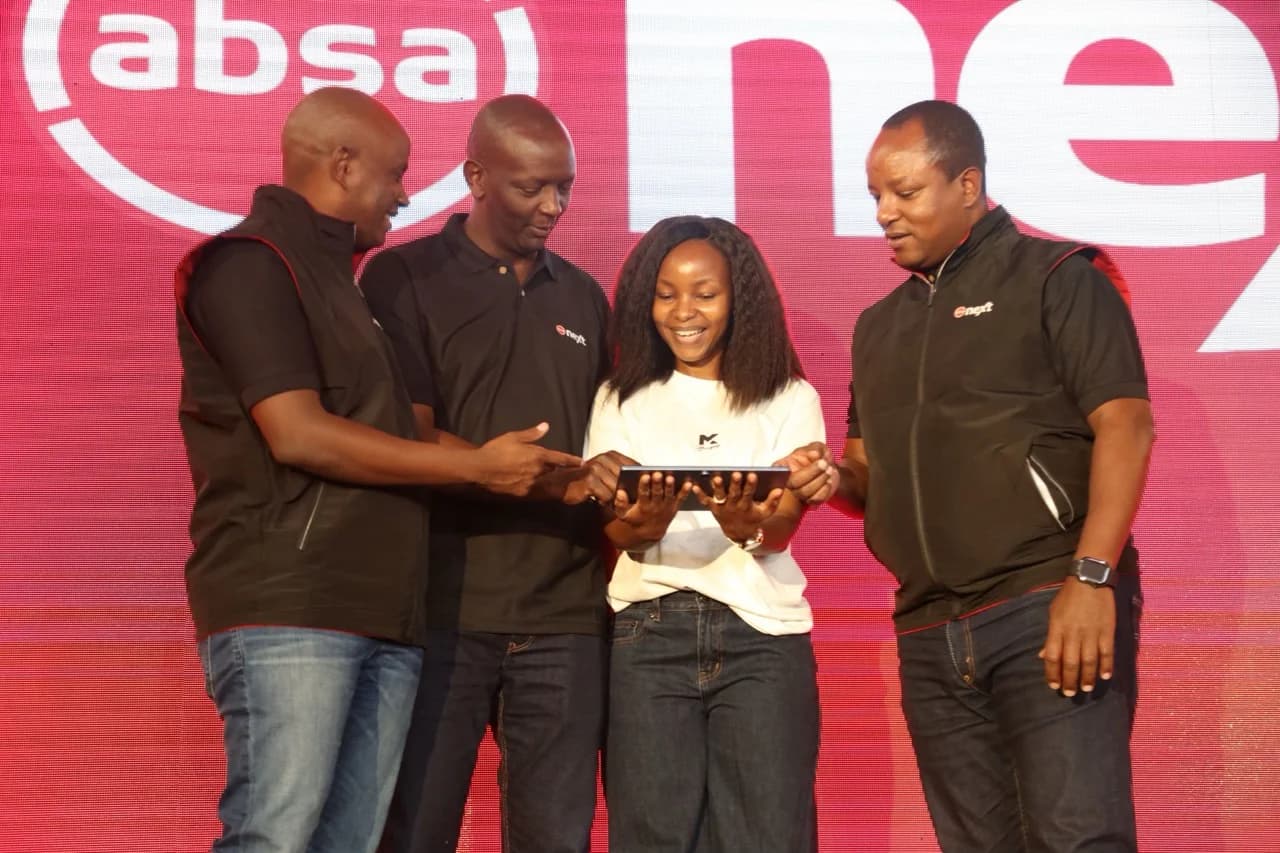
Absa Bank Kenya launched Absa Next, a phone app for saving, investing, borrowing and splitting bills. You don’t need an Absa account to use it. Loans run from KES 500 to KES 1 million. Savings earn up to 7% a year, and Absa says its investments return up to 16%. Absa calls it Kenya’s first integrated digital financial solution.
Absa Next is a separate app from the main Absa Kenya banking app. You open an account inside it with a Kenyan national ID, and that’s the only document it asks for. Passports don’t work for registration yet. The app is on Google Play and the App Store.
- Save on your own or with a group, such as a chama, at up to 7% a year. A chama is an informal savings group whose members pool money.
- Invest, with returns of up to 16% on Absa’s figure.
- Borrow from KES 500 to KES 1 million for personal or business needs.
- See your personal and business money on one dashboard.
- Link Visa cards from Absa and other banks, and top up the account from them.
- Split a bill with friends or family.
- Send money to other banks over Pesalink, the instant bank-to-bank transfer service, and pay Till, PayBill and Pochi la Biashara numbers.
- Withdraw cash at any Absa ATM.
- Earn Next Coins on some transactions. The app turns them into cash once a month.
There are also savings goals with game-style rewards, and a feature that pulls your accounts at other banks into the same view.
“Up to” means 7% is the top savings rate. The release doesn’t say what balance or lock-in period gets you there. Say you did get the full 7% on KES 10,000 for a whole year. That’s KES 700 in interest. Kenya takes 15% withholding tax on bank interest, so you’d keep KES 595.
The 16% is harder to place. The release doesn’t name the investment product, say whether 16% is a past return or a forecast, or give a time period. For scale, the government’s one-year Treasury bill paid 9.04% at the Central Bank of Kenya’s auction on 24th September. Treasury bills are short-term loans you make to the government. A money market fund, which we explained when we walked through opening one, mostly holds that kind of short-term debt.
Absa’s own chief executive, Yusuf Omari, said in July that Treasury bill rates had fallen from 16% to about 8% within a few months of January. A 16% return now would be almost seven percentage points above what the government pays for a year’s money.
For the loans, the release gives the range and nothing else. There’s no interest rate, fee or repayment period. Absa decides who qualifies partly through alternative credit scoring. Instead of checking only your loan history at a credit bureau, the lender also looks at other signs of how you handle money. Absa hasn’t said which data it uses.
Absa says Absa Next uses open banking to show your accounts at other banks. Open banking means you give one app permission to read your account data at another bank, through a direct connection between the two.
Kenya doesn’t yet have a law requiring banks to share that data. The Central Bank of Kenya and the National Treasury only published a draft National Payment System Bill on 21st September 2026. It would create a licence for “account information service providers”, the firms that pull your accounts into one view. Public comments close on 9th October 2026. Absa hasn’t named the banks or wallets Absa Next can read from today.
Absa already runs Timiza, a mobile wallet on *848# and an app. Timiza lends to Absa and non-Absa customers alike, and its goal savings account pays up to 6% a year, credited quarterly. Absa Next pays up to 7%. NCBA has had its Loop app since 2017, and we wrote about it in 2024 after it became a company separate from the bank. So “first” is Absa’s own description.
In July, while he was still interim chief executive, Omari promised “a digital-only platform” before the end of the year. He described it as “an entire, fully fledged bank that offers savings, lending, investing and insurance”. Absa Next covers three of the four. There’s no insurance product in the launch. Omari was confirmed as chief executive on 10th September.
Sitoyo Lopokoiyit also spoke at the launch. He ran M-PESA Africa at Safaricom until February and became Absa Group’s chief executive for personal and private banking in April, as we reported when he was appointed. Lopokoiyit said Kenya’s record in financial innovation made it the natural market to build Absa Next in. Absa built the app in Kenya on cloud servers and plans to use it as the template for digital banking in other Absa Group markets. It didn’t name those markets or give dates.
So if you have a Kenyan ID, you can open Absa Next from your phone today without visiting a branch or holding an Absa account. Before you borrow, check the interest rate and fees the app shows you, because the release gives neither. Before you invest, find out which product pays 16% and over what period.


Comments
No comments yet. Be the first to share your thoughts.