
Domestic sources are expected to provide 19 per cent, equivalent to $2.1 billion (Sh273 billion) annually, with the balance coming from international support.
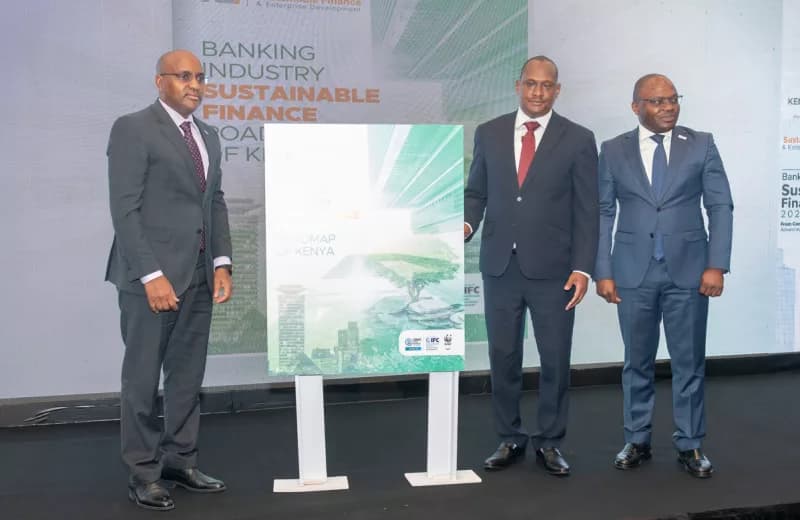
Kenya Bankers Association chairman and KCB Group CEO Paul Russo, NETFUND chief executive Samson Toniok and KBA chief executive Raimond Malonje during the KBA Sustainable Finance Summit and launch of the Banking Industry Roadmap to accelerate sustainable finance/ HANDOUT

BANKS in Kenya are under pressure to identify bankable projects while addressing high investment risks and unsuitable lending to unlock Sh7.3 trillion in climate financing over five years.
According to an industry study, banks must develop innovative financing products, strengthen project preparation and mobilise partnerships to unlock sustainable investments.
This, as Kenya launches the Banking Industry Sustainable Finance Roadmap 2027–2037.
The roadmap identifies inadequate feasibility studies, limited borrower information, insufficient collateral, unpredictable cash flows and high project preparation costs as key barriers preventing sustainable investments from attracting financing.
Kenya’s Nationally Determined Contribution (NDC) 3.0 estimates climate financing needs at approximately $56 billion (Sh7.28 trillion) between 2031 and 2035, translating to an average of $11.2 billion (Sh1.46 trillion) annually.
The Kenya Bankers Association (KBA) says banks, which hold more than 90 per cent of financial sector assets, will play a critical role in mobilising capital towards the country’s sustainable development priorities.
However, uncertainty over project performance, technology, weather-related risks and execution continues to discourage lenders, while conventional loan tenors, pricing and collateral requirements often fail to accommodate green investments.
The roadmap proposes developing bankable project pipelines, introducing development finance institution-backed guarantees and blended financing facilities, and expanding innovative lending products for agriculture and micro, small and medium-sized enterprises (MSMEs).
A project preparation facility is also proposed to screen priority investments, fund pre-feasibility studies and connect projects with investors.
Speaking during the roadmap launch in Nairobi, yesterday, KBA chairman and KCB Group chief executive Paul Russo said the industry must move beyond sustainability commitments to practical implementation.
“The challenge before us is not simply to agree that sustainable finance matters. We must determine how to make it work in practice,” Russo said.
He noted that Kenya has opportunities in renewable energy, agriculture, transport, infrastructure and MSMEs, but the existence of investment opportunities does not automatically translate into bankable projects.
“We must therefore strengthen project preparation, improve the availability of reliable data, build institutional capacity and explore financing structures that can make viable projects more attractive to lenders and investors,” he said.
The roadmap proposes expanding agricultural financing through cooperatives and anchor buyers, supported by seasonal repayment arrangements, agricultural insurance and technical assistance to reduce lending risks.
For MSMEs, standardised small-ticket loans targeting solar energy, energy efficiency, clean cooking and productive equipment could improve access to sustainable financing.
KBA chief executive Raimond Molenje said the framework would help banks integrate sustainability into governance, risk management, reporting and capital allocation.
He said the industry had recorded an 83 per cent compliance rate with climate-related risk disclosure requirements, but institutions needed to ensure the information informs lending decisions and portfolio management.
The roadmap also proposes a shared market intelligence system to collect anonymised data on financing volumes, pricing, portfolio performance and realised impact, helping policymakers identify areas requiring targeted incentives or public investment.
Implementation is expected to begin in 2027, with a foundation phase running through 2032, followed by scale-up and consolidation towards 2037.
Environment PS Festus Ngeno, in his speech read by National Environment Trust Fund CEO Samson Toniok, said environmental protection should be treated as a core economic priority, requiring stronger collaboration between government, financial institutions, investors and development partners.
The roadmap was developed by KBA through its Centre for Sustainable Finance and Enterprise Development, in partnership with the International Finance Corporation and WWF-Kenya.
IFC regional director for Eastern Africa Mary Porter Peschka said the framework would help mobilise capital towards sustainable development priorities, while WWF-Kenya chief executive Jackson Kiplagat called for measurable institutional action.
The central challenge remains translating Kenya’s climate ambitions into commercially viable projects that can attract private capital while delivering measurable economic and environmental benefits.
Comments
No comments yet. Be the first to share your thoughts.