
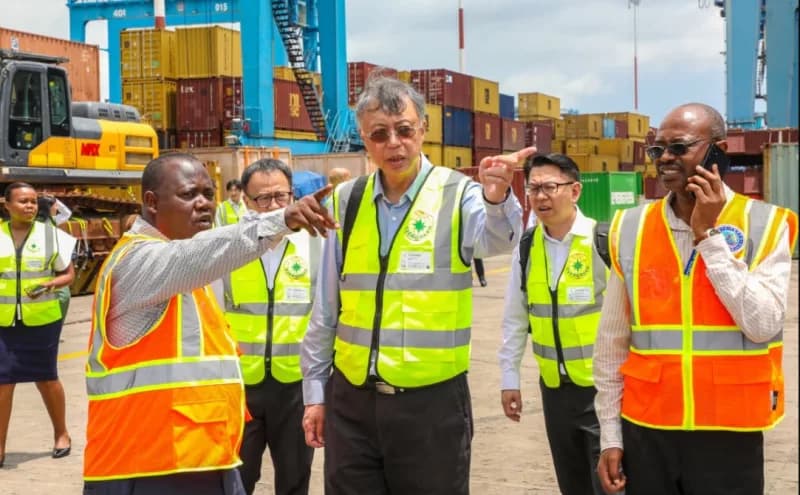
KPA General Manager Cargo Operations Sudi Mwasinago with Evergreen President K. H. Wu, Evergreen's agent-Gulf Badr chairman Bahaa Badr and other officials during a business tour of the Port of Mombasa/ KPA

KENYA is expanding its port infrastructure and eliminating trade bottlenecks as global shipping lines increase interest in the country's maritime network.
This comes at a time when there is growing competition from Tanzania for regional cargo.
The Kenya Ports Authority is advancing expansion projects at the Port of Mombasa to accommodate larger vessels and rising cargo volumes.
The latest global shipping lines, to show interest in Kenya is Taiwan's Evergreen Line which has renewed attention on the commercial opportunities emerging along the East African coast.
The world's seventh-largest container shipping line is investing in a new generation of vessels, including ultra-large ships capable of carrying 24,000 twenty-foot equivalent units (TEUs), with Mombasa among its major destinations in the Indian Ocean.
Last week, French shipping giant CMA CGM took the cargo battle inland with a dedicated rail freight service linking Kilindini harbour to Nairobi’s Embakasi Inland Container Depot (ICD)
Evergreen President K.H. Wu, accompanied by a company delegation and Bahaa Badr, chairman of Gulf Badr, the shipping line's agent, visited Mombasa this week for discussions on port infrastructure, operational capacity and the outlook for maritime trade.
The shipping line has ordered 23 feeder and medium-sized container ships and 11 liquefied natural gas (LNG) dual-fuel mega vessels, reflecting its strategy to expand regional cargo distribution and long-haul shipping.
Representing KPA chief executive William Ruto, General Manager Cargo Operations Sudi Mwasinago outlined the authority's expansion programme, including the imminent completion of Berth 19B.
The facility is expected to add approximately 300,000 TEUs (containers) to Mombasa's annual container handling capacity, while planned developments at Berths 23 and 24 will further increase the port's ability to handle growing cargo volumes.
“Mombasa remains the main maritime gateway for Kenya and the Northern Corridor, while the Port of Lamu offers additional capacity and a longer-term platform for regional trade, mainly transshipment,” Sudi noted.
KPA projects that combined annual cargo volumes across its ports will reach 168 million metric tonnes by 2045, compared with 45.45 million tonnes handled at Mombasa in 2025.
The projections underscore the importance of infrastructure investment as Kenya seeks to strengthen its position as a gateway for landlocked East and Central African economies.
Evergreen operates approximately 244 container ships with a combined capacity of 2.06 million TEUs, representing about 5.9 per cent of global container shipping capacity.
Top 10 container shipping lines (global ranking) are MSC (Mediterranean Shipping Company) (Switzerland) which has a 21.5 per cent share of global cargo, Maersk (Denmark) 13.5 per cent, CMA CGM Group (France) 12.9 per cent, COSCO Group (China) 10.6 per cent and Hapag-Lloyd (Germany) 6.9 per cent.
Others are ONE (Ocean Network Express) (Japan) with a 6.4 per cent share, Evergreen Line (Taiwan) 5.9 per cent, HMM Co Ltd (South Korea) three percent, Yang Ming Marine Transport Corp. (Taiwan) 2.2 per cent and Zim (Israel) with a two per cent share.
The infrastructure push comes as Kenya faces growing pressure to improve the efficiency of its trade corridors, with Tanzania increasingly attracting cargo through the Port of Dar es Salaam.
A recent report by the State Department for East African Community Affairs indicated Kenya was losing between five and eight per cent of high-value transit cargo annually, partly due to inefficiencies and non-tariff barriers along the Northern Corridor.
The 1,700-kilometre corridor, linking Mombasa to Uganda, Rwanda, Burundi, South Sudan and eastern Democratic Republic of Congo, handles more than 35.84 million metric tonnes of cargo annually and accounts for over 80 per cent of Kenya's transit trade.
It remains the region's main trade corridor with Tanzania (Dar es Salaam) serving the region through the 1,300 kilometre-long corridor.
A recent monitoring exercise found that persistent bottlenecks were undermining tye Northern Corridor's competitiveness, which Kenya has since moved to address, including reducing the number of roadblocks on the roads and speeding up cargo clearence.
According to EAC Affairs Principal Secretary Caroline Karugu said, the government has committed to reducing roadblocks to fewer than five gazetted stops, cutting Regional Electronic Cargo Tracking System response times from four to six hours to less than one hour, and restoring transit times to between 36 and 48 hours.
Reducing delays by half is estimated to save transporters between $288 (Sh37,172) and $360 (Sh46,465) per trip, while eliminating delay-related barriers could generate annual national savings of between $43 million (Sh5.6 billion) and $54 million (Sh6.9 billion).
Comments
No comments yet. Be the first to share your thoughts.