
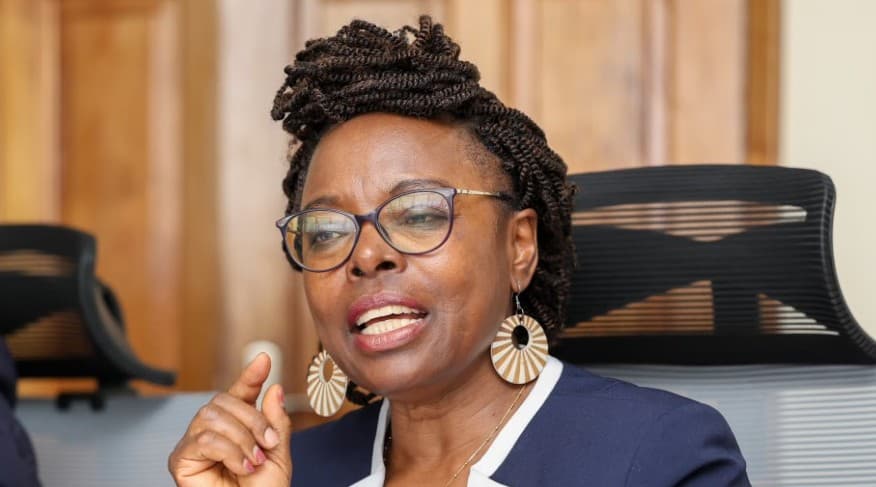
Development projects lag as salaries, debt payments consume Sh13.17 trillion in three years

A new report by the Controller of Budget (CoB), Margaret Nyakang’o, has revealed that only Sh1.47 trillion of the Sh14.6 trillion approved for withdrawal over the past three financial years was set aside for development projects
Development projects are lagging behind as national and county governments continue to spend the bulk of public funds on salaries, debt payments and other recurrent expenses.
A new report by the Controller of Budget (CoB), Margaret Nyakang’o, has revealed that only Sh1.47 trillion of the Sh14.6 trillion approved for withdrawal over the past three financial years was set aside for development projects, with the remaining Sh13.17 trillion going towards recurrent expenditure.
The report, covering the period between July 2023 and June 2026, shows that the national and county governments received approval to withdraw the funds from the Consolidated Fund and the 47 County Revenue Funds (CRFs) through more than 33,000 requests.
The approvals were issued before the money could be spent, as the law requires the Controller of Budget to authorise withdrawals from the official accounts of both levels of government.
Nyakang’o approved the highest amount, Sh6.69 trillion, in the financial year ending June 2026, up from Sh4.06 trillion in 2024/25 and Sh3.89 trillion in 2023/24.
A breakdown of the spending approvals shows that recurrent activities took the largest share, with Sh7.57 trillion allocated to expenses such as salaries, allowances, official travel and the running of government offices.
Latest Stories
- Muturi turns up heat on Gachagua as opposition divisions threaten 2027 State House bid
- Colorectal cancer drug linked to rare skin condition that mimics potentially deadly skin cancer
- Forgotten flint tools in museum boxes reveal how Egypt’s early farmers paved way for pharaohs
- No strong evidence testosterone therapy improves menopausal brain fog, study finds
Another Sh5.59 trillion was approved under Consolidated Fund Services (CFS), which caters for the national government’s maturing public debts, interest payments and pensions.
In her report, Nyakang’o said all the requests submitted for withdrawals from the Consolidated Fund during the period were processed and approved.
“Over the MTEF period, 1,799 requisitions to withdraw funds from the Consolidated Fund were submitted to the COB. All these requisitions were processed, and approval for withdrawal was granted,” reads the report.
She also disclosed that the requests were handled within a short period, with most taking about a day to process.
“In the Medium-Term Period, from Financial Year 2023/24 to FY 2025/26, cumulative requisitions from the consolidated fund amounted to Sh14.4 trillion. On average, the consolidated fund requisitions were processed within a day,” the CoB said.
For county governments, the approval of funds involves two stages. The first allows the transfer of the equitable share of national revenue from the Consolidated Fund to the respective County Revenue Funds, while the second authorises counties to withdraw the money into their operational accounts.
During the three years, Nyakang’o approved the transfer of Sh1.19 trillion in equitable share allocations to the 47 CRFs. She then authorised the withdrawal of Sh1.43 trillion from the county funds to the respective operational accounts.
The Sh1.43 trillion comprised both transfers from the national government and revenue collected directly by county governments.
Counties submitted 31,517 requests seeking approval to move money from their official accounts to operational accounts. The highest number of applications, 12,276, was recorded in the 2025/26 financial year.
However, 606 of the requests were rejected over concerns involving financial procedures, tax deductions and compliance with public finance regulations.
“However, 606 of these requisitions were declined for various reasons, including inappropriate templates inconsistent with established exchequer guidelines, payments processed to the IB Level in bulk rather than directly to the beneficiaries’ accounts, non-adherence to the pending bills payment plan, non-deduction of applicable withholding taxes, administration costs for county-established funds exceeding the 3 per cent threshold required by PFM Regulations, and failure to follow the First In, First Out criteria in settling pending bills,” Nyakang’o noted.
The report cautions that approved withdrawals do not necessarily represent the exact amounts eventually spent by government agencies, since some institutions may fail to use all the funds authorised for them.
Consequently, actual expenditure may differ slightly from the approved amounts.
Nevertheless, the figures offer an indication of government spending priorities over the three financial years, with recurrent activities and debt servicing accounting for the largest share of public resources while development projects received a smaller portion.
Comments
No comments yet. Be the first to share your thoughts.