
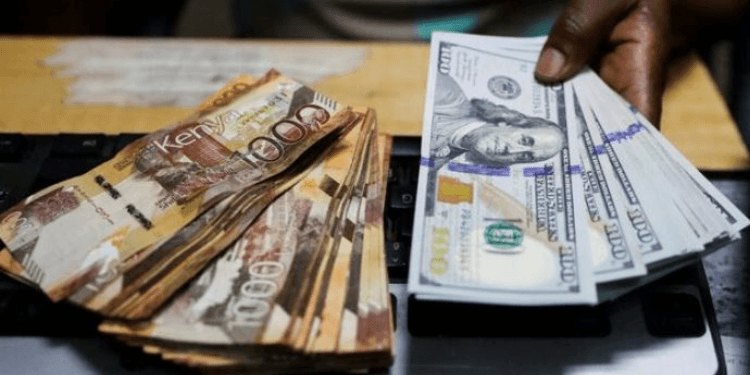
The Kenya shilling remained stable against the US dollar at the start of the trading week, exchanging at Ksh129.27 on Monday, July 20, as the country’s foreign exchange reserves continued to strengthen amid rising diaspora remittances.
Data released by the Central Bank of Kenya (CBK) showed the shilling trading at Ksh129.27 against the greenback, compared to Ksh129.34 recorded on July 16 and Ksh129.22 a week earlier, indicating continued exchange rate stability despite global economic uncertainties.
The local currency also exchanged at Ksh174.10 against the Sterling Pound, Ksh147.94 against the Euro, and Ksh79.63 per 100 Japanese Yen.
Kenya Shilling Remains Stable Amid Rising Forex Reserves
The stability of the shilling comes as Kenya’s foreign exchange reserves increased to USD14.169 billion, equivalent to six months of import cover, up from USD14.127 billion reported a week earlier.
CBK said the reserves remain well above the statutory requirement of maintaining at least four months of import cover, providing a crucial buffer against external shocks and supporting the country’s ability to meet its international payment obligations.
The latest monetary developments bulletin released by the regulator noted that the foreign exchange market continued to function in an orderly manner during the week ending July 16.
At the same time, inflows from Kenyans living abroad continued to support the country’s external position.
Diaspora remittances rose to USD394.2 million in May 2026 from USD342.2 million recorded in May 2025, representing a 15.2 percent increase.
Cumulative remittance inflows for the 12 months to June 2026 reached USD5.4 billion, compared to USD5.084 billion in the corresponding period in 2025.
According to CBK, remittance inflows remain an important source of foreign exchange earnings and continue to support Kenya’s balance of payments position.
Treasury Bills Attract Strong Demand
Investor appetite for government securities also remained robust during the week.
The Treasury bill auction held on July 16 received bids worth Ksh44 billion against an advertised amount of Ksh28 billion, translating to a performance rate of 157.3 percent.
Interest rates on the 91-day and 182-day Treasury bills declined during the auction, while the yield on the 364-day paper increased marginally.
The strong subscription underscores sustained investor confidence in government securities as investors continue to seek relatively safe investment instruments in the domestic market.
Meanwhile, the money market remained liquid, supported by CBK’s open market operations.
Commercial banks held excess reserves averaging Ksh24 billion above the required Cash Reserve Ratio, while the Kenya Shilling Overnight Interbank Average (KESONIA) rate remained unchanged at 8.75 percent.
Stock Market Posts Gains
At the Nairobi Securities Exchange (NSE), key market indicators recorded gains during the week ending July 16.
The NSE All Share Index (NASI) increased by 1.82 percent, while the NSE 20 Share Index and NSE 25 Share Index rose by 2.41 percent and 1.26 percent, respectively.
Market capitalization also increased by 1.82 percent as investor sentiment improved.
Equity turnover advanced by 32.57 percent during the week, while the volume of shares traded rose by 22.83 percent.
However, activity in the bond market slowed, with bond turnover in the domestic secondary market declining by 7.89 percent.
Globally, inflationary pressures eased further.
United States inflation fell to 2.4 percent in June from 2.5 percent in May, while Euro Area inflation declined to 2.6 percent from 2.8 percent.
The U.S. Dollar Index weakened by 0.14 percent during the week, while Murban crude oil prices rose to USD75.27 per barrel from USD72.57, reflecting heightened geopolitical tensions in the Middle East.
Follow our and X Account for real-time news updates.



Comments
No comments yet. Be the first to share your thoughts.