

Eastleigh building collapse leaves traders counting losses as customers abandon busy streets

Traders report sharp drops in daily sales as fear keeps customers away and the slow rescue operation enters its sixth day.
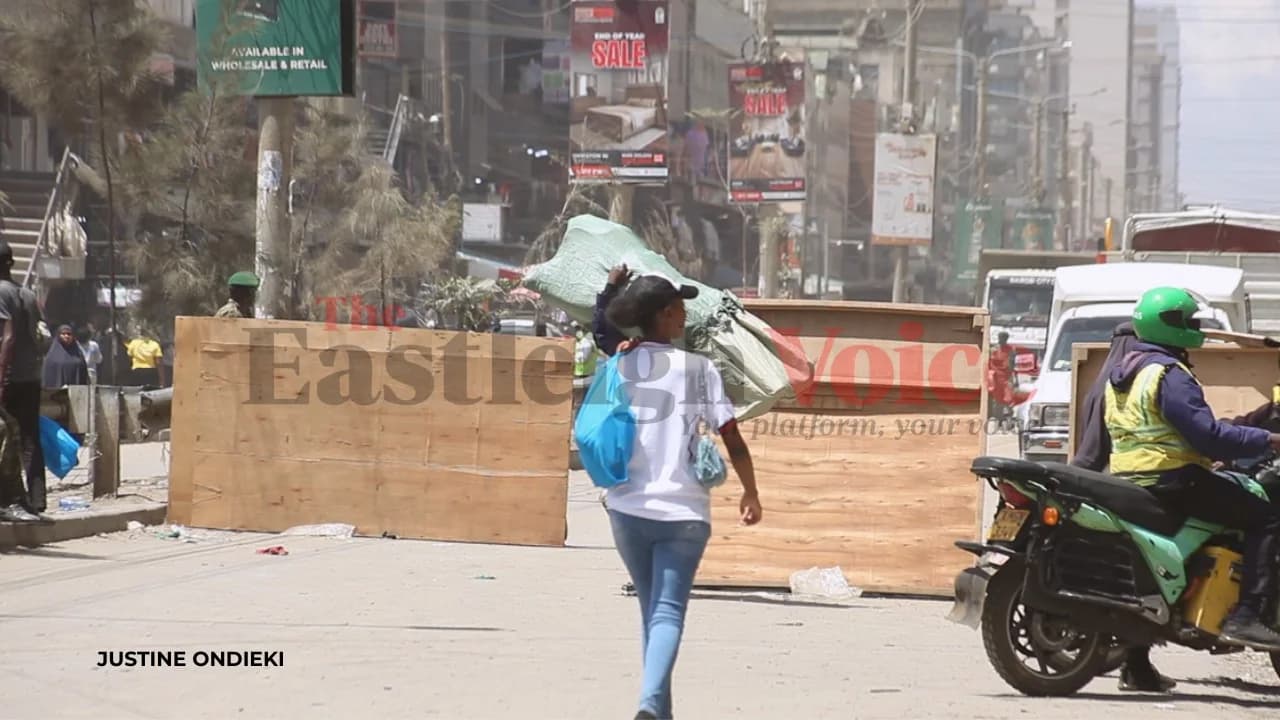
Traders operating along Eastleigh’s busy streets are counting their losses following the collapse of a building, as fear and uncertainty drive away customers and disrupt businesses that depend on daily sales to survive.
As the rescue operation enters its sixth day, traders say the impact has spread beyond the immediate site of the collapse, with customers avoiding the affected streets, sales declining and business owners struggling to meet daily expenses.
For many small-scale traders, the disruption has raised concerns about how long they can sustain their businesses without a steady flow of customers.
James Musembi, a trader in the area, said business had deteriorated significantly since the incident, with customers afraid to visit shops for fear that another building could collapse.
“Even if you open your shop, there are no customers because people are afraid. They pass by without buying anything. If this continues, the business will not be profitable,” Musembi said.
He said the situation had left traders worried about their livelihoods, particularly those who depend entirely on daily earnings to support their families.
Latest Stories
- Egypt orders closure of independent news site Mada Masr
- Ruto seeks expanded labour mobility deal, urges Russia to open doors for 30,000 Kenyan workers
- Okoth sinks former club as Gor Mahia edge Homeboyz to maintain FKF Premier League perfect start
- Former EACC CEO Halakhe Waqo, NACADA boss Anthony Omerikwa among nine candidates on IEBC CEO shortlist
Musembi also called on authorities responsible for approving building plans and supervising construction to ensure that structures meet the required safety standards before construction is authorised.
He said the collapse had affected not only businesses operating inside the building but also traders in neighbouring premises who were now struggling to attract customers.
Muhyiddin Abdi, who works along Ninth Street, said the incident had left him and other workers uncertain about their financial future.
“We have been greatly affected. We have no work, and the shops are closed. We have lost our morale, and I do not know how long we can survive like this,” Abdi said.
He appealed to the government to support affected workers and traders through rent assistance as they try to recover from the disruption.
“If the government could pay our rent for one month, it would help us a lot,” he said.
For Purity Wambui, who operates a small business along Second Avenue, the decline in customers has translated into a sharp drop in daily earnings.
Wambui said her business previously generated more than Sh1,000 a day, but since the collapse, she sometimes struggles to make even Sh500.
“We have lost a lot of money. Before, we could make more than Sh1,000, but now we cannot even get Sh500. We come to work, but we do not make enough money,” she said.
She said small businesses such as hers rely on regular customers and daily sales to remain operational. However, the reduced flow of people has made it increasingly difficult to sustain her business.
Wambui said traders were also working under constant uncertainty, unsure how long the disruption would last or when customers would return. She said the situation remained tense, with traders worried they might have to abandon their businesses and flee if conditions worsened.
“We are working under tension because customers are not coming, and if things get worse, we have to run. The process is very slow, and we keep wondering how long this will take,” she said.
She warned that prolonged disruption would deepen their financial losses and make it harder to support their families, noting that traders were spending entire days at their shops without making meaningful sales.
“If this continues, the losses will be enormous for us and our families. We come here and spend the whole day, but business is not moving,” Mburu said.
Kamukunji MP Yusuf Hassan at the site of the collapsed building along 9th Street in Eastleigh, Nairobi. (Photo: Yusuf Hassan/Facebook)Another trader questioned the procedures used to approve building construction, saying authorities should ensure all projects meet the required standards before work begins.
He said traders were bearing the cost of the disruption despite having no direct role in the building's construction.
Mwangi added that although some customers continued visiting the area out of curiosity to see the collapsed structure, many left without making purchases.
“People come in the morning, but we can go the whole day without getting buyers. They come, see what has happened and leave. Business has become very bad,” he said.
He warned that continued disruption could make it difficult for traders to keep their businesses running.
The collapse has also raised concerns about the safety of other buildings in the area, with traders fearing that the possibility of further demolitions or structural failures could continue to discourage customers from returning.
For small-scale business owners, the consequences are immediate. Daily sales enable them to pay rent, replenish stock, meet household expenses and support their families. However, these financial obligations remain even as their incomes decline.
The traders are calling for stronger oversight of construction projects and accountability from those responsible for enforcing building safety standards.
They say preventing similar incidents is essential not only to protect lives but also to safeguard the livelihoods of businesses and workers who depend on the continued activity of Eastleigh’s commercial streets.
Nancy Mburu, a small-scale clothes trader, said she was at work when the building collapsed at around 1 pm on Friday. She recalled seeing a cloud of dust but initially thought it was a theft incident. She and other traders then began closing their shops and leaving the area.
“We saw dust everywhere and thought there were thieves. We started closing our shops and left. We did not come back on Saturday, but when we returned on Sunday, there were many people in the area, although there was also tear gas,” Mburu said.
She said business had remained slow since the incident, with customers who normally visit the area to buy clothes staying away.
Nancy Mburu, a clothes trader in Eastleigh, says the building collapse has disrupted business, costing her at least Sh10,000 in lost sales over six days. (Photo: Justine Ondieki)Mburu estimated that she had lost at least Sh10,000 in sales over the six days, a significant setback for a small-scale trader who relies on daily earnings.
“When there is chaos, we have to leave, and business becomes very slow. The people who come to buy clothes are the ones we depend on, but now business is down,” she said.
She appealed to authorities to speed up the rescue operation, saying the disruption had lasted longer than traders had anticipated.
“Let them bring in more people to help with the rescue. This has taken longer than we expected,” she said.
MP raises alarm over slow rescue operation
Meanwhile, Kamukunji MP Yusuf Hassan has warned that time is running out to rescue people believed to be trapped beneath the collapsed Eastleigh building, urging the national and county governments to deploy additional resources to speed up the operation.
Speaking on Tuesday after visiting the site, Yusuf said although the rescue operation had made some progress, emergency teams needed to intensify their efforts to reach those believed to be trapped in the lower basement.
The operation has entered its sixth day, with rescue efforts progressing slowly and no one having been pulled from the rubble since Saturday. The delay has heightened anxiety among families waiting for news of their loved ones.
“I am worried that we have reached the end of the journey because if we cannot get to the bottom of that building and rescue people, then it will be a big problem,” he said.
Kamukunji MP Yusuf Hassan (right) speaking to rescuers at the scene of the collapsed Eastleigh building on October 27, 2026. (Photo: X/Yusuf Hassan)Yusuf said he had witnessed increased activity at the site compared with his visit on Monday night, raising hopes that rescue teams could make further progress.
He urged the national and county governments, together with agencies involved in the operation, to provide additional equipment, personnel and other resources to help rescuers reach those still believed to be trapped beneath the rubble.
The slow pace of the search has heightened uncertainty for families awaiting answers, while traders and other workers in the surrounding area continue to grapple with the economic consequences of the collapse.
Yusuf warned that further delays could reduce the chances of finding survivors, calling for urgent action to ensure rescuers reach the deepest sections of the collapsed building.


Comments
No comments yet. Be the first to share your thoughts.