
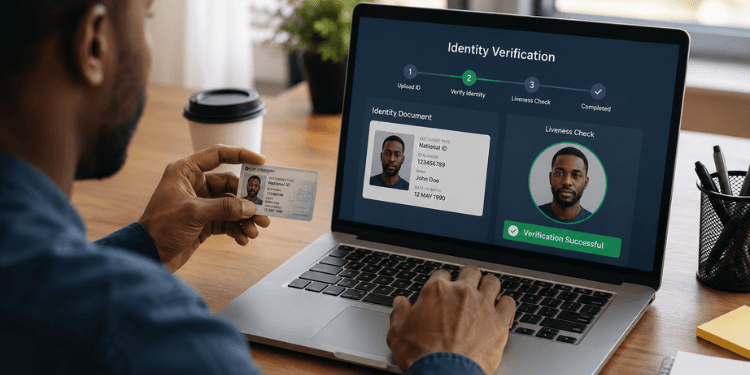
If you create online accounts more often, you might have noticed how much faster everything has gotten. Opening a digital bank account, joining a trading platform, or signing up for an online store used to mean waiting days for identity verification.
Now it takes minutes. But while it got easier for regular folks, the people trying to commit fraud got a lot more creative. Cybercriminals are using deepfakes, completely made-up identities, and AI-powered attacks to fool the old security measures.
This trend is popping up everywhere. AI is transforming all sorts of industries, and fraud is a major target. But the platforms people rely on every day are starting to fight back.
They are rolling out smarter verification systems that spot the fakes without slowing things down for people who are actually supposed to be there.
Automated Identity Verification Has Become a Core Piece of Online Security
A big change has taken place in the way online platforms handle their customers. Confirming someone’s identity is no longer just a boring compliance task.
It has become one of the most important ways to protect both the business and the people who use it from increasingly sophisticated fraud.
The FICA South Africa guide by Casino.com explains how identity and proof-of-address checks help online operators meet verification requirements before customers can access certain services.
While the guide focuses on South Africa’s FICA framework for online casinos, it also highlights a broader trend across the digital world.
Identity verification is becoming a normal part of safe online onboarding, not something limited to financial services or regulated gaming sites.
Old manual methods were just too slow and painful, and change had to come. Users want things fast and smooth, and automated systems have stepped up to deliver. AI gets a lot of the credit from industry experts for driving that success.
Traditional roles have been scaled back significantly, and tools like OCR software have taken their place. Instead of having customers upload documents for a human to go through, AI-powered software now scans government IDs in a matter of seconds.
Artificial Intelligence Is Making Document Checks More Reliable
Alongside the decline of manual inspections, artificial intelligence has also become far more prevalent throughout today’s digital environment.
Modern identity verification extends well beyond simply reading the information printed on an identity document.
Rather than delivering an immediate decision, these systems examine numerous security features before determining whether a document should be trusted.
Within seconds, advanced verification tools analyze holograms, watermarks, specialized fonts, microprinting, document layouts, and embedded security patterns that would traditionally require much closer inspection.
A hardly surprising development, given how rapidly document fraud continues to evolve, these additional checks allow organizations to identify suspicious applications far more effectively than older verification methods.
Document liveness detection has also become increasingly common. Instead of accepting a photograph or digital copy alone, the technology helps confirm that an actual physical document is being presented throughout the verification process.
As digitally manipulated documents continue to gain momentum, this additional layer of protection has become increasingly valuable for almost all organizations seeking to strengthen their overall security.
Biometric Verification Continues to Strengthen Digital Trust
Alongside smarter document analysis, biometric verification has also become a more prominent feature of modern identity checks.
Rather than relying solely on the information in an identity document, many online platforms now compare a live selfie with the photograph on the customer’s identification.
Passive and active liveness detection add another layer of protection by helping verify that the individual completing the process is physically present, rather than relying on a deepfake video, synthetic image, or another type of spoofing attempt.
As AI-generated fraud continues to evolve, these technologies have naturally become more important across numerous digital services.
Industry experts increasingly argue that deepfake attacks pose an emerging threat to organizations responsible for securing customer accounts.
As a result, many identity verification providers now combine document authentication with biometric verification to strengthen trust throughout the onboarding process.
Rather than depending on a single security measure, layered verification is becoming increasingly prevalent as organizations respond to more sophisticated forms of identity fraud.
Faster Onboarding Doesn’t Have to Mean Weaker Security
You might think that speeding up onboarding automatically makes it less secure. But that is actually no longer true. You get the best of both worlds now because businesses use smart checks to let you in quickly and keep your info secure.
The new approach is to stop running every customer through the exact same verification steps. Instead, modern identity platforms consider a range of signals during sign-up.
Factors such as the device you use, your behavior on the site, the quality of your uploaded documents, biometric confidence scores, and recognized fraud indicators all play a role in determining whether you get access. People who seem low risk often get verified in under a minute.
Those who raise a few red flags might be asked to complete additional checks before proceeding. This lets businesses make sign-ups faster for most users without compromising on security.
Follow our and X Account for real-time news updates.




Comments
No comments yet. Be the first to share your thoughts.