
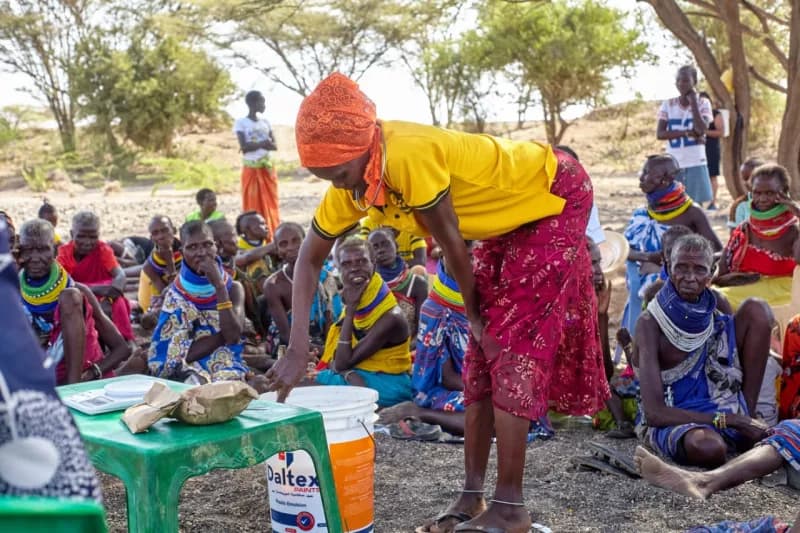
Women from Nayanaengikalalio village, Kawalase location receive training on liquid soap making courtesy of Ijuzi Dada Initiative/HANDOUT

For many women leaving prison, freedom comes with a difficult question: how will they rebuild their lives and survive in a society that may be reluctant to accept them?
Without reliable sources of income, business skills or social support, reintegration can be a daunting experience.
But for formerly incarcerated women such as Annette Njoki, skills training and mentorship have offered a chance to start again and discover new possibilities.
Njoki, who spent several years in prison, says her encounter with Cleanstart, an organisation supporting the reintegration of formerly incarcerated women, helped her rediscover her worth and potential.
“I was formerly incarcerated for a couple of years, and I bless the Lord for the reintegration I got back into society,” she said.
While in prison, Njoki met Cleanstart Chief Executive Officer Teresa, whom she affectionately refers to as “our gorgeous Mum”. Through the organisation's Ufunuo programmes, she began a journey of self-discovery and personal transformation.
“I was introduced to the Ufunuo programmes that really made me understand, appreciate and love myself. I forgave myself and discovered that great potential is inside me,” she said.
Her transformation continued when she met Tabitha Ndaka, founder of Ujuzi Dada Initiative, which equips women and young people, particularly in rural communities, with practical skills to help them earn a living.
Through the initiative, Njoki learned to manufacture detergents and fabric softeners, make scented candles and prepare pastries, including cakes, doughnuts and samosas.
She developed a particular passion for baking and now prepares cakes and pastries from home, selling them to customers in her neighbourhood.
Although she hopes to secure premises and expand her business, Njoki says the opportunity has given her renewed confidence and a sense of purpose.
She now leads Cleanstart's Kajiado chapter, known as Dolls with Goals, where she hopes to help other women rebuild their lives through skills and entrepreneurship.
Tabitha Ndaka, founder of Ujuzi Dada Initiative/HANDOUT

For Ndaka, Njoki's experience reflects the wider ambition of Ujuzi Dada Initiative, a non-profit organisation that provides practical economic skills and entrepreneurship training to rural women and young people.
Ndaka says she has trained more than 1,000 women across different counties, with some going on to establish businesses while others remain unable to start enterprises because they lack capital.
“I have trained more than 1,000 women in different counties. Some have started businesses, while others are not able to start because of capital,” she said.
She is appealing for support from donors and partner organisations to help trained women acquire the resources needed to turn their skills into sustainable businesses.
The initiative works with community-based organisations, which provide an organised structure through which groups can identify their needs and participate in training.
Ndaka said the process begins by understanding what each group wants to achieve, particularly where members are already involved in merry-go-round savings schemes and table banking but are seeking additional income-generating activities.
Beyond technical training, participants receive guidance on entrepreneurship, including business management, record-keeping, costing, pricing, branding and marketing.
“We walk with them on the entrepreneurship journey, following up until I see them stand by themselves,” she said.
She described the work of helping rural communities build sustainable livelihoods as fulfilling, despite challenges associated with limited resources.
Recently, Ndaka trained 180 women in Turkana, where participants were introduced to income-generating skills, including the manufacture of liquid soap.
Roselyne Akiru, a team leader representing women in Turkana, expressed gratitude for the training, saying it had introduced participants to new ways of earning a living.
She said the women, including those from Nayanaengikalalio village in Turkana Central, hoped the initiative would return to offer further training in products such as panga soap and other household essentials.
“We have started a journey of making liquid soap, and we pray for God to bring back Ujuzi Dada to teach us again on making panga soap and many more,” Akiru said.
Women in Meru receive training in yoghurt making/HANDOUT

In Machakos, Elizabeth Katilo has already turned her training into a source of income.
“I was earning a living by working on other people's farms, but I knew I wanted more,” she said.
After her women's group received training in home-care products manufacturing and culinary arts, Katilo established a laundry soap and handwash business. She also works as a school caterer.
“The skills, mentorship and continuous follow-up have transformed my life and my family's future,” she said.
For women such as Njoki and Katilo, the training has offered more than technical knowledge. It has created opportunities to earn an income, regain confidence and build a more secure future.

Comments
No comments yet. Be the first to share your thoughts.