
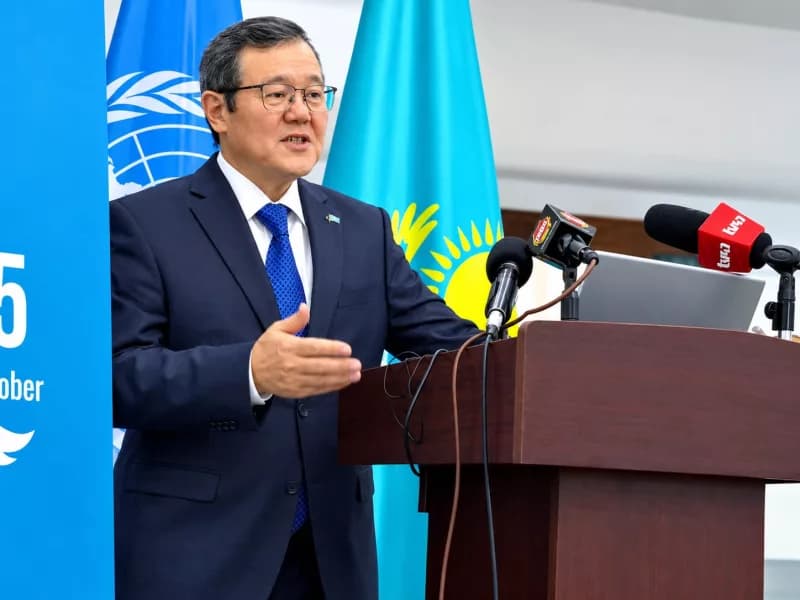
Sadykov said Kazakhstan was ready to facilitate Kenyan investors interested in the project, including through incentives available in its special economic zones
Kazakhstan Ambassador to Kenya Barlybay Sadykov during a press briefing at the embassy chancery on October 23. /JACKTONE LAWI

Kenyan tea and coffee exporters could establish processing and distribution hubs in Kazakhstan to expand access to Central Asian markets, as Nairobi seeks to deepen trade ties with the resource-rich economy.
Republic of Kazakhstan ambassador to Kenya Barlybay Sadykov, said the two countries had agreed to explore the establishment of tea and coffee hubs.
The proposed facilities would process, package and distribute Kenyan products across Kazakhstan and neighbouring markets, potentially opening new opportunities for exporters seeking to diversify their markets and capture more value from their produce.
“We are interested in increasing imports of Kenyan products, including tea, coffee, flowers and fruits,” he said during a briefing on Kenya-Kazakhstan relations.
The ambassador said the proposed hubs would help Kenyan businesses reach a wider regional market, including Central Asia and parts of the Eurasian region.
The latest update comes following president William Ruto’s visit to the middle Asian country in May 2026.
“Kazakhstan has a population of about 20 million, businesses could use the country as a gateway to a wider market spanning Central Asia and neighbouring economies,” added Sadykov.
He challenged Kenyan exporters to export directly rather than passing through Pakistan, arguing that direct trade could create opportunities for Kenyan exporters and processors.
“Instead of buying from Pakistan, why don't we buy it from Kenya? the proposed hubs can offer an opportunity for businesses to establish processing operations closer to their target markets.”
The proposal comes as Kenya seeks to diversify export destinations and increase the value earned from agricultural products.
The proposed processing hubs form part of a wider effort to expand commercial relations between the two countries.
Kenya and Kazakhstan signed 10 bilateral agreements during Ruto’s May visit, covering trade, finance, investment, transport, logistics, information and communications technology, mining, space technology, tourism and cooperation between diplomatic academies.
Despite the agreements, trade between the two countries remains relatively modest.
Sadykov put bilateral trade turnover at approximately $50 million (Sh6.5 billion), saying the current level did not reflect the commercial potential of the two economies.
He said Kazakhstan was seeking to diversify its imports from Kenya while offering Kenyan businesses access to new suppliers of agricultural inputs, industrial materials and other products.
The proposed exports from Kazakhstan include grain, fertilisers, petrochemicals, construction materials and processed food products.
Both countries are also considering establishing a bilateral business council and organising trade missions to connect companies and identify investment opportunities.
The ambassador said a July visit by a Kazakh business delegation had included meetings with Kenyan government officials and business representatives to advance cooperation in trade, investment, mining, transport and agriculture.
He urged businesses to take advantage of the agreements by pursuing specific commercial projects rather than relying on diplomatic engagement alone.
Kazakhstan eyes Kenya mining, port and fertiliser trade deals
Kazakhstan is exploring investment in Kenya’s mining sector and the use of Mombasa and Lamu ports to expand trade with East Africa, as the two countries seek to strengthen commercial ties.
Kazakhstan’s national mining company, Tau-Ken Samruk, signed a memorandum of understanding with Kenya’s National Mining Corporation during a presidential visit, Ambassador Sadykov said.
A Kazakh delegation visited Kenya in July for discussions with the Ministry of Mining and the National Mining Corporation. The company is evaluating mineral information and samples provided by Kenya to determine whether the opportunities justify investment.
Sadykov said any eventual agreement could cover mineral exploration, mine development or processing. He did not disclose the deposits under consideration or the potential investment value.
Kazakhstan is also considering using Mombasa and Lamu ports to move its goods into regional markets.
“Discussions with the Kenya Ports Authority included optimising transport routes and potentially establishing joint terminals, transport costs remaine a major barrier to trade, accounting for up to 40 per cent of the cost of goods on some routes,” said the Ambasador.
The two countries are also pursuing opportunities in grain and fertiliser supplies, with Kenyan businesses seeking links to Kazakh suppliers, including in the fertiliser and sulphur trade.
The Kazakh embassy is helping businesses establish contacts but has cautioned importers to verify suppliers to avoid online fraud.
“The current indicators of trade and economic cooperation do not meet the potential,” Sadykov said, calling for greater diversification of exports and imports.


Comments
No comments yet. Be the first to share your thoughts.