
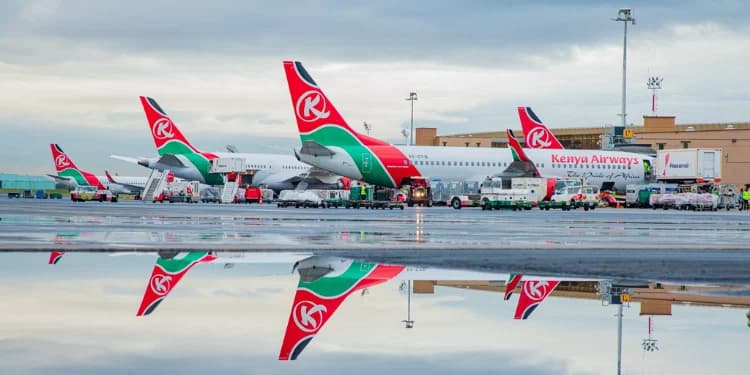
Kenya Airways (KQ) has recorded a Ksh16.08 billion net loss in the first half of 2026, worse than the Ksh12.154 billion loss in the same period in 2025.
The operating margin also deteriorated from negative 8.4 per cent to negative 13.1 per cent.
The rise in costs pushed the airline’s operating loss to Ksh10.64 billion, compared with Ksh6.24 billion in the first half of 2025.
Kenya Airways revealed that jet fuel prices increased by 66 per cent during the period, largely due to geopolitical tensions in the Middle East.
The increase drove a 32% rise in KQ’s fuel costs compared with the same period last year, with fuel accounting for about 32% of total operating expenses and 52% of direct operating costs.
At the same time, global supply chain disruptions continued to affect the airline’s operations, with shortages of critical aircraft spare parts, longer delivery times and delays in getting components limiting the availability of some aircraft.
“Collectively, these factors exerted sustained pressure on margins and overall network profitability,” said KQ chairman Kiprono Kittony.
Pre-Tax Loss Hits Ksh15.92 Billion
After accounting for other costs of Ksh5.33 billion and interest income of Ksh47 million, Kenya Airways recorded a pre-tax loss of Ksh15.92 billion.
This compared with a pre-tax loss of Ksh12.173 billion in the same period last year.
Taxation stood at Ksh152 million, resulting in a net loss of Ksh16.08 billion after tax.
The airline’s net margin stood at negative 19.8 per cent, compared with negative 16.3 per cent in the first half of 2025.
The airline also recorded stronger performance from its cargo business during the period.
Cargo revenue increased by 18 per cent to Ksh8.77 billion, according to the results.
The growth in cargo income contributed to the overall increase in total income as Kenya Airways continued to seek ways to strengthen revenue amid operational and financial challenges.
Despite the challenges, Kenya Airways said its underlying commercial performance remained encouraging, supported by strong demand and improved revenue generation.
Passenger traffic declined by nine per cent, but the airline recorded a four-percentage-point improvement in its cabin factor, indicating better utilization of available seats. The carrier also said it benefited from stronger average fares.
Kenya Airways Group Managing Director George Kamal said the airline had started restoring aircraft capacity after several planes were affected by maintenance and supply chain challenges.
A Boeing 787-8 Dreamliner resumed operations in mid-July 2026, while a Boeing 777-300ER was delivered and returned to service. The airline said both aircraft had been well received in the market.
Financial Pressure Continues
The latest results follow Kenya Airways’ return to losses in 2025 after a profitable 2024.
The airline had reported a Ksh12.15 billion net loss for the first half of 2025, reversing a Ksh513 million profit recorded in the corresponding period in 2024.
KQ recorded a net loss of KSh 17.2 billion for the full year ended December 2025, down from a profit of KSh 5.4 billion in 2024.
According to the airline’s March 24 report, the company experienced a 13% decline in passenger numbers and an 18% reduction in available seat capacity.
Follow our WhatsApp Channel and X Account for real-time news updates.




Comments
No comments yet. Be the first to share your thoughts.