
Fishmongering trade is one of Kenya’s fastest-growing businesses, especially along the shores of Lake Victoria, making it a vital economic pillar in Nyanza, where white meat is in demand.
People rarely talk about fishmongers, although fish is one of the most popular dishes in the Nyanza region, with the demand for white meat finding its way to majority of Kenyans’ kitchens.
The trade has evolved over time significantly from traditional open-lake sale of raw fish to a more professional venture of selling raw, dried, smoked and fried fish and other seafood.
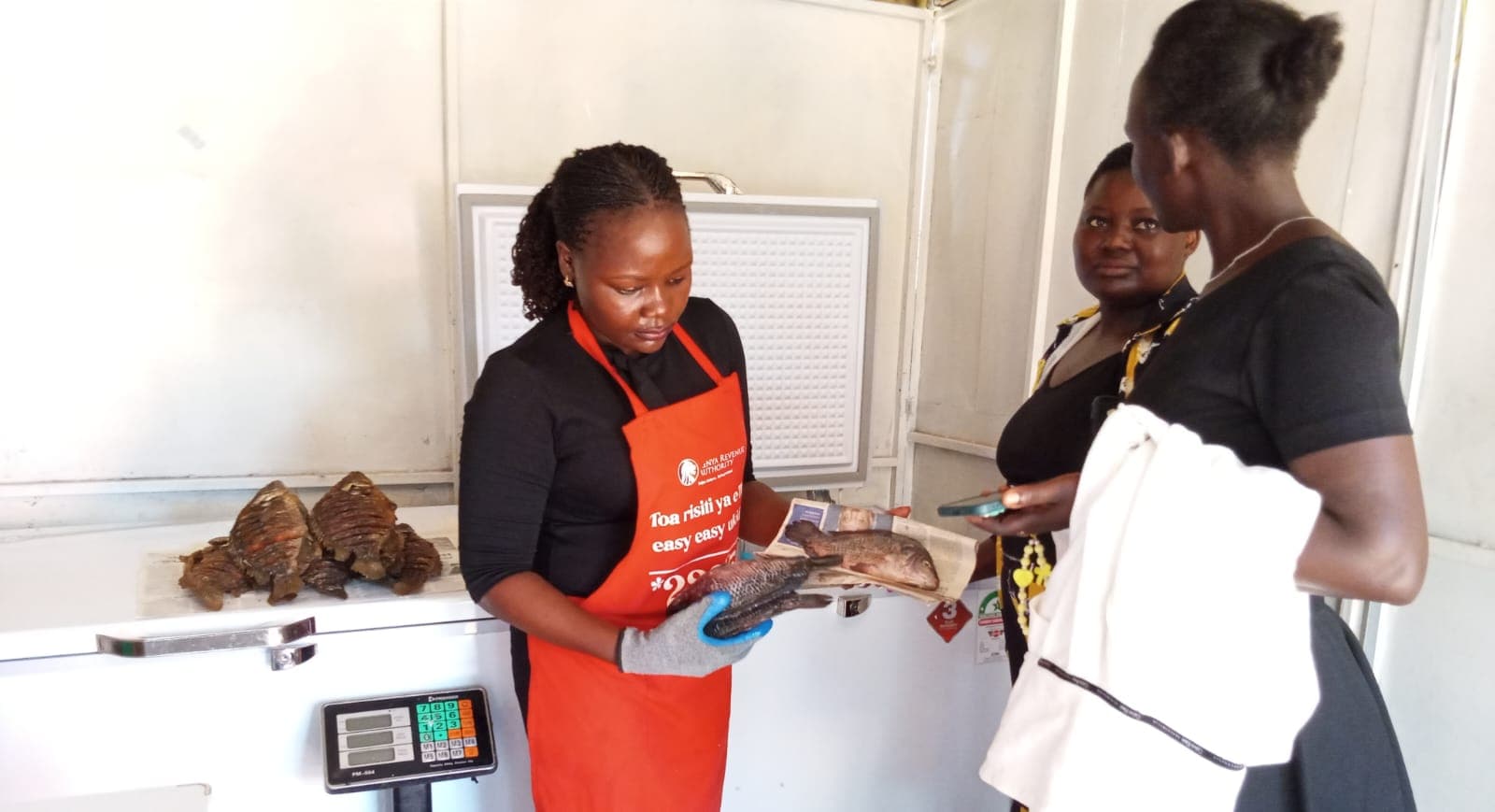
Mrs. Norma Achieng, a fishmonger in Soko Mjinga market, situated in Migori town has transformed this business to a professional merchandise, generating wealth and creating employment along the way.
Achieng who is a journalist by profession says that when she started the business a year ago, majority of fish mongers who are women, were selling fish in a more traditional way, they deep fry and wait for customers to purchase.
She adds that a small number of fish mongers could have raw fish and wait for a customer before deep frying, but the challenge was that raw fish could not stay more than a day.
Having identified these gaps, Mrs Achieng decided to be a fishmonger with the purpose of transforming the trade to a more professional venture to attract customers and make profits.
She explains that since the majority of Migori residents like consuming fish, her first priority was to set up a fish business that would cater to the preferences of her customers.
Initially she started with around 200 kgs, with a working capital of about Sh65,000, alongside a small refrigeration unit. Her fish source supply comes from Sori and Waondo in Mbita, targeting specific varieties preferred by her clientele for their quality, the majority of her fish produce being tilapia and Nile perch.
Once she surveyed the market and knew the required price for one kilo of fish, she priced her stock competitively below prevailing market rates and sold at a lower price to hook customers and secure a competitive price.
Today, Achieng’s venture has now grown, making it a wholesale endeavour that supplies raw fish to other small-scale fishmongers.
‘I purchased a larger chest freezer of 300 litres that could handle between 150 and 250 kilogrammes of fish (300-400 whole fish) at a go, making me a wholesale distributor to the majority of other fishmongers in Soko Mjinga and Marindi markets within Migori town,’ she narrated.
Although she is engaged in wholesale trading, Achieng is also a retailer selling her fish to walk-in customers.
She explains that most customers prefer raw and deep-fried fish, an opportunity that she has embraced fully to ensure her customers are satisfied with her produce.
For Achieng, the dream of becoming a professional fishmonger is now a reality despite having no family background or role model in the business.
She adds that, at first, she was so scared of starting up the business because none of her friends or relatives had done it.
But after observing the market niche and gaps, her gamble has paid off through the profits she is making that have enabled her to supplement her employment income.
Although the business is good, she has faced some challenges in transitioning from journalism into agribusiness that exposed the complex realities of fish trading.
She spent the better part of 2025 saving to start-up the business, surveying the market, prices, and other required information.
Her first attempt to set up the fish business that was purely retail collapsed, first accumulating losses that largely contributed to debt to her clients (other fish mongers).
She gave out a debt of around Sh70,000 to the small trade fish mongers, who did not pay back on time, while others disappeared without a trace.
“When I started the business in 2025, fish retailers came to me and told me how things work here: you give us fish, we sell, and by evening we bring back the money,” she narrated.
In the long run some paid half of what they had taken while at the same time got another stock on top of that debt. Some disappeared, making it a taunting task to trace their whereabouts.
Some of her debtors could hide from her, something that got her fed-up and decided to start afresh in a more professional way.
“Now I have a pay bill, a till number and a pochi la biashara account. No credit; if you want fish, you pay upfront. In business there is nothing like relatives, friends and family; business is business,” she narrates.
Achieng accumulated another amount, opened a bigger business, and got a bigger fridge and a larger space; she learnt her lesson of dealing with debtors, and her business has since been flying high.
She also talked about the transportation challenge of ferrying fish from Waondo in Mbita-Homabay. The difficult part of this is that most transporters do not want to transport fish because of the smell that discomforts other travellers.
Although 70 per cent of her produce is from Migori, some clients prefer fish from Mbita, a task that she has to do to make her customers happy.
On the issue of financial support, Achieng is urging both the County and the National government to aid fishmongers with fridges to preserve fish for income and profit increase.
To support the broader sector, she advocates for government assistance programmes like grants, specifically tailored to small-scale fish mongers with priorities on subsidised cold storage facilities and cold-chain transport solutions to reduce post-harvest losses.
Her advice to the youth is that, a business can be done by many, but it takes a smart move to start a successful venture.
“When I started this business, some of my friends felt it was a dirty job, unlike my usual job, journalism, which is a little bit of a white-collar job. But my advice to the youth is that there is no dirty business; what matters is the growth of the venture, the profits and job creation,” she concludes.
Ms Rhoda Achola, a retail fishmonger at Sonko Mjinga, says that Achieng’s fish are of high quality and quantity, something that has set her apart from the rest of the other fish wholesalers.
Achola also praises Achieng’s customer relations model, saying that at times she makes her customers feel as if they co-own her business.
She has been buying raw fish at a price of between Sh100 to Sh300, the best fresh fish that my customers keep coming because of the nice taste they get, she said with a broad smile.
“She is still young, and my prayer is that God should continue giving her more wisdom to expand her business beyond Migori,” concluded Achola.
By Beryl Akinyi and George Agimba


Comments
No comments yet. Be the first to share your thoughts.