
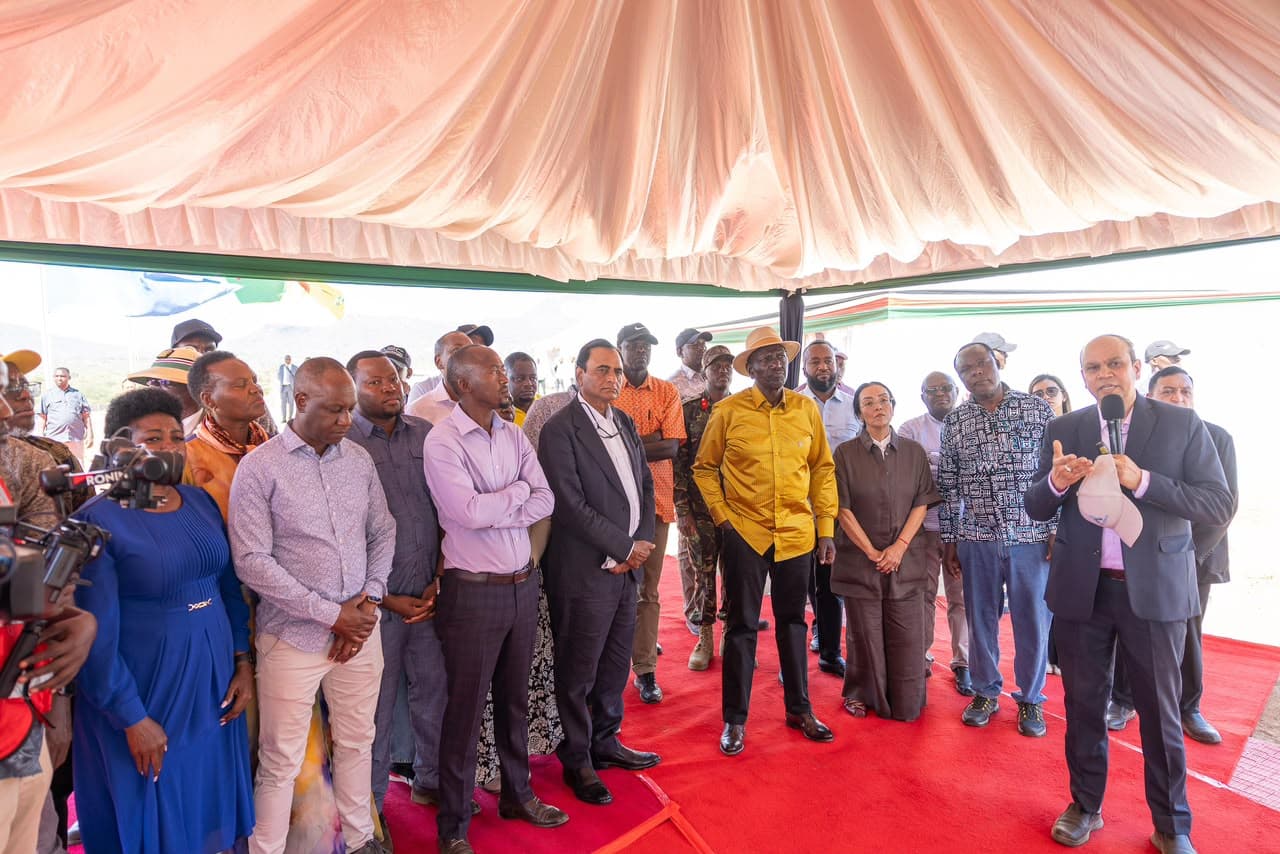
President William Ruto (in a yellow shirt, Principal Secretary for Industry Juma Mukhwana (in blue trousers) and other officials during the groundbreaking ceremony of the Devki cement and clinker factory in Ngaaie, Kitui County /PCS

The Sh70 billion Devki cement and clinker factory in Ngaaie, Kitui County, is expected to create 4,000 jobs when completed, as the government seeks to boost local manufacturing and reduce dependence on imported industrial products.
President William Ruto presided over the groundbreaking ceremony on Tuesday, October 27, with Principal Secretary for Industry Juma Mukhwana describing the investment as a significant step towards Kenya’s industrial transformation.
Mukhwana said the project reflected the government’s ambition to shift the economy from consumption and imports towards production, investment and exports.
“We shall no longer be satisfied with being a market for products manufactured elsewhere. We shall become the manufacturers! We shall become the exporters!” he said.
The planned factory represents an investment of approximately Sh70 billion, according to information provided at the ceremony.
Mukhwana said Kenya needed to increase its manufacturing capacity to create jobs, add value to locally available resources and strengthen its position in regional and international markets.
He noted that Africa had significant mineral resources, land, energy, labour and markets but continued to account for only a small share of global manufacturing output despite having roughly 17 per cent of the world's population.
He attributed the gap partly to the continent’s reliance on exporting raw materials and importing finished products.
“Because for too long, we have exported raw materials, exported jobs, exported opportunities and imported finished products,” Mukhwana said.
The Principal Secretary credited government policies aimed at encouraging domestic production with attracting investment into the cement manufacturing sector.
He cited the introduction of the Export Promotion Levy on imported clinker in 2023 as a measure intended to encourage local manufacturing, attract investment and reduce dependence on imports.
According to Mukhwana, two new clinker factories had since opened in Kisumu and West Pokot, while two others were under construction in Kwale and Kitui.
He said the developments demonstrated how deliberate industrial policies could encourage investors to commit capital to productive enterprises.
“The world is no longer looking at Kenya only as a destination for tourists. The world is increasingly looking at Kenya as a destination for factories!” he said.
Mukhwana said local clinker production could strengthen supply chains and create opportunities for transporters, engineers, technicians, contractors and small businesses.
He urged the Devki Group to ensure the investment benefits communities around the factory through employment, business opportunities and skills development.
He also called for high standards of environmental stewardship, workplace safety and responsible use of natural resources.
The factory is part of the broader push to expand Kenya’s industrial base under the Bottom-Up Economic Transformation Agenda, which places manufacturing, agriculture, affordable housing, infrastructure, energy and job creation at the centre of national development.
Mukhwana said industrialisation was essential to Kenya’s ambition of becoming a developed economy, warning that the country could not generate enough employment opportunities for young people by relying on imported goods.
“We cannot become a first-world economy with a third-world manufacturing base!” he said.
He challenged Kenyan investors to establish factories, add value to local resources and produce goods for regional and global markets.
“To Kenyan investors, I say: do not wait for foreigners to industrialize our country. Follow this example. Build a factory. Add value to our resources. Create jobs. Produce for Africa and the world,” he said.
Mukhwana said the project should mark a step towards greater economic self-reliance and prosperity, adding that Kenya was ready to attract investment and expand manufacturing.
Comments
No comments yet. Be the first to share your thoughts.