
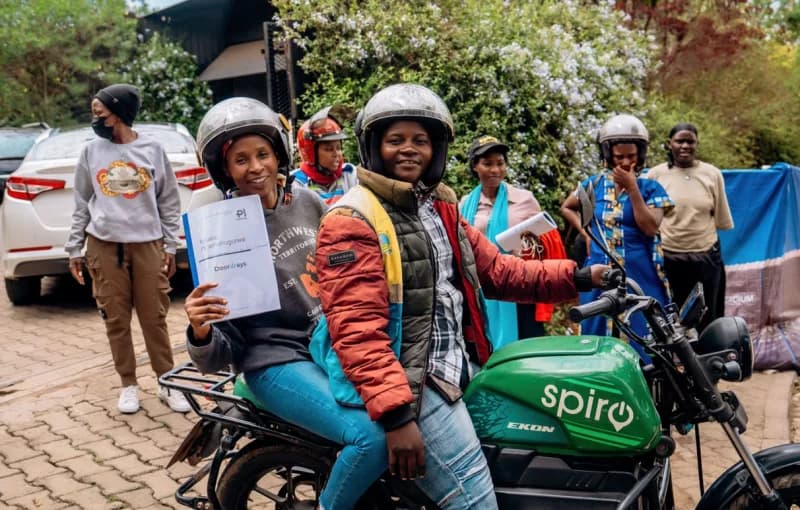
A rider and other participants during the Spiro and Entrepreneurial Solutions Partners (ESP launch of the Women in E-Mobility programme in Rwanda/ HANDOUT

Electric mobility company Spiro and Entrepreneurial Solutions Partners (ESP), a pan-African firm specialising in entrepreneurship development, have launched the Women in E-Mobility programme in Rwanda.
The initiative, which will expand to Kenya, is designed to help women become professional electric motorcycle riders, develop their own businesses and generate sustainable income.
The programme has started with 50 women undergoing training in Rwanda as part of an initial pilot targeting 500 participants, before expansion into other African markets, including Kenya, with an ambition to support 5,000 women by 2030.
It seeks to increase women's participation in the continent's growing electric mobility industry, where motorcycles are increasingly becoming important for passenger transport, delivery services and logistics.
In Rwanda, women account for just four per cent of transport workers, highlighting the gender gap the programme seeks to address.
However, a 2025 study in Kigali found that 47.7 per cent of women surveyed would consider becoming motorcycle taxi drivers.
For Kenya, the initiative presents an opportunity to expand women's participation in the boda boda industry and emerging electric motorcycle businesses as the country embraces cleaner transport alternatives.
Spiro already has an established presence in Kenya, where it operates electric motorcycle assembly activities and a battery-swapping network, providing infrastructure that could support the participation of women in the sector as the programme expands.
The initiative combines practical motorcycle riding and road safety training with financial literacy, digital skills and entrepreneurship development to prepare participants to operate commercially.
Women will also have access to affordable financing, including lease-to-own arrangements, allowing them to acquire Spiro electric motorcycles and access its battery-swapping infrastructure.
Beyond providing motorcycles, the programme will connect participants with ride-hailing, delivery and logistics platforms to help them access customers, generate income and develop sustainable businesses.
The approach seeks to address barriers that often prevent women from entering the motorcycle transport business, including limited access to capital, skills, commercial networks and business opportunities.
Spiro Group chief executive Anant Badjatya said the initiative would help ensure women benefit from the economic opportunities emerging from Africa's transition to electric mobility.
“Electric mobility is creating new economic opportunities across Africa, and we want more women to be part of this transformation. Through this programme, we are giving women the tools to become professional drivers, build their own businesses and generate income,” he said.
ESP co-founder and chief executive Eric Kacou said access to a motorcycle alone was insufficient to establish a successful business, noting that entrepreneurs also needed financing, skills, customers and ongoing support.
“For women entrepreneurs, having access to a motorcycle is only the first step. Building a successful business also requires skills, financing, customers and ongoing support,” he said.
Rwanda was selected as the starting point because of its growing electric mobility ecosystem and Spiro's established local operations, including assembly facilities and battery-swapping infrastructure.
The partners will use the initial pilot to assess participants' progress, income generation and business performance before progressively extending the programme to other African countries where Spiro operates between 2027 and 2030.
To finance the expansion, Spiro and ESP are seeking partnerships with development finance institutions, impact investors, governments and commercial players to increase access to affordable financing, strengthen training and create commercial opportunities.
Spiro operates in seven African countries, with more than 156,000 electric motorcycles, over 2,500 battery-swapping stations and more than 57 million battery swaps recorded.
The company says its electric motorcycles have covered more than 3.1 billion kilometres, as it seeks to replace expensive imported fossil-fuel-powered transport with locally assembled electric alternatives.
The Women in E-Mobility programme adds an entrepreneurship component to that expansion, with the partners seeking to link the growth of cleaner transport to job creation, business ownership and increased economic participation by women.


Comments
No comments yet. Be the first to share your thoughts.