
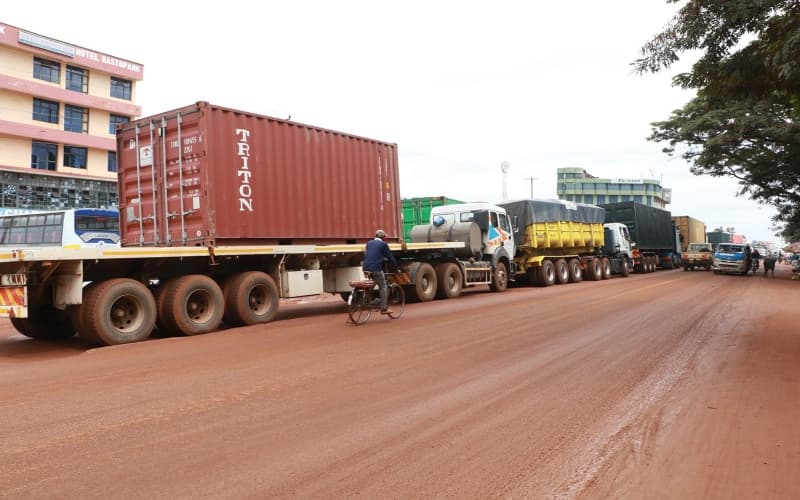
Truckers urged to cut fuel costs as freight emissions rise along Northern Corridor

Fuel accounts for between 50 and 55 per cent of truck operating costs, leaving transporters exposed to fuel price fluctuations and making efficient vehicle use a key factor in their profitability.
Kenya’s road transport companies are being urged to change driving habits and improve fleet management to reduce fuel bills and pollution, as trucks operating along surveyed sections of the Northern Corridor emit an estimated 2.59 million tonnes of greenhouse gases annually.
Fuel accounts for between 50 and 55 per cent of truck operating costs, leaving transporters exposed to fuel price fluctuations and making efficient vehicle use a key factor in their profitability.
The challenge is particularly significant along the Mombasa–Nairobi route, which accounts for an estimated 1.58 million tonnes of carbon dioxide equivalent annually, according to the 2025 Northern Corridor Greenhouse Gas Emissions Baseline Report.
The report estimates emissions of about 930,000 tonnes along the Nairobi–Malaba section and 84,000 tonnes along the Mau Summit–Busia section.
Industry stakeholders meeting in Mombasa said transporters could reduce expenditure and emissions through better driving practices, regular vehicle maintenance and closer monitoring of fuel consumption, without relying solely on replacing older trucks.
Kenya Transporters Association (KTA) chairperson Newton Wang’oo said fuel savings could improve business performance, urging companies to train drivers, track consumption and strengthen fleet management.
Latest Stories
- Nigerian billionaire Aliko Dangote buys 24.76 per cent stake in Kenya Pipeline for Sh42.5 billion
- Polio survivor Samuel Chira's push for inclusion after a childhood in hiding
- Ballon d'Or: How countries compare in all-time wins
- Kenya scores poorly on pension adequacy in global index, raising questions over retirees’ financial security
“Every litre of fuel saved translates into reduced operating expenditure, improved fleet productivity and enhanced competitiveness,” Wang’oo said.
The baseline assessment recorded an average of 15,583 trucks a day across five surveyed stations in Kenya, including 10,110 heavy commercial vehicles with five or six axles.
The scale of traffic highlights the potential impact of changes in how freight vehicles are operated and maintained.
Eco-driving practices recommended during the Mombasa training include smooth acceleration and braking, selecting appropriate gears, maintaining safe speeds and avoiding unnecessary engine idling. Industry estimates presented at the workshop suggest these measures could save more than 150 litres of fuel on a 2,300-kilometre return journey between Mombasa and Kampala.
Transport managers are also being encouraged to plan trips more efficiently, secure return cargo to reduce empty journeys, minimise waiting times and match vehicles to the loads they carry.
The Northern Corridor Green Freight Strategy 2030 targets a 10 per cent improvement in freight fuel efficiency and a 10 per cent reduction in carbon dioxide emissions intensity by 2030.
It also seeks to cut emissions of particulate matter, black carbon and nitrogen oxides by 12 per cent, improve the climate resilience of at least 2,000 kilometres of roads and train 1,000 drivers in eco-driving.
However, the financial savings will depend on whether companies consistently measure fuel consumption and use the data to assess driver performance, rather than treating training as a one-off exercise.
The emissions challenge extends beyond climate change. The baseline report estimates that trucks on the surveyed Kenyan road sections release approximately 15,000 tonnes of harmful air pollutants annually. Nitrogen oxides account for about 94 per cent of the reported total, while particulate matter accounts for five per cent and black carbon one per cent.
These pollutants raise concerns about exposure among drivers, workers at loading facilities and communities living near busy roads.
The report also puts the median age of sampled trucks at nine years, strengthening the case for regular servicing, timely repairs and correct tyre pressure to improve performance and reduce unnecessary fuel consumption.
Kuehne Climate Centre representative Carol Mutiso said improving freight transport could benefit businesses and the environment, but lasting changes would require investment in driver skills, management practices and partnerships.
The initiative is being implemented by the Northern Corridor Transit and Transport Coordination Authority in partnership with KTA, Smart Freight Centre and Kuehne Climate Centre.
The Authority and the transporters' association formalised their cooperation on green freight initiatives in October.
The Northern Corridor connects the Port of Mombasa to landlocked markets, including Uganda, Rwanda, Burundi, South Sudan and the Democratic Republic of Congo.
Road freight accounts for a substantial share of cargo movement through the port, making the cost and environmental performance of trucks important to regional trade.


Comments
No comments yet. Be the first to share your thoughts.