
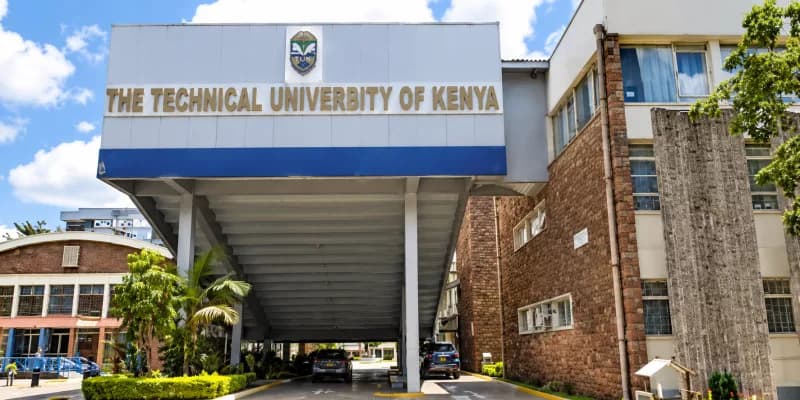
The liquidation has left workers facing a significant retirement income shortfall despite years of salary deductions intended to secure their financial future
Technical University of Kenya

Nearly 2,000 employees and former workers of the Technical University of Kenya (TUK) risk losing most of their retirement savings after their pension scheme was placed under liquidation.
This is after investigations exposed Sh6.825 billion in unpaid contributions and accrued interest.
The probe by senators showed that TUK Staff Retirement Benefit Scheme has only Sh907.1 million in available assets against outstanding receivables of Sh6.825 billion, leaving it with a funding level of about 13 per cent.
The shortfall threatens the retirement benefits of 1,850 members, including 1,299 serving employees and 551 deferred pensioners, who may initially recover only a fraction of their entitlements.
A report by the Senate Standing Committee on Labour and Social Welfare attributes the collapse to the university's prolonged failure to remit pension contributions deducted from employees' salaries, alongside matching employer contributions.
“The Committee also noted significant governance and oversight failures, including the failure by the trustees to convene Annual General Meetings for over a decade and inadequate reporting to members,” the committee chair Julius Murgor said in the probe.
The probe showed that while Kenya Commercial Bank discharged its role as custodian, the University and Scheme trustees failed to fulfil their fiduciary responsibilities, while the Retirement Benefits Authority and other oversight bodies did not enforce compliance sufficiently early.
The outstanding amount comprises Sh3.043 billion in unpaid principal contributions and Sh3.782 billion in accrued interest and penalties as of April 30, 2026.
Under a proposed liquidation plan, 90 percent of the available assets, equivalent to Sh816.39 million, will be distributed among verified members in proportion to their entitlements. The remaining Sh90.71 million will be reserved for legal action to recover outstanding debts.
The problems date back to July 2009, when TUK began accumulating unpaid pension contributions after deducting money from employees' salaries without remitting the full amounts to the scheme.
According to the Senate report, funds initially deposited into holding accounts at Kenya Commercial Bank were diverted to finance university operations, contrary to pension regulations and the scheme's trust deed.
The deficit had reached Sh589 million by 2015, prompting the Retirement Benefits Authority (RBA) to place the scheme under interim administration.
By 2019, actuarial assessments by Zamara Consultants showed that the university's outstanding pension obligations had risen to Sh1.178 billion.
The liabilities continued growing, reaching Sh4.148 billion by June 2024, according to the report.
On July 5, 2024, the High Court ordered the winding up of the scheme, despite the mounting arrears, the university remitted only Sh441.5 million to the scheme's custodian between 2013 and April 2024.
Over the same period, TUK accumulated operating deficits totalling Sh6.586 billion, highlighting the financial pressures facing the institution.
The Senate committee has now called for investigations into the alleged financial irregularities and directed relevant agencies to establish individual responsibility for the scheme's collapse.
The Directorate of Criminal Investigations (DCI) and the Ethics and Anti-Corruption Commission (EACC) have been directed to investigate former Vice Chancellor Prof. Francis Aduol, Finance Officer Ben Sanda, Legal Officer Ruth Kirwa and scheme trustees over alleged unauthorised withdrawals and failure to remit pension contributions.
The agencies are expected to submit a progress report within 90 days, while the Office of the Director of Public Prosecutions has been directed to institute prosecutions within 120 days.
The committee has also called on the National Treasury to ring-fence and release legacy funds earmarked for settling historical pension arrears within 30 days.
The Ministry of Education and the Treasury have been directed to incorporate the outstanding pension liabilities into the national budget within 12 months, potentially opening a path for government intervention to cushion affected workers.
Beyond the TUK case, the Senate has proposed changes to government payroll systems to prevent similar pension failures across public institutions.
The Treasury and RBA have been directed to integrate government human resource information systems with the Integrated Financial Management Information System (IFMIS) and government payment gateways within six months.
The proposed integration would automate statutory payroll deductions and their remittance, reducing the risk of employers withholding pension contributions after deducting them from workers' salaries.
The committee acknowledged the financial difficulties facing public universities but maintained that budgetary constraints do not justify using employees' pension contributions to finance institutional operations.



Comments
No comments yet. Be the first to share your thoughts.