
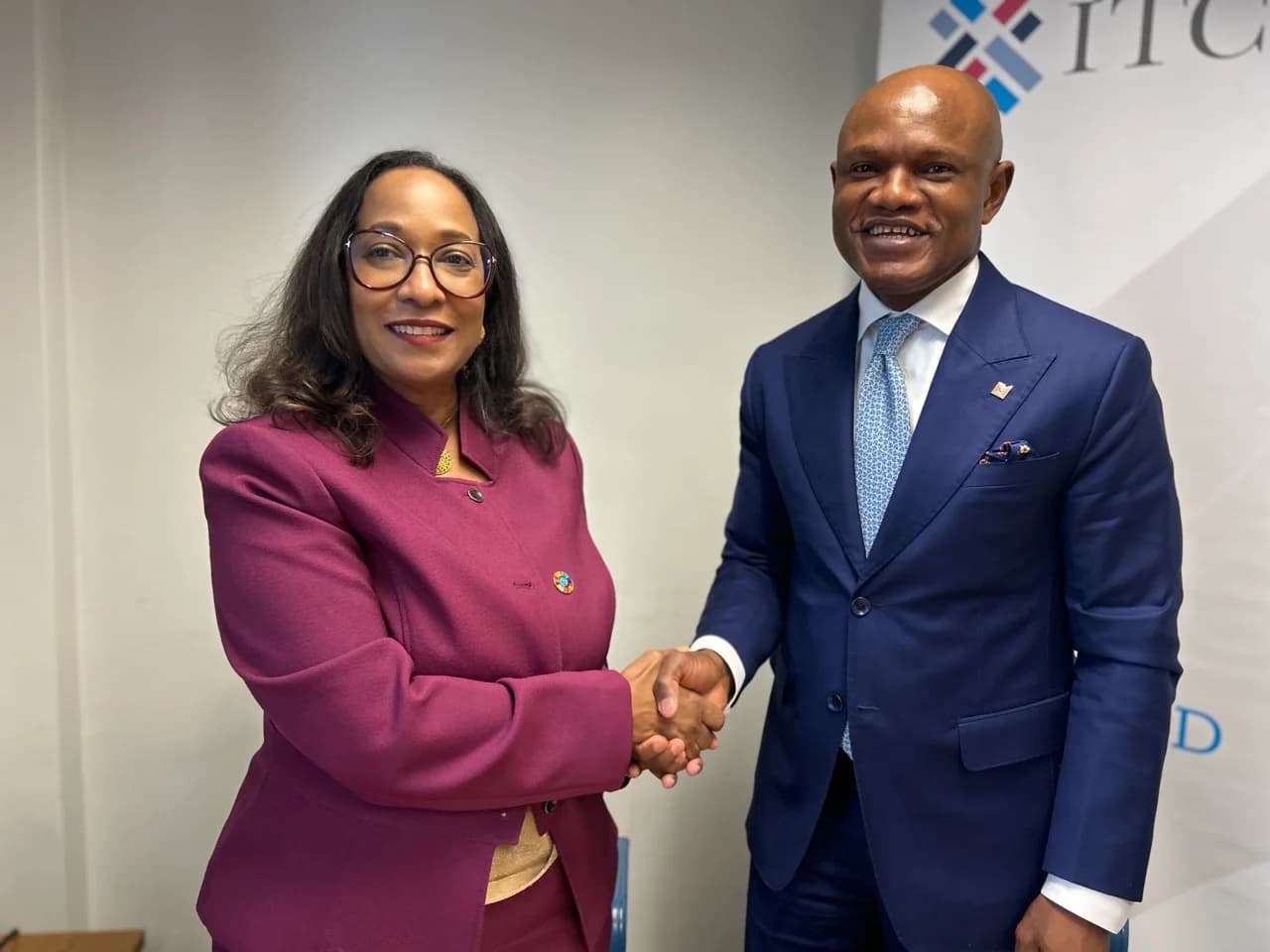
The International Trade Centre (ITC) and Access Bank have signed a three-year agreement to help small and medium-sized businesses in 14 African countries get loans, training and buyers in other markets. Kenya is one of the 14. The work starts with a pilot in Ghana that runs from September 2026 to June 2027, and women-led businesses go first. The rest of the countries come from 2027 onwards.
The two signed a memorandum of understanding (MoU) in New York, on the sidelines of the UN General Assembly. ITC published the announcement on 22 September. An MoU is a written statement of what two organisations plan to do together. This one names no amount of money.
ITC is the joint agency of the World Trade Organization and the United Nations. It helps small businesses in developing countries sell into foreign markets, and it runs online courses on trade, many of them free, through its SME Trade Academy. Pamela Coke-Hamilton has been its executive director since October 2020.
Access Bank is a Nigerian bank owned by Access Holdings Plc, and it has more than 63 million customers. The Access side of this deal is The Access Africa Office, a company registered in Ghana that coordinates Access Bank’s subsidiaries in the rest of Africa. That’s why Nigeria, the bank’s home market, isn’t on the list.
The 14 countries are Angola, Botswana, Cameroon, the Democratic Republic of Congo, The Gambia, Ghana, Guinea, Kenya, Mozambique, Rwanda, Sierra Leone, South Africa, Tanzania and Zambia.
The agreement lists five areas of work over the three years:
- Creating jobs through small and medium-sized businesses
- Access to finance, with particular attention to businesses owned by women and young people
- Making those businesses sustainable
- Training, including digital trade skills such as selling online to buyers in other countries
- Access to markets, including trade between African countries under the African Continental Free Trade Area
The African Continental Free Trade Area, or AfCFTA, is the agreement between African countries to cut tariffs and other barriers on goods and services they sell to each other. In February, we covered BiasharaLink and Deal House, two platforms Kenya built to turn AfCFTA trade enquiries at its embassies into signed deals.
The Ghana pilot uses ITC’s existing online courses and its training-of-trainers programmes, run together with Access Africa Office staff. Training-of-trainers means ITC teaches a group of people, and they go on to teach the business owners. After June 2027, ITC and Access Bank plan to add advanced training on sustainability standards and on digital marketplace tools. Sustainability standards are the environmental and labour rules that large buyers ask their suppliers to prove they meet.
Seyi Kumapayi, Access Bank’s executive director for African subsidiaries, said “finance alone does not get a small business to scale”. His case is that a loan only pays off when the business also has buyers and staff who know how to trade across borders, and ITC brings that second part. Coke-Hamilton called access to finance the biggest barrier to trade that small businesses across Africa face.
The release doesn’t say how many Ghanaian businesses are in the first group or how a business applies. It doesn’t say whether Access Bank will set money aside to lend to them, or at what interest rate. It also gives no start date for Kenya or any other country after Ghana.
Access Bank entered Kenya in February 2020 by buying Transnational Bank, which it renamed Access Bank (Kenya) Plc. In May 2025 it bought National Bank of Kenya (NBK) from KCB Group. On 23 September, the Central Bank of Kenya announced that all the assets and liabilities of Access Bank Kenya will move into NBK.
The Central Bank approved the move on 17 August. Treasury Cabinet Secretary John Mbadi approved it on 21 September, the date printed on the ITC and Access Bank release. The transfer takes effect once the two banks complete their transfer agreement, and the Central Bank didn’t give a date for that.
The release doesn’t say which Kenyan entity will run the programme here. Once the transfer completes, though, NBK will hold all of Access Bank’s business in Kenya. NBK made KES 2.39 billion in profit after tax in 2025, and we broke down how it did that while lending KES 24 billion less.
NBK already runs something close to this for women in business. In December 2025, Access Bank Kenya and NBK launched the W Initiative, which replaced NBK’s two women’s banking products, NIA and Almasi Lady. It pairs loans and cards with mentorship, training and trips to meet buyers.
There’s nothing to apply for under this deal in Kenya yet. If you run a women-led business and need credit now, you can ask NBK about the W Initiative. Co-op Bank also launched ELA this month, and it lends women in business up to KES 10 million without security. Many of ITC’s SME Trade Academy courses are free to join now.
The first real test comes in June 2027, when the Ghana pilot ends. The two numbers to look for then are how many businesses went through it, and how many of them got a loan from Access Bank.
Comments
No comments yet. Be the first to share your thoughts.