
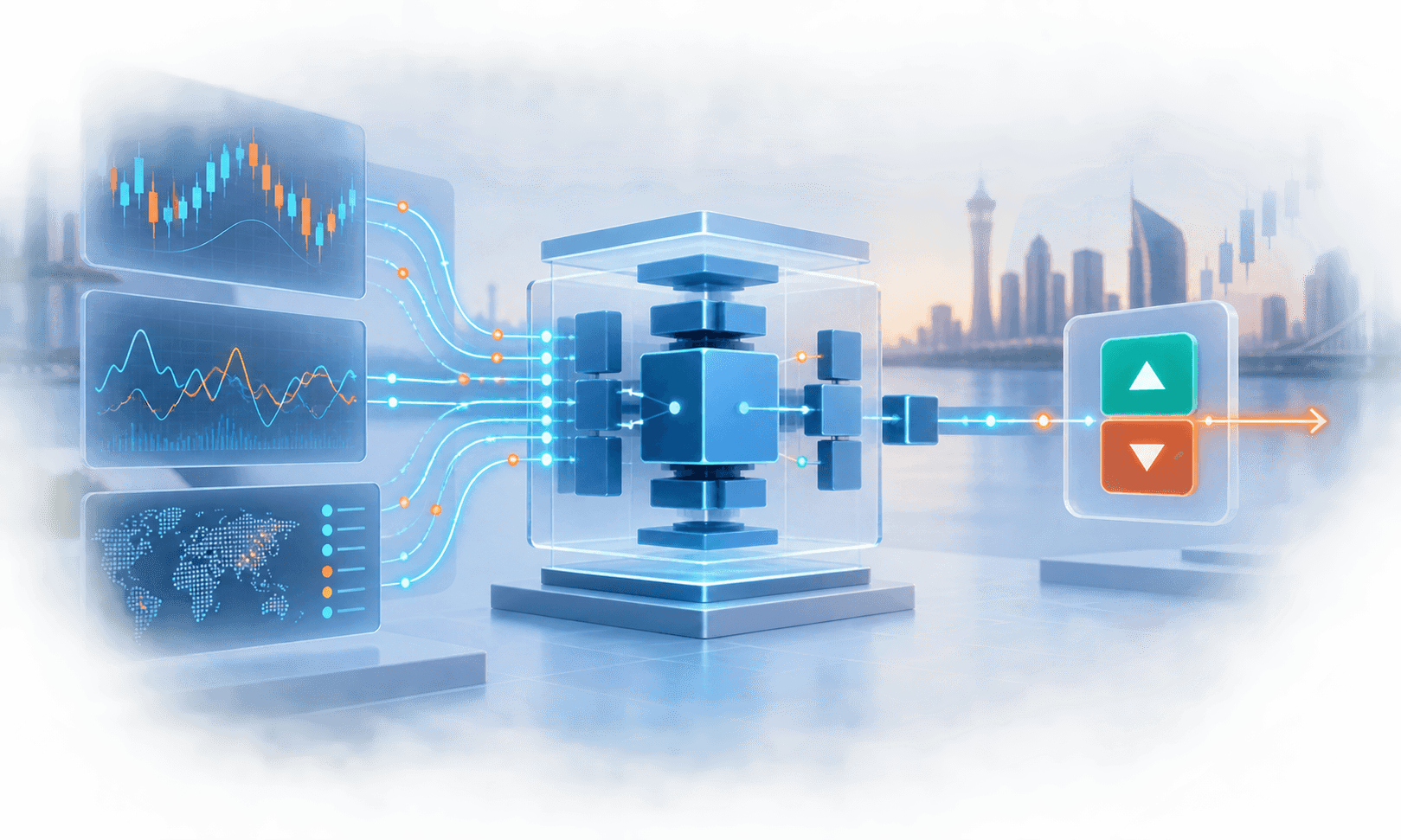
Prices shift while an investor sleeps or sits in a meeting. An algorithm won’t remove uncertainty. It follows pre-set instructions, perhaps entering a position when two moving averages cross or standing aside when costs climb. Code acts on those instructions, but the decisions behind them still belong to the person who wrote them.
That sums up how algorithmic trading works for everyday investors. A computer programme watches market data, tests a rule, and sends an order when conditions are met. Technology that once lived on institutional trading desks has moved into retail platforms. Brokers like Versus Trade let traders connect these systems to real markets, and the investor still sets the scope and the risk.
At its core, algorithmic trading turns a trading rule into code. “Buy if the price closes above its 50-day average” is a rule. So is “close the position if the loss hits 1% of the account.” The algorithm reads real-time market data and can execute trades without a human trader clicking anything.
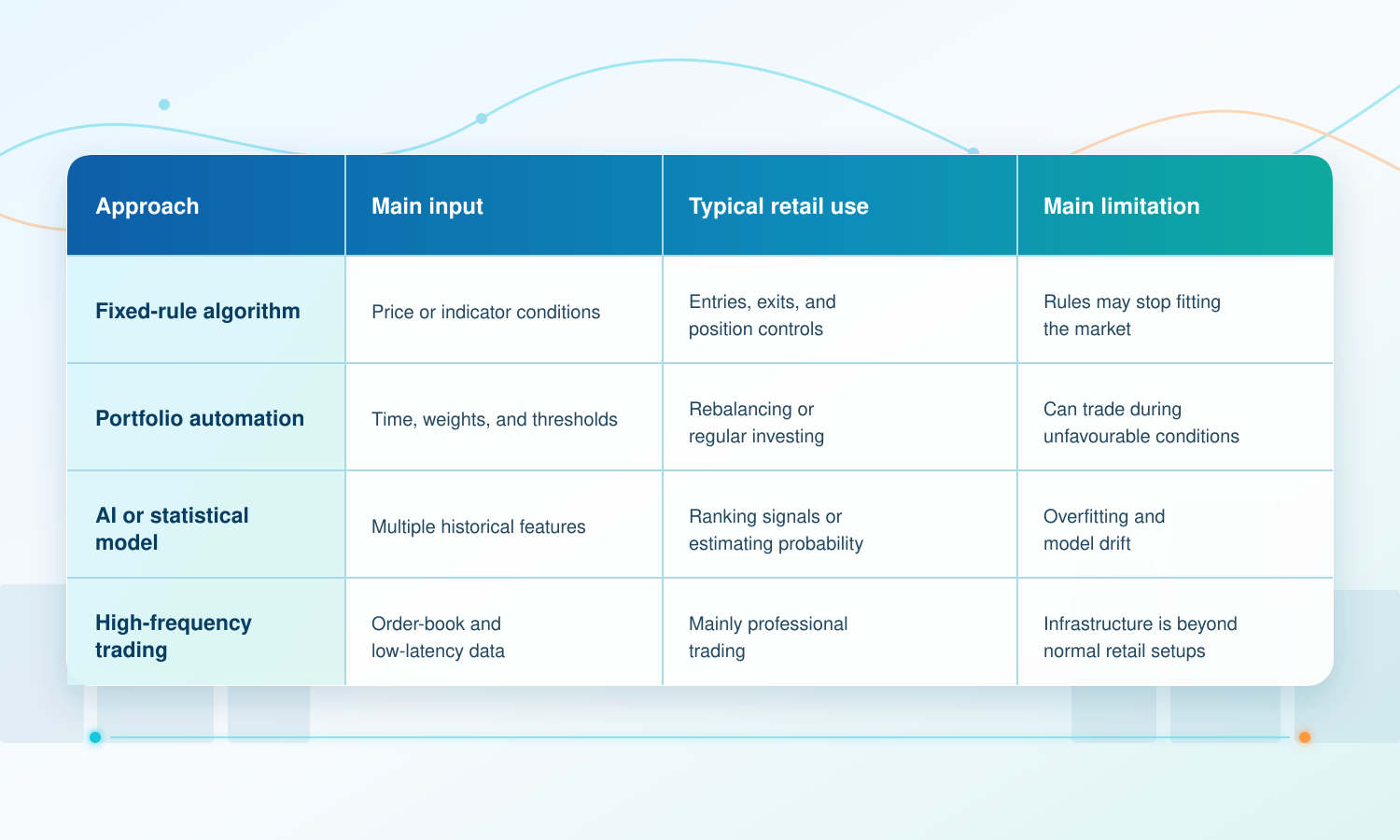
This also gives the practical answer to what automated trading is. Automation does not automatically mean AI or high-frequency trading. Many retail systems follow fixed instructions and familiar technical indicators. They might watch a stock price, a forex pair, or a cryptocurrency, then create buy and sell orders when a signal appears.
The trading process breaks into several stages:
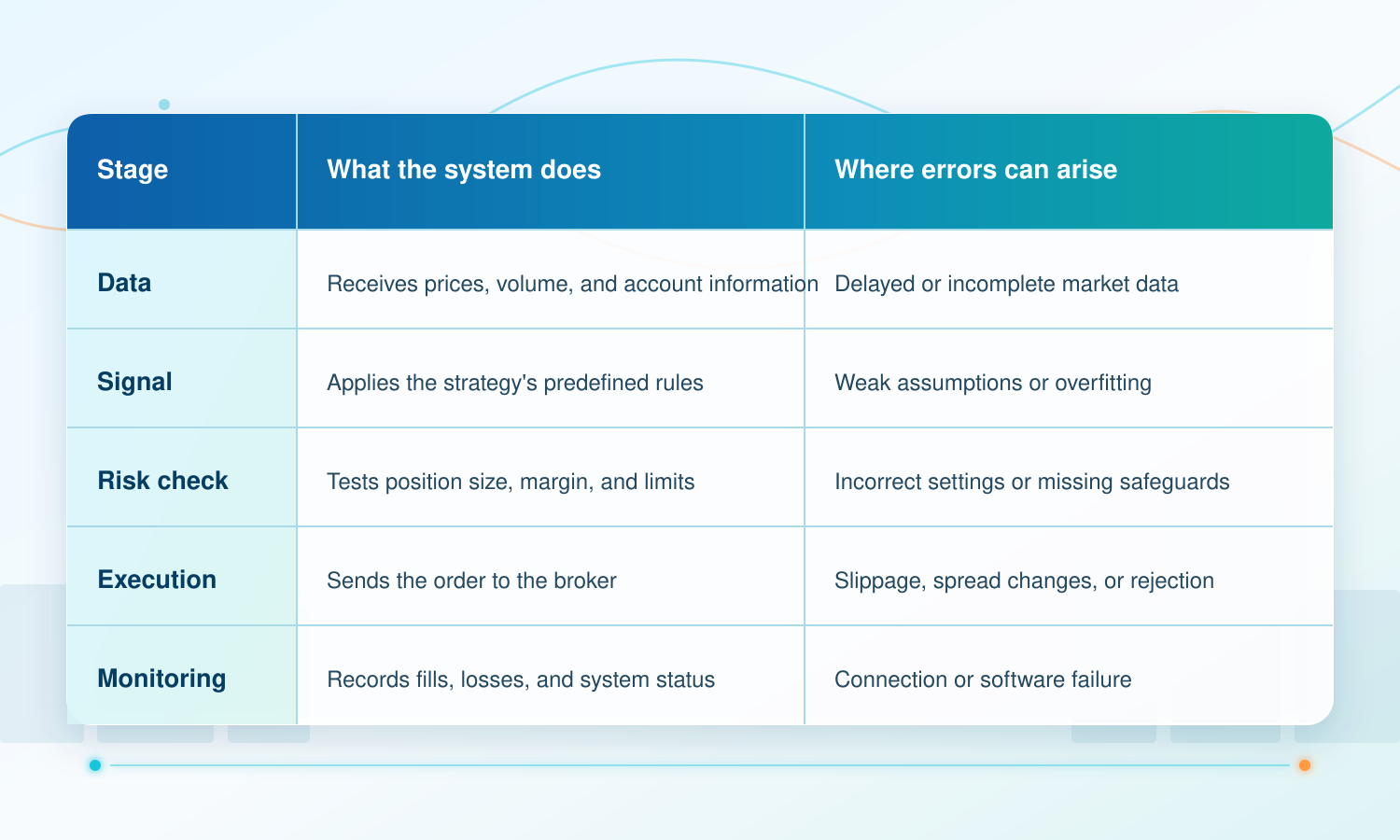
A programme can finish these steps faster than manual trading, but speed alone does not improve trading results. Market conditions can shift between the signal and the fill, so the market price may differ from the one the algorithm first saw.
Retail algorithms sit between a price stream and a broker’s execution system. The trading platform supplies quotes and account data. The programme evaluates the data and sends an instruction. What happens next depends on the broker’s execution model, the order type, the quoted price, and available liquidity.
That chain matters in forex and CFD markets because spreads, leverage, liquidity, and rapid price moves can change outcomes. An algorithm might spot the same entry in two sessions but receive different fills when volatility or trading volume changes. The infrastructure behind online trading technologies affects execution as much as the screen a trader sees.
Large trading firms may divide a large order to lower market impact. Retail algo trading usually works at a smaller scale. A personal system might place a sell order after support breaks, rebalance a portfolio monthly, or stop after a daily loss limit. These still count as algo strategies even when they run only a few times a week.
Asset hours still apply. Cryptocurrency venues can operate 24/7, while forex generally trades around the clock from Monday to Friday. Stock exchanges have set sessions. An algorithm still needs an open market and a working connection.
Expert Advisors, or EAs, brought programmable trading into retail terminals. That shift changed who could test rule-based execution in live markets. In MetaTrader 5, an EA can react to price ticks, timer events, and trading activity. MQL5 lets developers build automated trading strategies, custom indicators, and analytical tools.
That structure opened algo trading beyond quantitative funds. A trader could write an EA, commission one, or pick from free examples for testing. The programme could watch predefined conditions and manage orders inside the same terminal used for manual positions. You still needed to understand its assumptions and exposure.
“When MetaQuotes introduced MQL, traders suddenly had the opportunity to build their own indicators and expert advisors. Today, AI is taking that evolution even further.”
Co-Founder and CEO of Versus Trade—Vitalii Bulynin, FXStreet, 30 July 2026.
Expert Advisors also show why algorithmic trading differs from high-frequency trading. HFT firms compete through specialised connections and execution measured in fractions of a second. A retail EA has different goals, costs, and technical limits. Both use algorithms to execute orders, but their speed and market impact are not comparable. Broader resources to read and learn about CFD trading also cover strategies that remain entirely manual.
AI enters when a system learns patterns from data or adjusts a model instead of following only a fixed formula. It might estimate the probability of a price move from historical data, volatility, and trading volume. That output can inform trade decisions or position sizing.
“AI trading bots” is often used as a catch-all label. Some trading bots are conventional rule-based programmes with no machine learning. Others use AI models for signals but keep fixed controls for execution and risk management.
AI brings its own weaknesses. A historical pattern may vanish in live trading. Models can fit noise or react badly to changing market conditions. Even an accurate forecast may leave out spreads, commissions, and slippage. Security matters when third-party software receives account access or API permissions.
The benefits of algorithmic trading come down to practical matters. Code can watch several instruments and respond consistently, while reducing impulsive changes. It can also repeat the same mistake across every order. Removing emotion from trading does not remove flawed assumptions.
A signal says when to buy or sell. A complete trading algorithm also defines position size, maximum exposure, exit conditions, and what happens after a failure. Without those controls, an automated strategy can turn a short burst of unusual volatility into a chain of rapid losses.
Common safeguards include a maximum risk per trade, a daily loss ceiling, limits on open positions at one time, and a rule that blocks entries when spreads widen. Some systems pause after missing data or a rejected order. Others close positions when the connection recovers. These controls need testing because a stop-loss instruction does not guarantee execution at one exact price, especially in a fast or gapping market.
The principles in guidance on Forex risk management still apply when software places the order. Leverage magnifies gains and losses. Correlated positions can create more exposure than separate charts suggest. A system trading several currency pairs may effectively make the same US dollar bet more than once.
Backtesting helps reveal how algorithmic trading strategies would have behaved on historical data. It can show drawdowns, frequency, sensitivity to costs, and performance under different market conditions. It cannot reproduce the future. Results get especially fragile when a developer repeatedly changes rules until the strategy fits one dataset.
A more credible test separates development data from unseen data, includes realistic costs, and checks several market regimes. Demo or paper trading then shows how the system handles real-time market data and order flow without risking capital. Live trading, when it follows, often starts at a smaller scale because simulated fills may be cleaner than actual ones.
Retail investors can make algorithmic trading work without turning it into a high-frequency engineering project. A narrow, observable rule is easier to evaluate than a complicated model with dozens of variables. The first version might automate an alert or calculate position size before it gets permission to execute trades.
Platform choice shapes the next step. Some services include visual strategy builders. Others support scripts, APIs, or a marketplace for existing software. Existing programmes still need scrutiny: you need to know which instruments they trade, if they hold positions overnight, and how their risk limits behave.
Costs and permissions differ by broker. An account may support automated trading but restrict particular techniques or instruments. A custom programme may also need a continuously running terminal or hosted server. Reliable logs, alerts, and an emergency stop are less visible than a profitable backtest, yet they determine if the system can be supervised.
Algorithmic trading makes execution more consistent and trading more accessible. It does not turn a rule into an edge merely by placing it in code. MetaTrader 5 tutorials can explain the terminal, but responsibility stays with the investor. The computer handles repetition and speed. The person remains accountable for the strategy, the risk, and the decision to keep it running.
By Versus Trade COO & Co-Founder—Yurii Matkovskiy



Comments
No comments yet. Be the first to share your thoughts.