
Vihiga County has embraced the circular economy approach as a sustainable way of managing waste, with residents urged to take personal responsibility for keeping their surroundings clean and reducing waste.
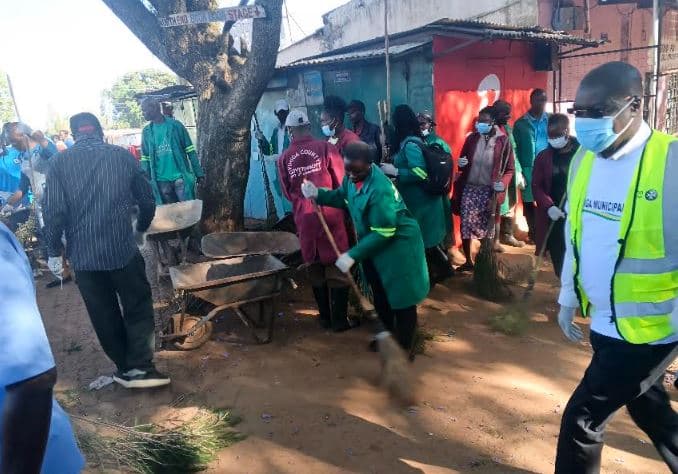
The county marked World Cleanup Day at the Municipal Grounds in Mbale Town on Sunday, a day after the global commemoration, under the theme “From Clean Plates to Clean Cities.”
The event brought together partners including Mudasa Academy, St. John Ambulance, the National Environment Management Authority (NEMA), Mbale Kenya Medical Training College (KMTC), and M-Taka Company, who participated in a clean-up exercise within Mbale Municipality.
Addressing participants during the event, chief guest Dr. Isaac Nyamweno, a physical planner and member of the Vihiga Municipality Board, appreciated the organizations and individuals who partnered in the exercise.
Nyamweno said rapid urbanization in Kenya, and Vihiga County in particular, had increased consumption of resources and generation of waste, consequently increasing the ecological damages.
He noted that an individual in an urban area in a developing country generates between 0.25 kilogrammes and 1.35 kilogrammes of solid waste per day, creating a situation where waste is generated faster than it can be properly managed.
“This leads to careless disposal of waste, especially in areas where residents do not have adequate waste management systems,” he said.
Nyamweno commended Vihiga County for its efforts in managing waste, saying the county was relatively clean compared with other counties.
He urged residents to avoid preparing or serving more food than they could consume, warning that food waste contributes to greenhouse gas emissions.
“On a daily basis, one billion meals are wasted and dumped,” he said and explained that climate change was contributing to rising temperatures, which create favourable conditions for disease vectors such as mosquitoes.
He added that poor waste disposal could also result in waste being swept into drainage systems, blocking water channels and increasing the risk of flooding during heavy rains.
He thanked residents, students, county officials, and partners who participated in the clean-up exercise and encouraged everyone to take responsibility for managing waste at household and community levels.
Speaking during the event, NEMA representative Brenda Obura called on residents to embrace the principles of a circular economy through recycling, reuse, and safe disposal of waste.
Obura commended M-Taka Company for its role in cleaning the municipality and urged residents not to leave the responsibility of keeping the environment clean to waste service providers and government agencies.
“We urge students and individuals to avoid dumping waste in undesignated places like rivers and drainage systems since it can cause hazards such as flooding and communicable diseases,” she said.
Vihiga County Director of Environment, Energy, and Natural Resources Aquila Lwanga said the county continued to face challenges in managing waste, adding that the responsibility could not be left to the government alone.
Lwanga said the county government had adopted the circular economy approach as a long-term solution to waste management.
“The solution we are offering as the County Government of Vihiga through the Department of Environment is what we call the circular economy, a conversation that we started in partnership with M-Taka that encompasses waste segregation at the source before waste service providers even come into the picture,” he said.
He explained that waste segregation at source would allow residents to separate different types of waste before collection, making it easier to recycle organic and non-organic materials.
Lwanga said the county government was responsible for ensuring that cleanliness was maintained across the county but faced challenges in establishing a Material Recovery Facility due to lack of suitable land.
He said such a facility would play a crucial role in sorting and recovering materials from waste, reducing the amount of waste dumped and helping address public health concerns associated with poor waste management.
Lwanga added that the Department of Environment was working on drainage trenches and clearing blocked waterways in preparation for the anticipated El Niño rains.
He, however, cautioned residents against irresponsible disposal of waste, saying garbage dumped in drainage channels could worsen flooding and create health risks.
The Vihiga County Municipality officer in charge of the environment, John Okwaro, said the circular economy approach remained at the forefront of the municipality’s waste management policy.
Okwaro said residents needed to change their perception of waste and recognize it as a resource rather than refuse.
“One of the key pillars of the circular economy is segregation at source, an act that we have to encourage many people to adopt, as organic waste can be used for manure and even food for animals such as pigs. Plastic can also be recycled for value, all contributing towards a circular economy,” he said.
He urged young people to take the lead in promoting responsible waste management and educating older generations on the importance of protecting the environment.
“I urge our young people to also take the initiative and educate our parents on the need to manage waste properly in keeping with today’s theme, ‘Clean Plates, Clean Cities,’ in order to avoid food wastage,” Okwaro said.
He further encouraged households to prepare adequate quantities of food to minimize leftovers and wastage.
Okwaro also called on traders in local markets to adopt proper methods of preserving food products to prevent them from spoiling and becoming waste.
He said proper food storage, waste segregation, recycling, and responsible disposal could help create employment opportunities while reducing environmental pollution.
By Florence Oteng’o and Yvonne Misango


Comments
No comments yet. Be the first to share your thoughts.