

If you are saving for something that is between three months and three years away, a first car, a new phone, a laptop that does not freeze on a video call, the money has to sit somewhere while you get there. For most Kenyans it sits in M-PESA or a bank account, where it earns close to nothing. A money market fund is the alternative built for exactly that gap. The Jubilee Money Market Fund (KES) quoted an effective annual yield of 10.61% as at 1 September 2026, which is the number this piece works from.
A money market fund pools savers’ money and lends it out short term, to the government through Treasury bills, to banks through fixed deposits, and to companies through commercial papers. The fund earns interest on all of it and passes most of that interest back to you. Because the loans are short, the value of your units does not swing around the way shares do. You put in a shilling, you get a shilling back plus interest. We wrote a full guide to how money market funds work in Kenya, and the mechanics have not changed since.
The Jubilee Money Market Fund (KES) is run by Jubilee Asset Management, the fund management arm of Jubilee Holdings, and is licensed by the Capital Markets Authority. Your money is held by Standard Chartered Bank Kenya as custodian, protecting your capital always.
The rate is an effective annual yield, which is quoted after Jubilee Asset Management has taken out their management fees. This makes it easier for you as an investor.
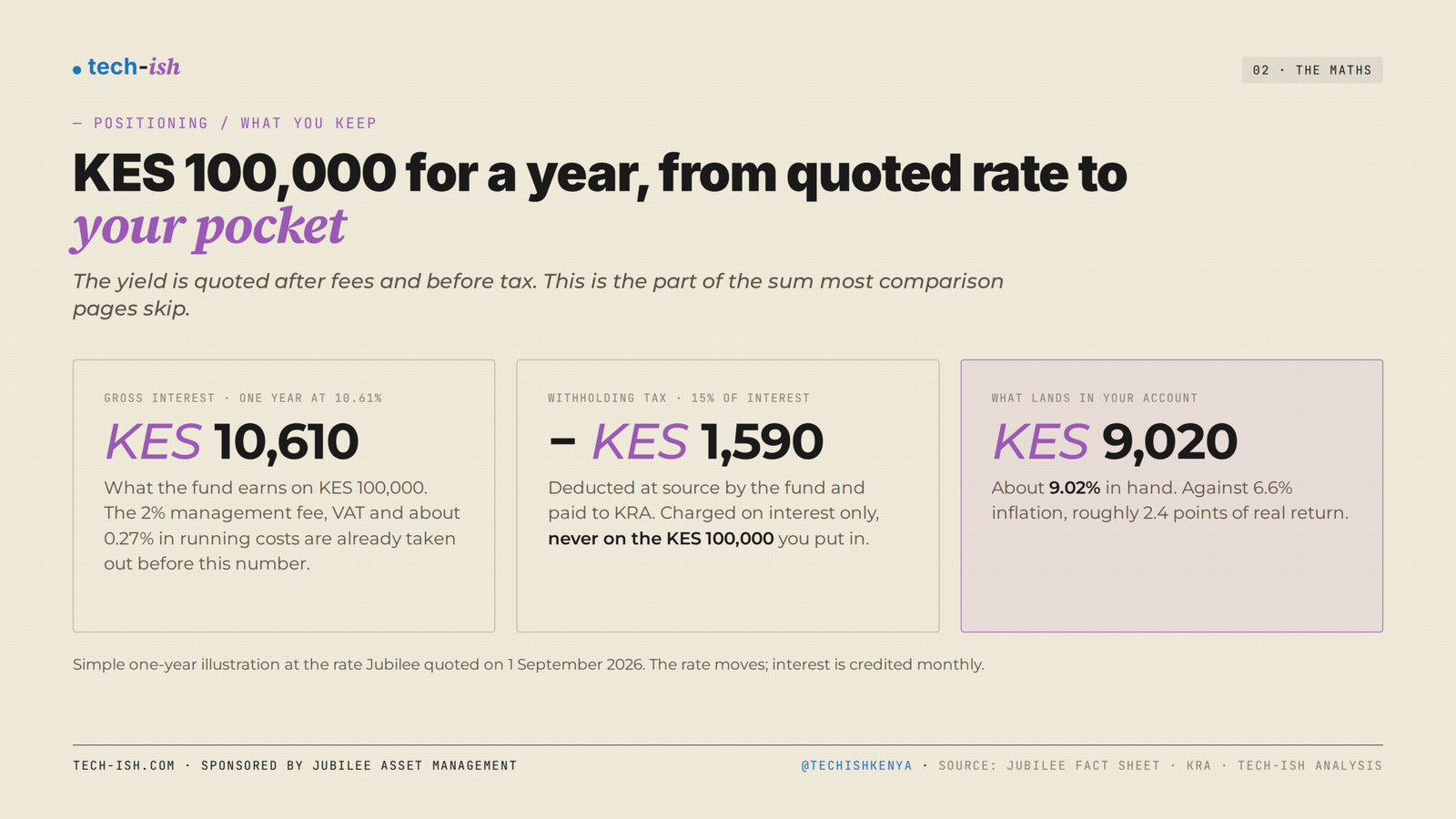
The one thing to look out for is the 15% withholding tax, and it is deducted before the interest reaches you. It applies to the interest only, never to the money you put in. If you had invested KES 100,000 in the Jubilee Money Market Fund (KES) and held it for a year in order to cash in the 10.61% interest rate, you would earn about KES 10,610 interest and you get to keep about KES 9,020 of it.
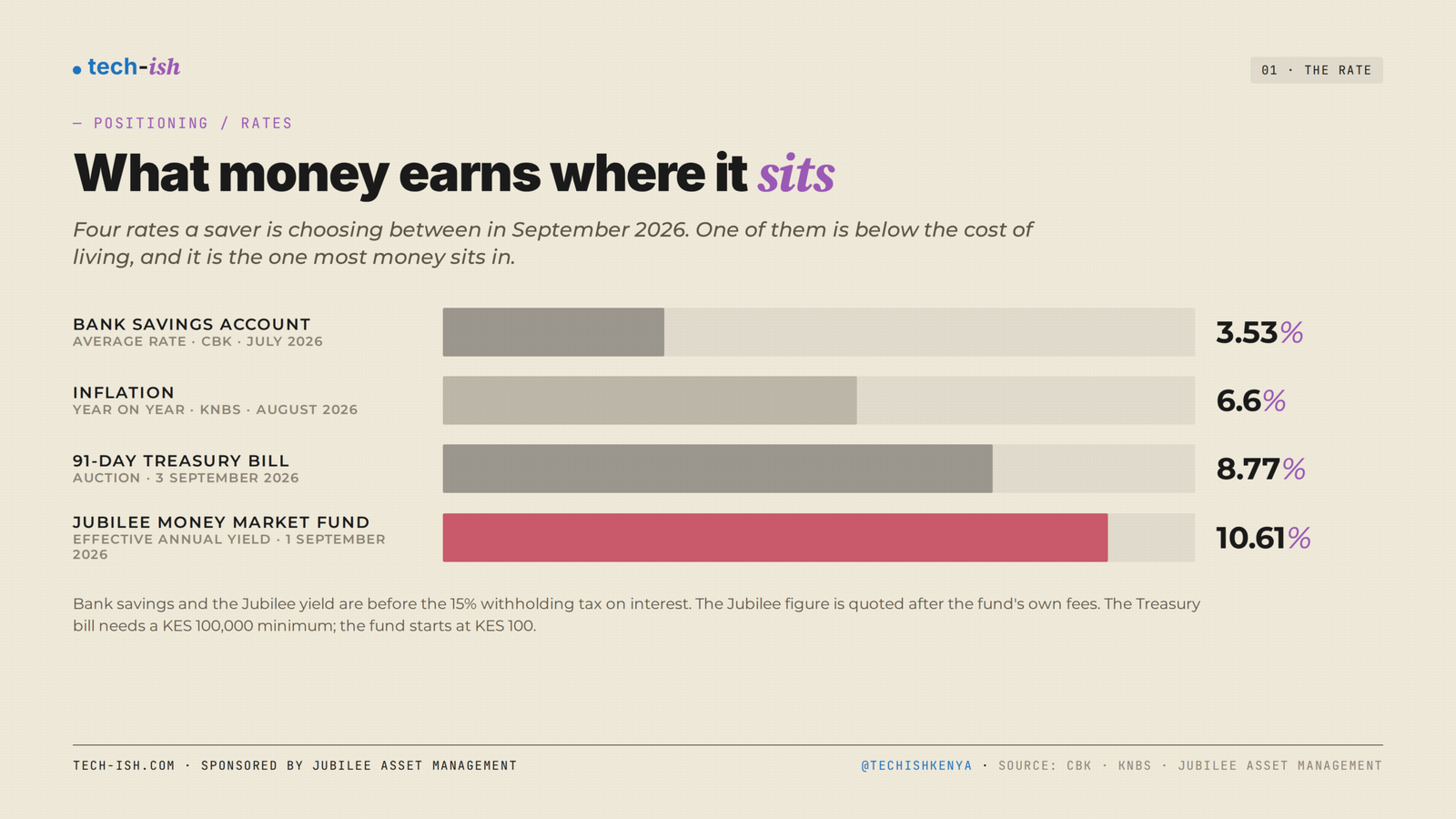
For scale, the Central Bank’s July 2026 data puts the average interest rate on a Kenyan bank savings account at 3.53%. The money market fund inside M-PESA pays around 6%, as we reported in June. Inflation in August was 6.6%, per KNBS, so money sitting at 3.53% is losing buying power every month it sits there.
The first car. Put away KES 30,000 a month for two years and you have KES 720,000 before interest. Over that horizon a money market fund does two useful things: the interest adds a noticeable amount to the target, and the 2 working days withdrawal means the money is there the week you find the right car, without breaking a fixed deposit early.
The phone or laptop upgrade. Kenya’s average smartphone selling price has nearly tripled since 2019, to KES 18,979 by mid 2025, and Jumia told investors in August that a mid-range phone in Kenya has gone from KES 35,000 to KES 45,000 in two years. That is a three to six month goal for most salaried people. The alternative is a device financing plan at KES 30 to KES 100 a day, which typically ends with you paying two to three times the sticker price. Saving the same daily amount into the Jubilee Money Market Fund (KES) from September gets you to the shop in January with the money in your account and the interest on top.
The emergency float. Three months of expenses that you never want to touch but need within two days if the car breaks or the landlord calls. This is the use case an MMF is best at, because the whole point of the product is that it earns while it waits.
The minimum amount required to open the Jubilee Money Market Fund (KES) investment account is KES 100, and top-ups start at KES 100. The Jubilee Money Market Fund (KES) charges no initial fee, no exit fee, no performance fee and no transaction costs. Interest accrues daily and is credited to your investment account monthly. You can open an account online through Jubilee Asset Management’s JAMHub Digital portal and fund it by M-PESA paybill 4103749 or bank transfer. We have written a step-by-step guide to opening the account, published alongside this piece.
The short version: if the money has a job in the next three years and you cannot afford to lose it, a money market fund is where it should sit, and 10.61% is a fair rate to sit at.



Comments
No comments yet. Be the first to share your thoughts.