
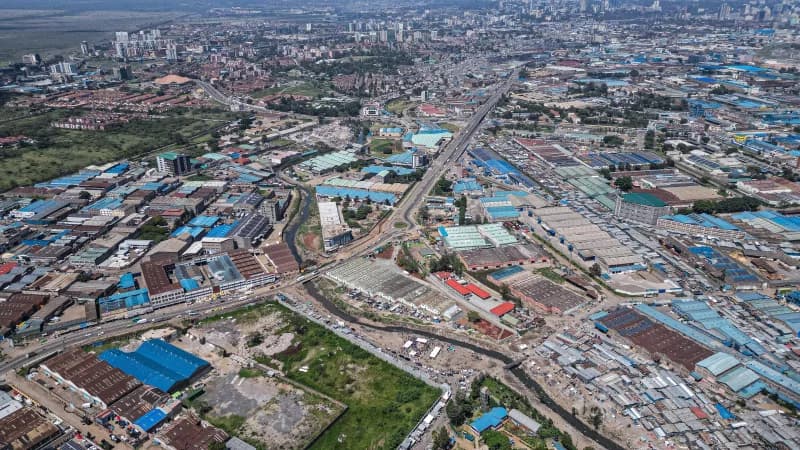
Ariel view of Muruku Kwa Reuben. /MINA

Africa's ability to manage rapid urbanisation is being constrained not only by a shortage of professionals but also by concerns over the quality and relevance of their training, a World Bank report has warned.
The report argues that increasing the number of engineers, architects and urban planners without improving the quality of their training could undermine efforts to manage the expansion of African cities.
“Any surge in the quantity of urban professionals needs to be matched by a quality surge,” the report states, warning that expanding the workforce without addressing training deficiencies could have limited benefits.
“Without a quality surge, the impact of an increased supply may be null, or even detrimental,” it adds.
The warning comes against a backdrop of a significant disparity in the availability of professionals between Sub-Saharan Africa and the United Kingdom, with the gap particularly pronounced in architecture and urban planning.
According to figures for 2019, Sub-Saharan Africa had 0.22 engineers per 1,000 people, compared with 0.63 in the UK.
The disparity was wider in architecture, where the region had just 0.033 architects per 1,000 people against 0.62 in the UK, nearly 19 times fewer.
The shortage was most pronounced in urban planning, with Sub-Saharan Africa having 0.01 urban planners per 1,000 people, compared with 0.33 in the UK.
This means the UK had approximately 33 times as many urban planners per capita as Sub-Saharan Africa, highlighting the scale of the professional-capacity gap facing the region.
The figures, drawn from research by Oborn and Walters (2020), point to the limited availability of professionals needed to guide urban development, design infrastructure and manage the expansion of settlements.
The ratio of architects includes Botswana, The Gambia, Ghana, Kenya, Mauritius, Nigeria, Rwanda, South Africa, Uganda and Zambia.
The ratio of engineers includes Botswana, Ghana, Mauritius, Uganda and Zambia, while the ratio of urban planners includes Botswana, Ghana, Mauritius, Nigeria, South Africa and Tanzania.
Urban planners play a central role in determining how cities grow, including guiding land use, coordinating infrastructure development and ensuring that housing, transport, water and sanitation services keep pace with population growth.
A shortage of these professionals, coupled with gaps in training, can weaken the ability of governments and urban authorities to anticipate development needs and prepare for the demands of expanding populations.
The report cautions that simply increasing university enrolment and producing more graduates will not necessarily address these challenges unless institutions also ensure that their programmes remain relevant to the changing demands of urban development.
It cites a 2015 UN-Habitat review of university urban-planning curricula in Kenya, which found that the University of Nairobi, for instance, had made only minor changes to its master's curriculum in urban planning since the programme was introduced in 1971.
However, the assessment does not establish whether the university subsequently revised its curriculum after 2015, nor does the report provide the dates or extent of any changes made since that assessment.
This means the observation should not be interpreted as evidence that the programme has remained largely unchanged to date.
The broader World Bank finding, however, illustrates the importance of keeping professional training programmes aligned with changing urban development needs.
The wider challenge, according to the World Bank, is to ensure that the supply of urban professionals grows alongside improvements in the quality of their training.
As African cities continue to expand, universities and professional training institutions face the task of preparing graduates with the expertise needed to manage increasingly complex urban environments.
The report's warning is that addressing the shortage of professionals without investing in the quality and relevance of their training risks leaving cities without the capacity required to plan and manage sustainable urban growth.



Comments
No comments yet. Be the first to share your thoughts.