
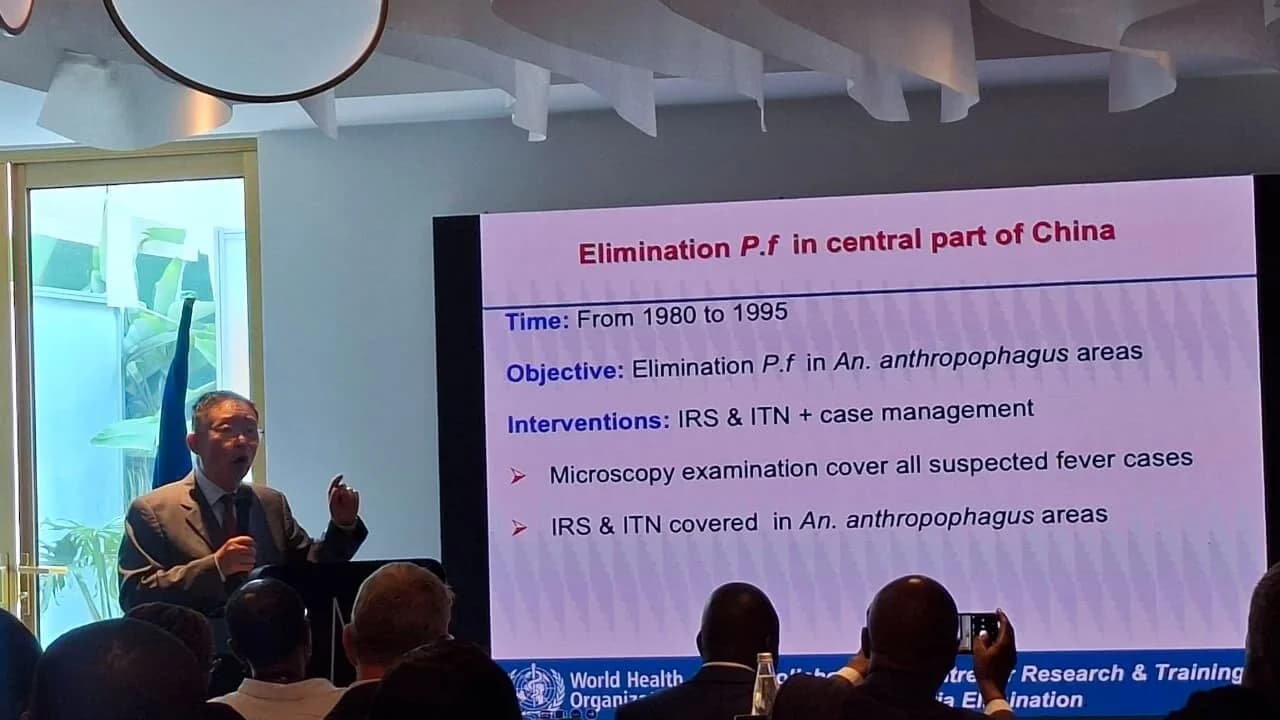
NAIROBI, Kenya, Oct 8—East Africa has four years to deliver on its 2030 malaria elimination ambition, but lessons from China’s seven-decade journey suggest the region must move faster from broad malaria control to a far more targeted system built around finding, investigating, and responding to every case.
China, once burdened by an estimated 30 million malaria cases annually in the 1940s, was certified malaria-free by the World Health Organization in 2021 after eliminating indigenous transmission in 2017.
Its experience was presented to delegates at the 2nd East African Community Malaria Stakeholders Meeting in Nairobi, where regional health leaders are examining whether East Africa remains on course to meet its 2030 elimination ambition.
Prof. Gao Qi, chair of China’s National Malaria Experts Group and a senior adviser to a WHO collaborating centre on malaria elimination, said the decisive shift came when China stopped treating malaria simply as a widespread public health burden and began treating every remaining infection as a potential source of renewed transmission.
“The goal is to remove,” Gao told delegates, explaining that elimination requires health systems to move beyond interventions focused primarily on high-burden populations and track individual infections to break chains of local transmission.
China eventually formalized that approach through its 1-3-7 surveillance model.
Under the system, confirmed malaria cases had to be reported within 24 hours, investigated and classified within three days, and an appropriate public health response launched within seven days.
The model created a clear chain of responsibility around every confirmed infection, requiring authorities to establish whether a case was locally transmitted or imported and determine what action was needed to prevent further transmission.
Gao said the critical difference between malaria control and elimination was ultimately one of speed and precision.
“If you delay, second-generation transmission has already occurred,” he said, stressing the need to intervene before another transmission cycle begins.
For East Africa, the significance of the Chinese model lies less in replicating its exact system than in adopting its underlying principle: no malaria case should disappear into routine health statistics without triggering an investigation.
As transmission falls, surveillance becomes more important, not less.
Gao cautioned against relying on any single intervention to deliver elimination.
Mass drug administration, he said, can rapidly reduce illness and deaths but cannot by itself prevent malaria from returning.
“MDA can quickly reduce morbidity and mortality, but MDA cannot be used alone,” he said.
China instead combined mass treatment with diagnosis, vector control, surveillance and increasingly targeted interventions as transmission declined.
That progression offers East Africa another important lesson: strategies that work when malaria is widespread cannot simply be carried unchanged into the final stages of elimination.
At high transmission levels, broad population coverage remains essential.
But as malaria becomes less common, the individual infection becomes more important than the population average.
“Coverage is key. If the coverage is low, your quality is not good; you cannot reach the goal,” Gao said.
At the elimination stage, however, “we need to talk about each case and each profile.”
China’s experience also demonstrates that eliminating indigenous transmission does not mean a country can stop watching for malaria.
Gao said China continues to detect imported malaria cases, including cases originating in Africa, despite maintaining zero indigenous transmission.
That has required the country to maintain surveillance and rapid-response capacity even after achieving elimination.
For East Africa, where people move continuously across national borders, imported infections present an especially important challenge.
A case acquired in one country can become the source of local transmission in another if it is not detected and contained quickly.
Gao warned against treating malaria as a problem belonging only to the country where transmission is occurring.
“The bottom-line problem is not your national problem. It’s also your own problem,” he said.
The message is particularly relevant to the East African Community, where elimination will depend not only on national programmes but also on countries sharing information and coordinating responses to imported and cross-border infections.
Edwin Onyango, who leads malaria surveillance under Kenya’s National Malaria Control Programme, echoed the call for greater regional cooperation.
“We must all work together to end this challenge,” he said.
China’s experience also shows why malaria elimination cannot be treated as a one-off campaign.
After indigenous transmission was interrupted, the country still had to maintain the surveillance, diagnostic and response systems needed to prevent imported cases from establishing local transmission.
For East Africa, reaching the 2030 target must therefore mean more than reducing cases to a particular level.
Countries will need to retain the capacity to detect and investigate infections even when malaria becomes uncommon and political attention shifts to other health priorities.
That is where sustained political commitment and financing become critical.
“Political commitment by state leaders is important,” Gao said, stressing that political declarations must translate into government action.
China progressively increased domestic financing as external support declined, offering a lesson for malaria programmes that remain heavily reliant on international funding.
The final stages of elimination, Gao suggested, cannot be sustained on political declarations alone; they require governments to assume increasing responsibility for financing and maintaining the systems that keep transmission at zero.
China’s experience took roughly seven decades, from a country carrying tens of millions of malaria cases to one that achieved malaria-free certification.
East Africa has four years to reach its 2030 ambition.
The region cannot reproduce China’s journey on a compressed timetable, but it can adopt the principle that underpinned its eventual success: the strategy must change as the disease changes.


Comments
No comments yet. Be the first to share your thoughts.