
Journalists in Homa Bay County have been urged to adopt factual, sensitive, and non-stigmatizing approaches when reporting on sexual and gender-based violence (SGBV), HIV, and teenage pregnancy.
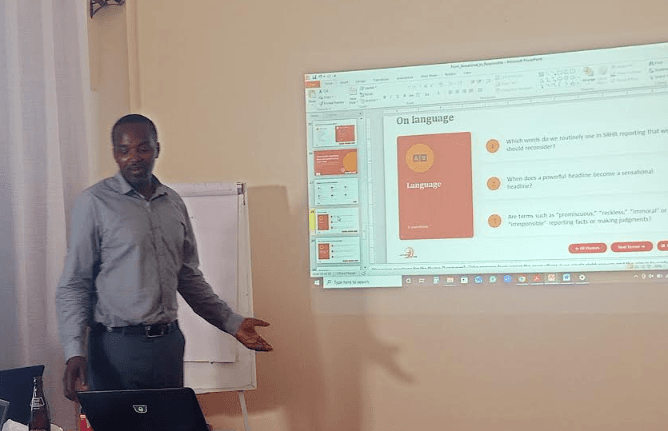
The call was made during a media engagement forum organised by Activate Action, a youth-led organization, which brought together journalists and media practitioners to discuss responsible reporting on sexual and reproductive health and rights (SRHR).
The engagement explored how the media can create a safe environment for survivors and young people to report violations and seek essential health and support services, while avoiding sensational and stigmatizing reporting that may discourage them from seeking help.
Rogers Omollo, the Executive Director of Activate Action, said the organisation was targeting journalists following concerns over the low number of reported SGBV cases despite indications that violence continues to occur within communities.
Omollo said responsible reporting could encourage more people to come forward and access available services.
He said journalists have an important role to play in informing communities about available services, reporting channels, and where survivors can seek assistance.
“We believe that when the media comes out and talks about how to report and where to report and becomes a stakeholder, we can get more people reporting and also help reduce these numbers,” Omollo said.
He noted that available data on HIV and teenage pregnancy in Homa Bay should not be viewed merely as statistics but be used to help communities understand the human impact of the challenges facing young people.
The director cited teenage pregnancy and HIV among issues requiring greater public awareness and community engagement.
Steve Biko, a programme officer at the organization, said the challenge was not necessarily a lack of reporting but the way some sensitive stories are presented.
He noted that media reports often focus on the outcome of an incident without sufficiently examining the factors that contributed to it.
“Many times, the media report outcomes, but we forget to report or touch on the things that contribute to the outcomes that we are seeing,” Biko said.
He cited teenage pregnancies, unsafe abortion, and young people’s inability to access appropriate services as issues that require deeper reporting on their underlying causes.
Biko further cautioned journalists against sensationalism, saying headlines and stories should inform the public without creating fear or reinforcing stigma.
“More people should be able to access the services, and more people should not feel stigmatized or fear how they would be quoted,” he said.
According to Biko, politicians, religious leaders and other prominent figures frequently receive media attention, while young people experiencing these challenges are not always given an opportunity to tell their own stories.
He urged journalists to create platforms where young people can explain their experiences and participate in discussions on solutions to challenges affecting them.
Journalists who attended the training said the engagement had strengthened their understanding of the need for factual, balanced, and responsible reporting.
James Omoro, a reporter with The Standard Group, said the training would help strengthen journalists’ understanding of sexual and reproductive health rights and improve reporting of related cases.
He said journalists could also help authorities by providing information and tips about violations occurring within communities, allowing relevant agencies to investigate and pursue cases.
Omoro raised concern over cases in which relatives or respected members of communities allegedly violate the sexual rights of minors, but families choose to resolve the matters informally instead of reporting them to the authorities.
He urged journalists to help expose such cases and ensure that survivors, particularly minors, are able to access justice through the appropriate legal channels.
Sharon Awino, a media practitioner, said media practitioners have a responsibility to provide accurate information without sensationalizing sensitive issues.
“We have learnt not to be sensational in our reporting but rather to do factual and balanced stories that will continue informing our society,” she said.
Sharon said journalists could help bridge information gaps by disseminating accurate information about sexual and reproductive health rights and available services to communities across Homa Bay County and beyond.
Jeremiah Orondo, on the other hand, emphasized that reporting on sexual and reproductive health and gender-based violence remains challenging because of cultural and family attitudes surrounding such cases.
He said through the training, journalists were reminded of the importance of verifying information, seeking relevant statistics, and reporting facts accurately.
“As journalists, simplicity should be our hallmark. We should write not only to be understood but also to make it difficult to be misunderstood,” Orondo said.
The journalists agreed that stronger collaboration between the media, community organisations and other stakeholders could help improve access to information, encourage reporting of violations and reduce stigma surrounding survivors and people seeking health services.
By Sitna Omar


Comments
No comments yet. Be the first to share your thoughts.