
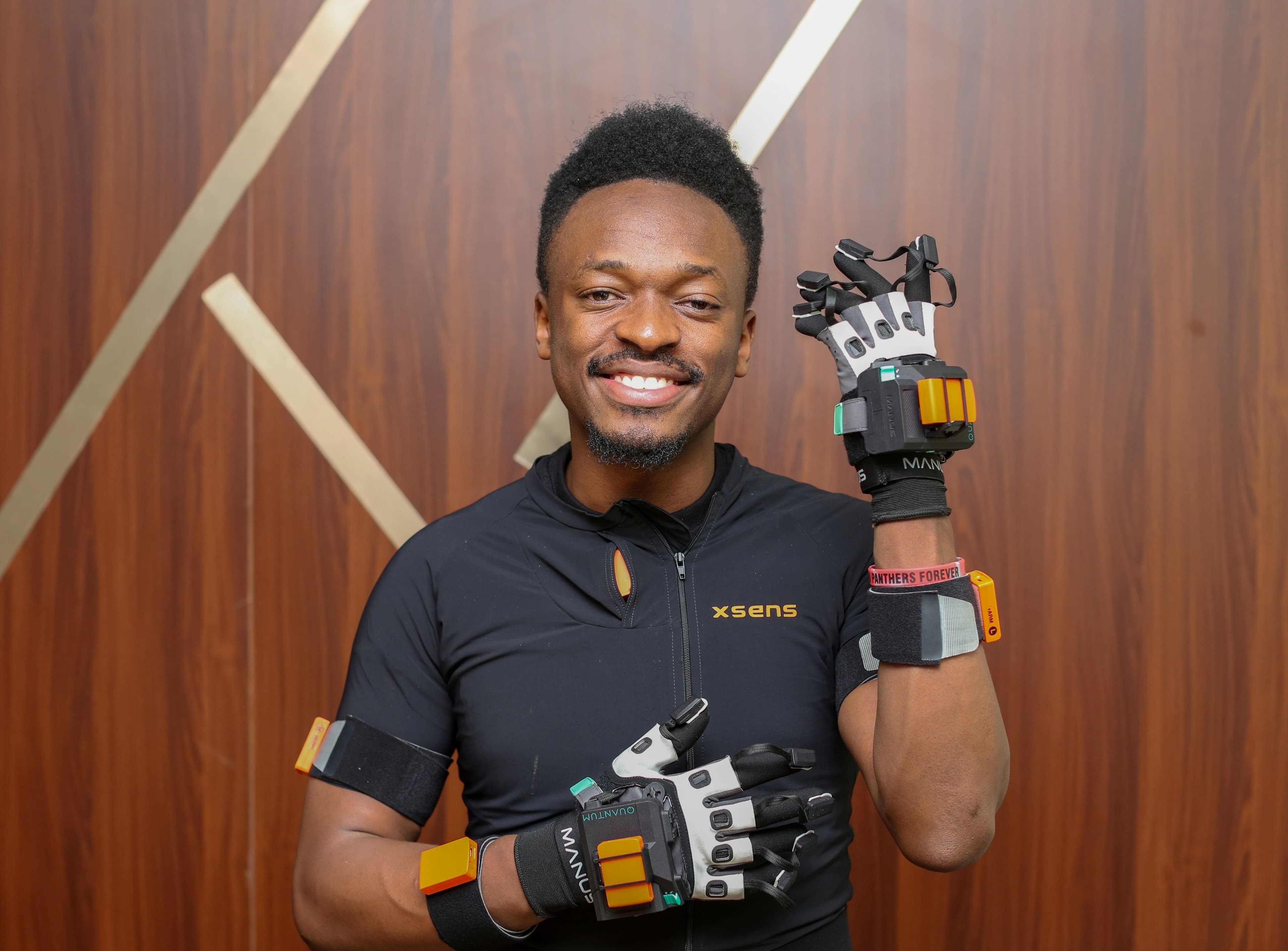
African engineers and innovators are using Artificial Intelligence (AI), 3D technology and smart devices to break down barriers facing people with disabilities, opening new possibilities in communication, mobility, education and employment.
Across the continent, innovators are developing locally tailored assistive technologies aimed at overcoming challenges such as high costs, limited access to specialised services, inaccessible infrastructure and technologies that often fail to reflect African realities.
In Kenya, engineer Elly Savatia is at the forefront of efforts to transform communication for deaf people and those who are hard of hearing through his innovative app, Terp360.
Savatia won the 2025 Africa Prize for Engineering Innovation for the technology, which uses artificial intelligence and 3D avatars to translate speech into sign language in real time.
The technology initially interpreted only the sign language alphabet and a limited number of words. However, feedback from users prompted Savatia and his Signvrse team to develop a more natural and practical signing experience.
Working with deaf Kenyans and people who are hard of hearing, the team used motion-capture technology to record more than 2,300 signs, including commonly used phrases and dialects.
Terp360 has since advanced to real-time speech-to-sign language translation using live interpretation through 3D avatars. The time required to produce the first sign from text has also been reduced from about 6.9 seconds to 3.5 seconds.
The team has also released what it describes as the largest open African sign-language motion dataset and benchmark, containing nearly 12,000 Kenyan Sign Language motion sequences and almost nine million motion frames, alongside baseline models and an open evaluation framework.
Savatia’s innovation is now attracting international interest, with the Signvrse team exploring expansion into the United Kingdom to respond to demand for British Sign Language (BSL). There has also been interest from the United States and South Africa, as the company pursues partnerships across telecommunications, banking, technology and government.
Another Kenyan innovator, Brian Mwiti Mwenda, is using technology to improve mobility and safety for blind and partially sighted people.
Mwenda was inspired by blind and partially sighted students at his school to develop The Sixth Sense, a handheld device that uses ultrasonic sensors to help users detect obstacles around them.
The device communicates the proximity of obstacles through vibrations, with the frequency increasing as the user gets closer to an object. It also features an emergency function capable of sharing the user’s location when assistance is required.
The Sixth Sense is now operational in the United Kingdom and is being rolled out in Austria with support from Access Austria, through a partnership with Hilfsgemeinschaft der Blind und Sehschwachen Österreichs, giving more than 10,000 members an opportunity to test and help co-design the technology.
The product has undergone more than 15,000 engineering hours and 5,000 hours of product testing, with more than 1,000 trial participants across four continents. It has completed final performance testing, meeting criteria for speed, accuracy, orientation and response.
In Tanzania, Dr Atish Shah, founder of Roverlabs Tanzania, is tackling another major challenge — access to affordable and personalised assistive devices.
The company uses smartphones as 3D scanners to remotely capture scans of patients’ limbs before applying artificial intelligence-enabled generative design and 3D printing to manufacture customised prosthetic devices in Dar es Salaam.
The lightweight devices can be delivered within three days, reducing the need for repeated hospital visits and cutting travel costs, particularly for people living in rural areas.
Roverlabs Tanzania has so far supported more than 2,000 patients through its AI-based accessible fabrication platform for assistive orthotics. The company is also incorporating home-based medical imaging, including X-rays and ultrasound services, to support people living with disabilities and chronic diseases.
The innovations demonstrate how engineering can improve independence when technologies are developed in close partnership with the people who ultimately use them.
The Africa Prize for Engineering Innovation, established by the Royal Academy of Engineering, supports innovators in turning promising ideas into sustainable businesses through funding, training, mentoring, networks and international visibility.
For assistive technologies, however, innovation is only the beginning. Developers must ensure that products are affordable, manufacturable and capable of being deployed at scale while continuing to test and refine them alongside users.
Savatia, Mwenda and Shah illustrate how African engineering is helping make communication more accessible, mobility more independent and employment more inclusive.
All three Africa Prize alumni have also participated in the Academy’s Advance programme, a thematic scale-up initiative designed to help innovators expand into the UK.
Their work offers a glimpse of how the next generation of African engineers could use technology to give millions of people with disabilities greater choice, autonomy and independence.
The spotlight will return to the continent’s innovators on October 28, when the 2026 Africa Prize Final is held at NH Johannesburg Sandton in Johannesburg.
Savatia, the 2025 winner, is expected to make an appearance at the event and showcase the progress his innovation has made since his victory in Senegal.
by Joseph Ng’ang’a
Comments
No comments yet. Be the first to share your thoughts.