
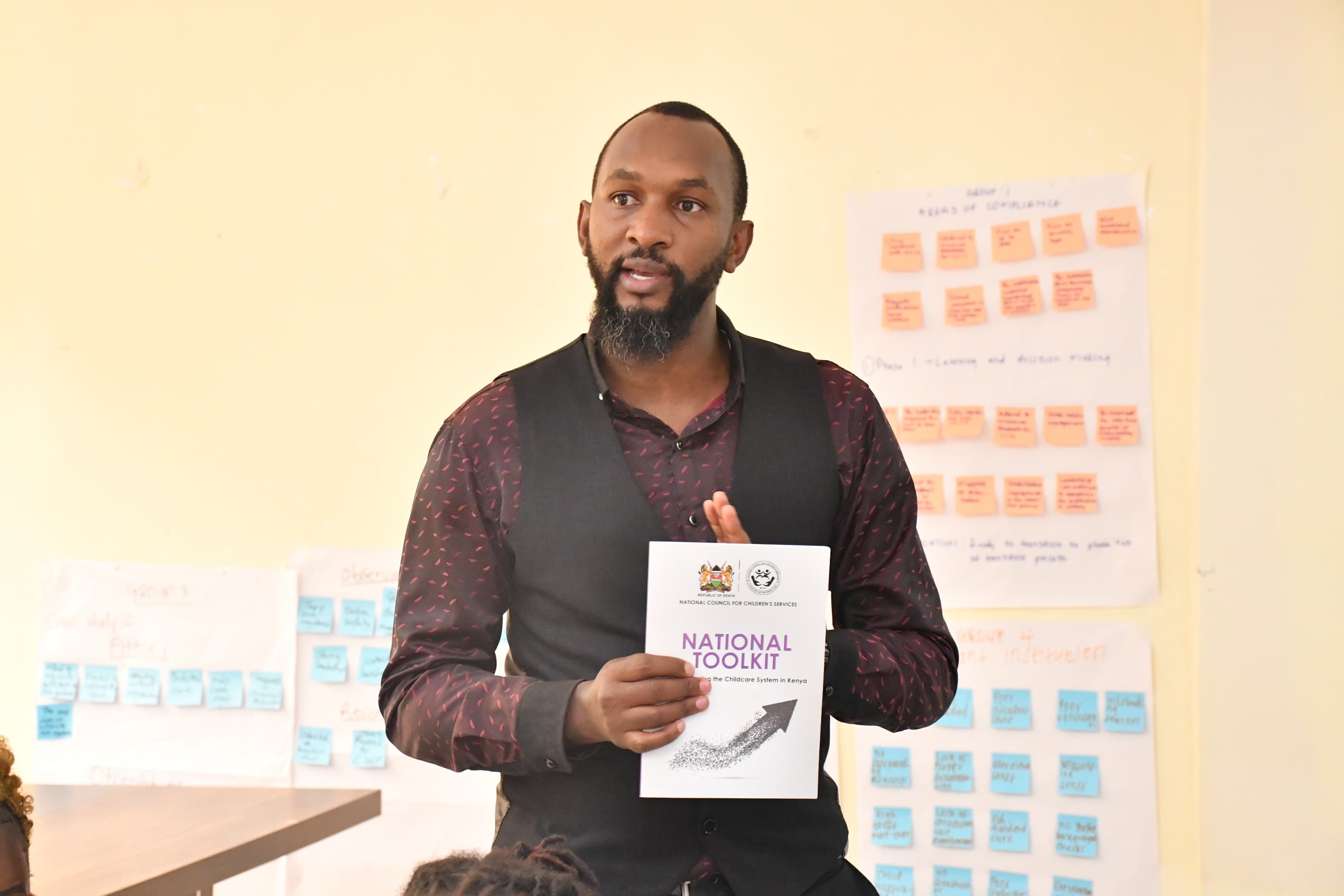
Children’s officers in Kiambu County are undergoing a five-day training aimed at preparing them to support the transition from institutional care to family- and community-based child protection services.
The training, being held at the Kiambu County Commissioner’s Hall from October 5 to 9, brings together county children’s officers and other stakeholders involved in the protection and welfare of children.
It is being facilitated by Weza Care Solutions in collaboration with the National Council for Children’s Services, the State Department for Children Services and Legacy for Children Kenya.
The programme focuses on strengthening participants’ understanding of the transition journey facing charitable children’s institutions (CCIs), while equipping them with the tools and skills needed to guide the process. It also seeks to improve participants’ understanding of the purpose, principles and requirements of child welfare programmes.
Speaking during the training, Davis Nyakundi, a consultant at Weza Care Solutions, said the programme was designed to help officers move beyond discussions about care reform and develop practical approaches for implementing it at county level.
“The transition from institutional care requires informed leadership, proper planning and close coordination among all the actors involved. Children’s officers are at the centre of this process and they need the knowledge and tools to ensure that every decision prioritises the safety, rights and long-term wellbeing of the child,” Nyakundi said.
Participants examined the current care system through a situational analysis and discussed the factors that contribute to the institutionalisation of children.
The discussions drew on findings from a situation analysis conducted in Kiambu, with officers considering why some children enter institutional care and the challenges that can prevent them from returning to families or being placed in family-based alternatives.
The training further addresses barriers to transition through group work and reflection sessions. These discussions are expected to help officers identify gaps in coordination, documentation, family support, referral systems and access to social services.
According to the organisers, understanding these barriers is essential as Kenya continues to strengthen systems that prevent unnecessary separation of children from their families. Where separation occurs, the preferred approach is to provide safe and suitable family- or community-based care rather than relying on residential institutions as a first response.
The workshop is also intended to help officers respond to questions surrounding care reform and develop a shared understanding of the responsibilities of government departments, care institutions, families and community actors.
Nyakundi said successful implementation would depend on ensuring that reforms are understood not only by policymakers but also by the officers and organisations working directly with children and families.
“Care reform is not simply about closing institutions. It is about building the services and support systems that make it possible for children to grow up in safe, stable and caring family environments. That includes strengthening families, improving prevention and response services, and ensuring that children receive appropriate support throughout the transition,” he said.
The sessions include presentations, group discussions, practical exercises and daily reflections. Participants are expected to leave with a clearer understanding of the legal requirements governing child welfare programmes, the principles guiding care reform and the steps involved in managing the transition of children from institutional settings.
The training comes at a time when child protection actors are placing greater emphasis on family strengthening, prevention of unnecessary separation and the development of alternative care options. Children’s officers are expected to play a key role in assessing children’s needs, tracing families, coordinating referrals and monitoring reintegration and other placement decisions.
The organisers said the training would also promote greater consistency in the way child welfare cases are handled across the county. By improving coordination and strengthening professional skills, the programme aims to ensure that interventions are guided by the best interests of the child.
The five-day programme ends on October 9. Its outcomes are expected to inform the work of children’s officers and other stakeholders as Kiambu advances efforts to improve child protection and support the transition towards safer, family-centred care.
by Kipkorir Felix and Grace Naishoo
Comments
No comments yet. Be the first to share your thoughts.