
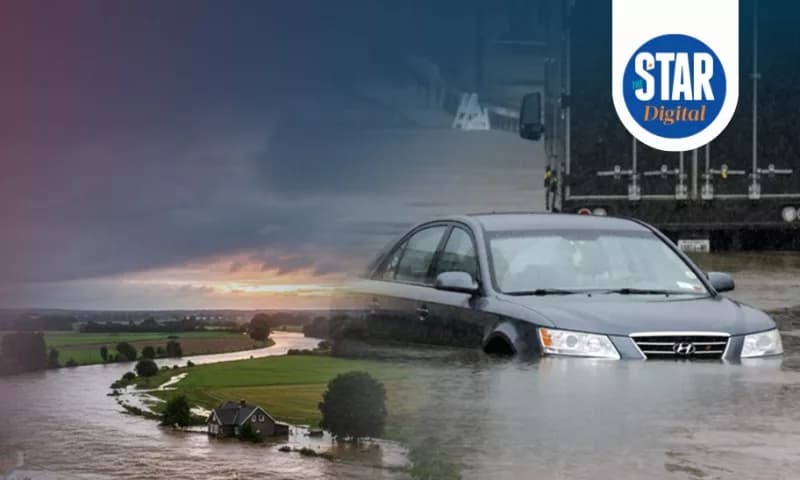
Already, the World Meteorological Organization (WMO) has warned that the current El Niño event could reach unprecedented strength
Anticipated Impacts of El Niño Rains in Kenya (October–December)

County governments and disaster teams in high-risk zones, particularly Western Kenya, Rift-Valley zones and low-lying flood basins – the Tana Delta – have been urged to prepare a head of the anticipated El Nino.
Environment PS Festus Ng’eno on Tuesday said the move is part of a wider plan to safeguard lives and livelihoods.
“The early signs are already here. In the week leading up to October 18, a single station in Trans Nzoia recorded 147 millimetres of rain, 110 millimetres of it in one day. This coming week, rain is forecast in most of the counties.
We know what such a season can do,” Ng’eno said.
Speaking at Michael Joseph Centre during the unveiling of Safaricom’s 2026 Sustainability Report, Ng’eno said the country saw the impact of the 1997 El Nino event.
“We saw it again in 2023 and 2024: homes lost, roads cut, schools closed and lives taken. The government's position is straightforward. We will not be caught flat-footed,” Ng’eno said.
The PS said the country has entered the October to December short rains season, with the Kenya Meteorological Services Authority (KMSA) and WMO forecasting a strong El Niño event that could intensify to very strong levels.
“Above average rainfall is expected in nearly every county, with the rains likely to extend into January across much of the country,” Ng’eno said.
The PS said the value of a forecast is not realised when it stays on paper.
Ng’eno said the value is realised when it reaches the people and institutions that need it, in time, and when it informs action.
“Our task this season is to move from climate information to early action.”
Ng’eno said drainage must be cleared before the storm, not during or after it.
He urged farmers to use seasonal advisories to plan their planting and protect their livestock. Ng’eno said families living along river corridors and in flood plains must heed the warnings and move to safety when told to do so.
The PS said the Rift Valley lakes were swelling raising a lot of concerns.
“Since 2010, Lake Baringo has expanded by about 119 square kilometres, and Lake Bogoria by about 11. More than 40,000 people have already been affected.”
Lake Baringo is a freshwater lake while Lake Bogoria is saline.
The PS said heavy rains this season raise the risk that the two will converge, with grave consequences for people, farmland, infrastructure and a unique ecosystem.
“We are working with Baringo county, other government ministries, departments and agencies and our partners on disaster risk management around the basin.”
Ng’eno said towns must be built differently.
“Our cities were designed to push water away as fast as possible. We need sponge cities: green spaces, wetlands and drainage that absorb stormwater, reduce flash floods and conserve water for the dry months.”
The warning comes as Kenya enters the October-December short-rains season, which is critical for crop production, pasture and water supplies, particularly in arid and semi-arid areas.
WMO secretary general Celeste Saulo said the projected intensity was beyond the range of monitoring charts used over the past four decades.
“This is literally off the monitoring charts that we have used for the past four decades. El Niño will peak towards the end of 2026, but its impacts will be felt long after that,” she said.
The WMO declares an El Niño when sea surface temperatures in the tropical Pacific rise at least 0.5°C above average.
A very strong event can disrupt normal temperature and rainfall patterns, causing drought in some regions and heavy rainfall and flooding in others. It can also increase temperatures across large parts of the world.
Saulo said the resulting extreme weather did not have to become a humanitarian disaster if governments acted early.
“But a powerful El Niño does not have to be a recipe for humanitarian disaster. We have the science, the forecasts and the early warning systems to save lives and protect livelihoods. What we need now is decisive action, especially to protect the most vulnerable communities,” she said at a joint press conference with UN Under-Secretary General for Humanitarian Affairs Tom Fletcher.
The WMO said the window for preparedness remained open in many regions but warned that it would not last indefinitely. It urged governments and humanitarian organisations to use scientific forecasts to anticipate risks and protect vulnerable populations.
The latest Global Seasonal Climate Update shows that El Niño conditions strengthened between July and September 2026. The monthly Niño 3.4 index rose from 2.0°C to 2.8°C above average, confirming sustained warming across the equatorial Pacific.
The forecast for November 2026 to January 2027 indicates an increased likelihood of above-normal rainfall across the central and eastern equatorial Pacific.


Comments
No comments yet. Be the first to share your thoughts.