

Agriculture and Livestock Development CS Mutahi Kagwe has outlined a digital transformation of Kenya’s agricultural sector, with 8.9 million farmers already registered under Government systems.
In order to enable targeted delivery of agricultural services and improve productivity, Kagwe said the registration under the Kenya Integrated Agricultural Management Information System (KIAMIS) and the Animal Identification and Traceability System would help the government reach farmers with subsidized fertilizer, certified seeds, vaccination, animal identification and other services, while improving accountability.
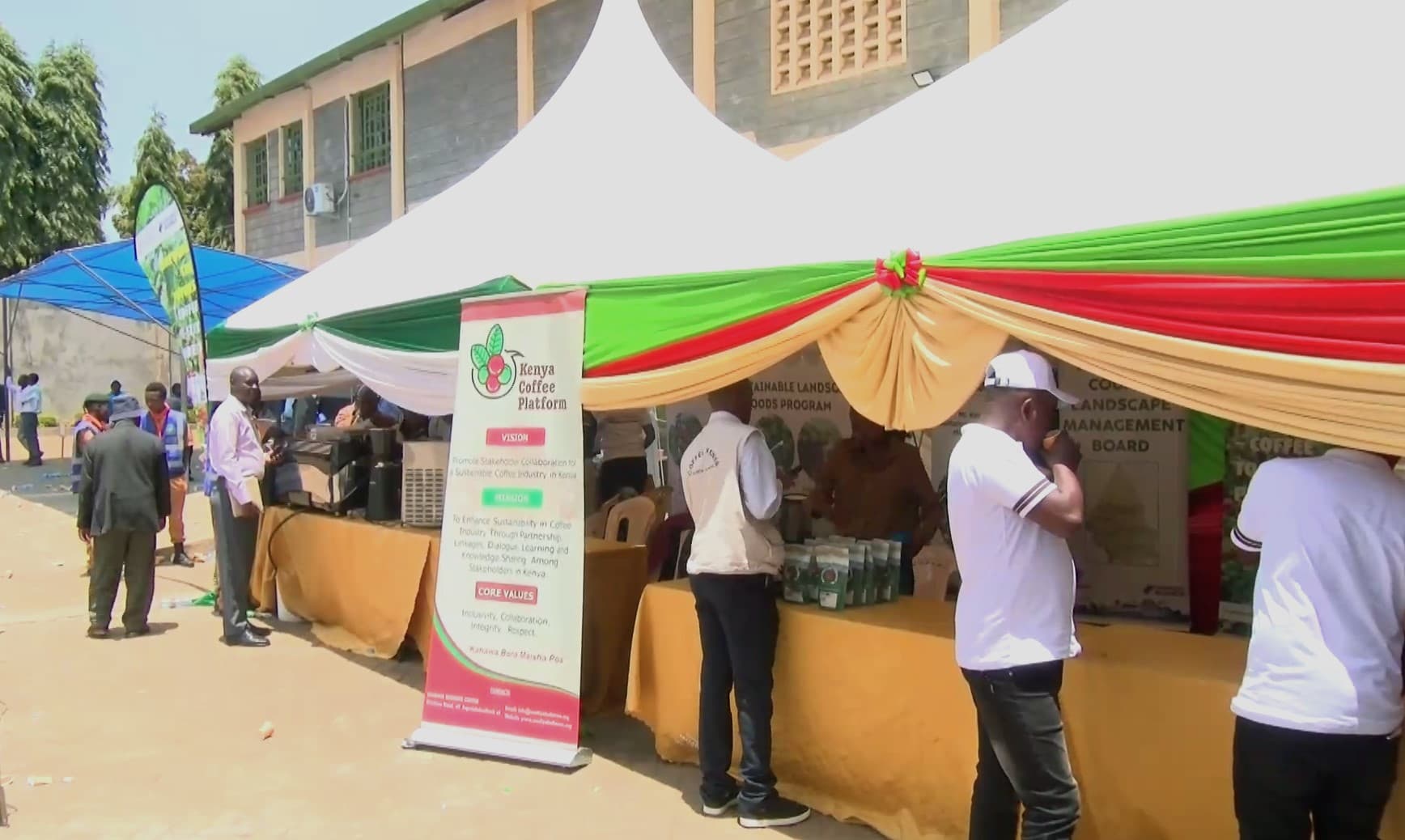
Speaking during the ongoing Nairobi International Trade Fair, the CS said the government had launched the Kenya Agricultural and Digital Information Centre (KADEC), as a single source of agricultural data and technology to address gaps in farmer identification, extension services, access to inputs and connections to markets.
“A farmer in Turkana harvests today, but the system that should support her is still fragmented. Her location is not clear, advisory services arrive late, and access to inputs depends more on chance than design,” he said.
Kagwe said the government was also introducing universal digital addressing to identify and reach farmers more efficiently, enabling extension services, finance, insurance, inputs and market information to reach the right farmers at the right time.
Through a partnership with Fahari Aviation, a subsidiary of Kenya Airways, the Ministry is introducing drone technology to support precision application of inputs, crop and livestock monitoring, soil analysis and detection of pests, diseases and climate-related risks.
The CS said the partnerships would also strengthen national capacity in Artificial Intelligence and homegrown large language models, with frameworks for data protection and oversight.
Kagwe added that the Government was simultaneously scaling up scientific soil testing, noting that 63 per cent of Kenya’s soils were acidic.
“Our business as the ministry and government is soil health, not the fertilizer. Good soil health, based on sound science and data, is what shall feed and sustain us,” he said.
He said applying farm inputs without establishing soil requirements was similar to prescribing medicine without first diagnosing an illness.
The CS said the government had launched the National Digital Soil Works Project, establishing a connected network of modern laboratories under the Kenya Agricultural and Livestock Research Organization (KALRO) to work with national and county governments, farmers and private-sector players.
The laboratories will be supported by soil doctors at the last mile to expand testing and enable farmers to make informed decisions on fertilizer use.
“Just because you have always used C.A.N or N.P.K fertilizers does not mean that you have been farming efficiently. Test the soils,” he said.
Kagwe said climate change remained the most immediate threat to agricultural production, with droughts and floods estimated to create long-term economic liabilities equivalent to up to 2.8 per cent of Kenya’s GDP annually.
He said the government was expanding irrigation through rehabilitation of existing schemes, new infrastructure and water-efficient technologies while promoting drought-tolerant crops, conservation agriculture, agroforestry and sustainable land management.
Kagwe said agriculture grew by 3.1 per cent in 2025 but farmers continued to face rising production costs, climate variability, and pressure on natural resources and changing market demands.
In the livestock sector, he said investments in animal health, breeding, dairy productivity and market infrastructure were creating opportunities for producers, with marketed livestock production rising from Sh232.3 billion in 2024 to Sh269.4 billion in 2025.
He cited the Isiolo Abattoir and Bachuma National Livestock Quarantine Centre as investments aimed at connecting farmers to markets, creating jobs and promoting value addition.
Kagwe called for reliable access to affordable livestock feeds and expanded insurance programmes, noting that dry conditions had contributed to recent milk supply constraints.
On agricultural exports, he said tea earned about Sh187 billion in 2025, cut flowers Sh103 billion, fruits and vegetables Sh100 billion and unroasted coffee Sh52 billion.
“Our approach is not simply about producing more, but about earning more from what we produce,” he said.
The government, he added, was promoting aggregation, processing, value addition and market development across coffee, tea, sugar, cotton, dairy and horticulture.
Kagwe said reducing post-harvest losses was also critical, with the government distributing mobile dryers and other equipment while promoting the Warehouse Receipt System to help farmers avoid distress sales and access financing.
He called for stronger cooperatives and farmer aggregation to address fragmented land holdings, alongside investment in storage, cold-chain infrastructure and efficient market connections.
The CS said young people and women should be at the centre of agricultural transformation, with opportunities extending beyond farming to processing, technology, finance, logistics and entrepreneurship.
“As we transform agriculture, our measure of success will be how many young people find meaningful opportunities, how many women build viable enterprises, and how much value farmers retain,” he said
Kagwe urged the Agricultural Society of Kenya to reposition its shows and trade fairs as platforms for investment, innovation, knowledge exchange and business partnerships.
The ASK Show is being held under the theme: Promoting Climate-Smart Agriculture and Trade Initiatives for Sustainable Economic Growth.”
by Wangari Ndirangu
Comments
No comments yet. Be the first to share your thoughts.