
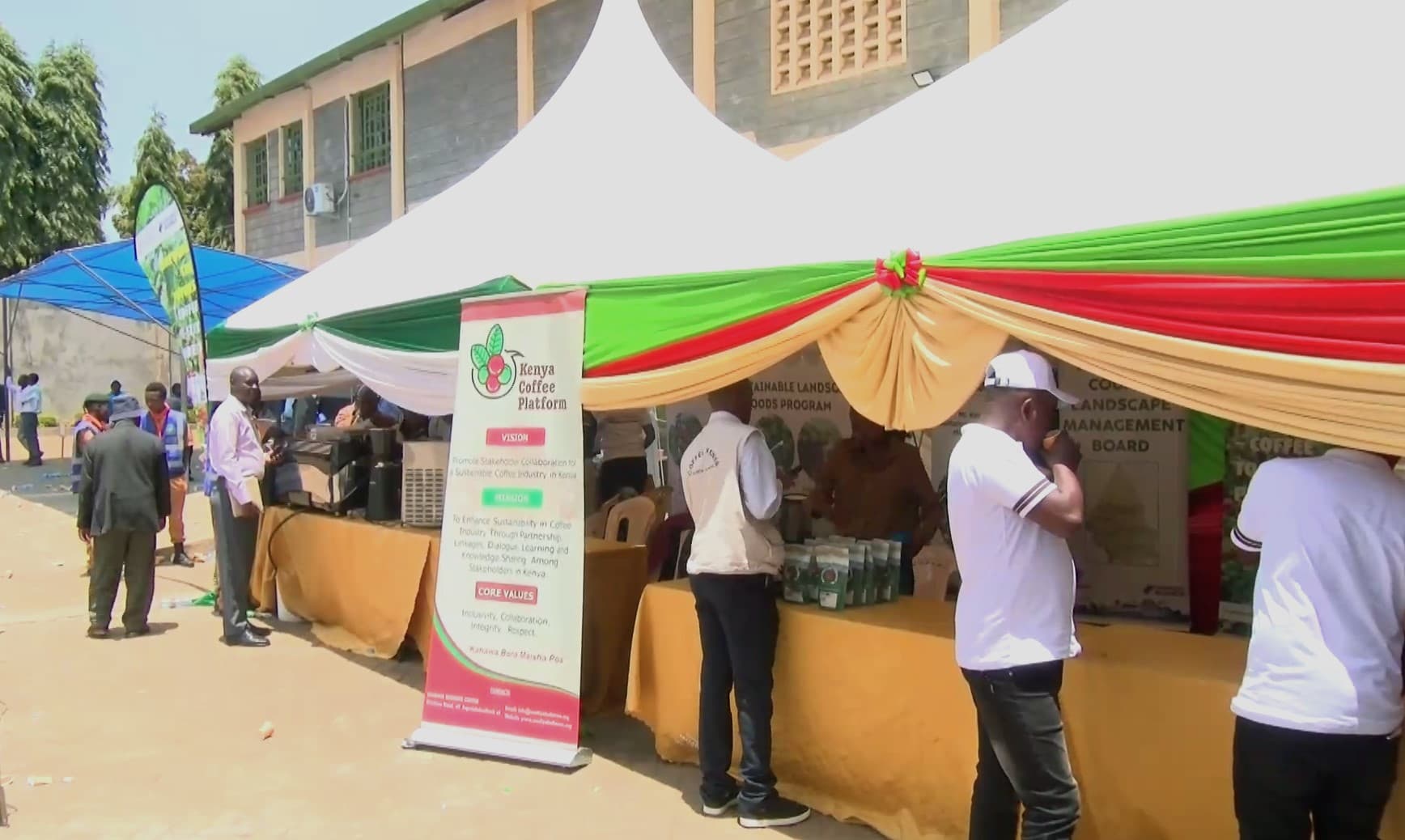
Kenyan coffee farmers will have more options to market their produce following the implementation of the Coffee Act 2026, which allows coffee to be sold through the Nairobi Coffee Exchange (NCE), direct sales, international exchanges and other channels prescribed by the Cabinet Secretary.
Coffee Board of Kenya chairperson Henry Kinyua said the new framework was aimed at strengthening the sector, while ensuring farmers receive payment for their produce within a reasonable period.
Speaking during the International Coffee Day celebrations in Kirinyaga County, Kinyua said up to 80 per cent of Kenyan coffee was currently sold through the Nairobi Coffee Exchange.
Held under the theme: Building Prosperity Through Collaboration, the event brought together farmers, government officials and other players in the coffee value chain
Kinyua said farmers selling through the exchange would continue to benefit from the Direct Settlement System, under which payments are made directly to growers’ accounts.
“Within five days after the coffee is procured, money is already in the account of the growers,” he said.
The chairperson noted that while individual farmers under co-operatives could sometimes experience delays as societies consolidated coffee from different growers, payments in the last coffee season had generally been made within a reasonable period.
The chairperson also pointed to the Coffee Cherry Advance Revolving Fund, administered through the New Kenya Planters’ Cooperative Union (KPCU), as another mechanism enabling farmers to access part of their expected coffee earnings in advance.
Kinyua said the board was working on regulations aimed at promoting and developing the coffee sector and strengthening the global profile of Kenyan coffee ensuring that Kenyan coffee retained its reputation in international markets, while ensuring farmers benefited from the crop.
“We are looking forward to how we are going to make Kenyan coffee the greatest product as it has always been, and ensure that the story reaches everybody across the globe,” he said.
Kirinyaga County Executive Committee (CEC) Member for Agriculture Dr. John Gachara, said the county is seeking to increase coffee productivity, while maintaining high quality, noting coffee remained one of the county’s key economic crops, urging farmers to focus on improving the productivity of individual coffee bushes.
“Farmers do not produce coffee; the coffee bush is the one which produces coffee,” he said.
He said extension officers were working with farmers to increase production to more than 10 kilogrammes of coffee per bush while maintaining quality that could compete in the global market.
Gachara also urged farmers to use recommended agricultural chemicals and production practices to ensure their coffee met international market standards.
His Trade counterpart Calbert Njeru said coffee production had increased significantly in the county in recent years.
He revealed the production had risen from about 2.3 million kilogrammes in 2017 to 49.1 million kilogrammes last year.
Njeru attributed part of the growth to support from the county government to coffee unions and primary co-operative societies, adding that coffee generated Sh7.4 billion for Kirinyaga farmers last year, providing an important source of income that circulates within the local economy.
Kirinyaga Coffee Union chairman Godfrey Munyagia said the celebrations provided an opportunity for farmers and sector stakeholders to discuss challenges facing the industry and develop ways of making coffee farming sustainable.
Munyagia urged farmers to increase production, saying the sector had opportunities for growth if farmers and stakeholders worked together.
“We have a brighter future in coffee,” he said, urging farmers to share their challenges with sector stakeholders and seek practical solutions.
by Mutai Kipng’etich


Comments
No comments yet. Be the first to share your thoughts.